






 Portuguese
  Spanish
  3 min of reading
  0 comments


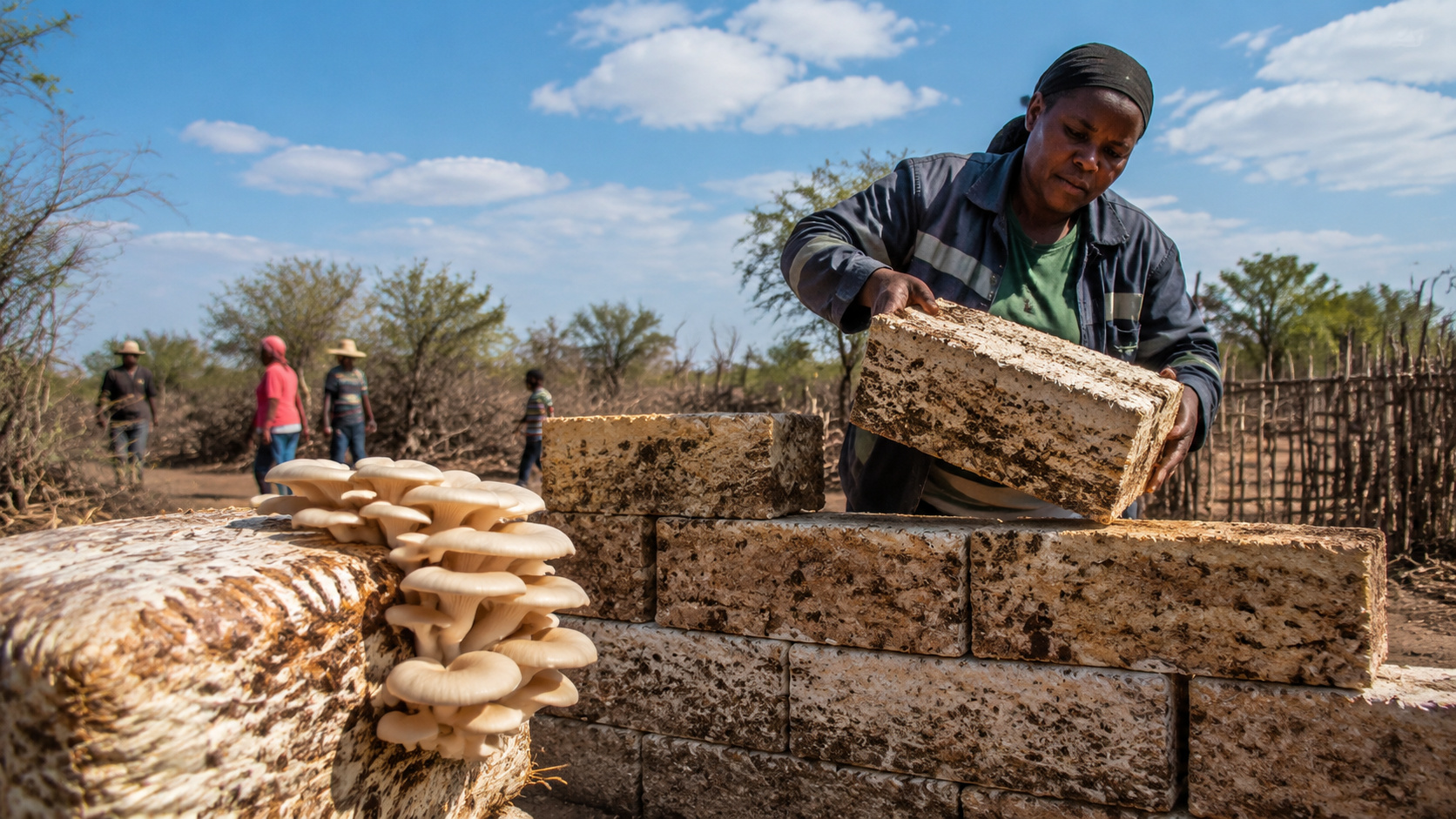
The MycoHab project transforms invasive shrubs into nutritious mushrooms and mycelium walls, generating food, affordable housing, and new economic opportunities for rural communities, combining sustainability and biological innovation
First the bush turns into mushrooms, then the rest becomes a wall. In Namibia, the uncontrolled spread of shrubs invades grazing areas and reduces agricultural productivity, harming rural communities. The MycoHab project transforms this vegetation into edible mushrooms and mycelium blocks, creating local housing and income solutions.
The mycelium acts as a natural biological glue, binding wood particles to form strong walls. At the same time, mushroom cultivation offers nutritious food and income generation, connecting social, environmental, and economic impacts in an innovative initiative.
The information was released by Bio-Hab, an organization specializing in sustainable housing, detailing how biological technology can be practically applied in low-income communities.
-
Without a mansion, without high investment, and without a traditional classroom, a teacher living in a 22 m² house taught students to build a 9 m² studio apartment with the equivalent of R$10,000.

-
Largest bridge in São Paulo reaches 75% completion and is expected to strengthen strategic connection in the interior of São Paulo.

-
Without her own home and pressured by rent, a 25-year-old bought a small 15-meter boat, gradually renovated the interior by herself, transformed the interior with paint, new flooring, a larger bathroom, and started living on the canals, paying much less per month.
-
Tired of seeing families sleeping on the street, São Paulo delivered 18 m² furnished microhouses and took 888 people off the streets: Vila Reencontro became the model social housing for the homeless population.


Why invasive shrubs became raw material
The excessive growth of shrubs prevents land use for grazing and agriculture, and harms the local ecosystem. Instead of discarding this vegetation, MycoHab transforms the wood into substrate for edible mushrooms, which then generate food and income.

This approach avoids burning and intensive manual removal, making the process more safe and sustainable. Local communities participate in the harvesting and processing, creating immediate economic opportunities.
How the fungus transforms waste into blocks
The mycelium is the structure of the fungus that connects plant particles. As it colonizes the waste, it acts as a natural glue, forming solid and moldable blocks into walls for small constructions.
This method eliminates the need for cement or synthetic materials, resulting in biodegradable, lightweight, and thermally insulating blocks, ideal for social housing prototypes.

What Has Been Built
Rural communities in Namibia have already experienced simple and functional houses made with mycelium blocks. The prototypes serve as a living laboratory, allowing adjustments in strength, durability, and thermal comfort.
The project combines biological technology and social housing, showing how environmental problems can be transformed into practical and accessible solutions.
Why It Is Still an Experimental Technology
Despite positive results, the use of mycelium in construction is still in the experimental phase. It is necessary to evaluate resistance to rain, longevity, and pests before large-scale application.

The goal is to make mycelium a viable and scalable alternative, offering low-cost housing with reduced environmental impact.
The information was released again by Bio-Hab, an organization specializing in sustainable housing, reinforcing the challenges and potential of mycelium as a construction material.
The MycoHab project shows how it is possible to transform invasive shrubs into food and houses, generating income and concrete improvements for local communities.
Share your opinion on this initiative and tell us if you believe mycelium can change the way we build sustainable housing.







Be the first to react!