






 Portuguese
  Spanish
  3 min of reading
  0 comments


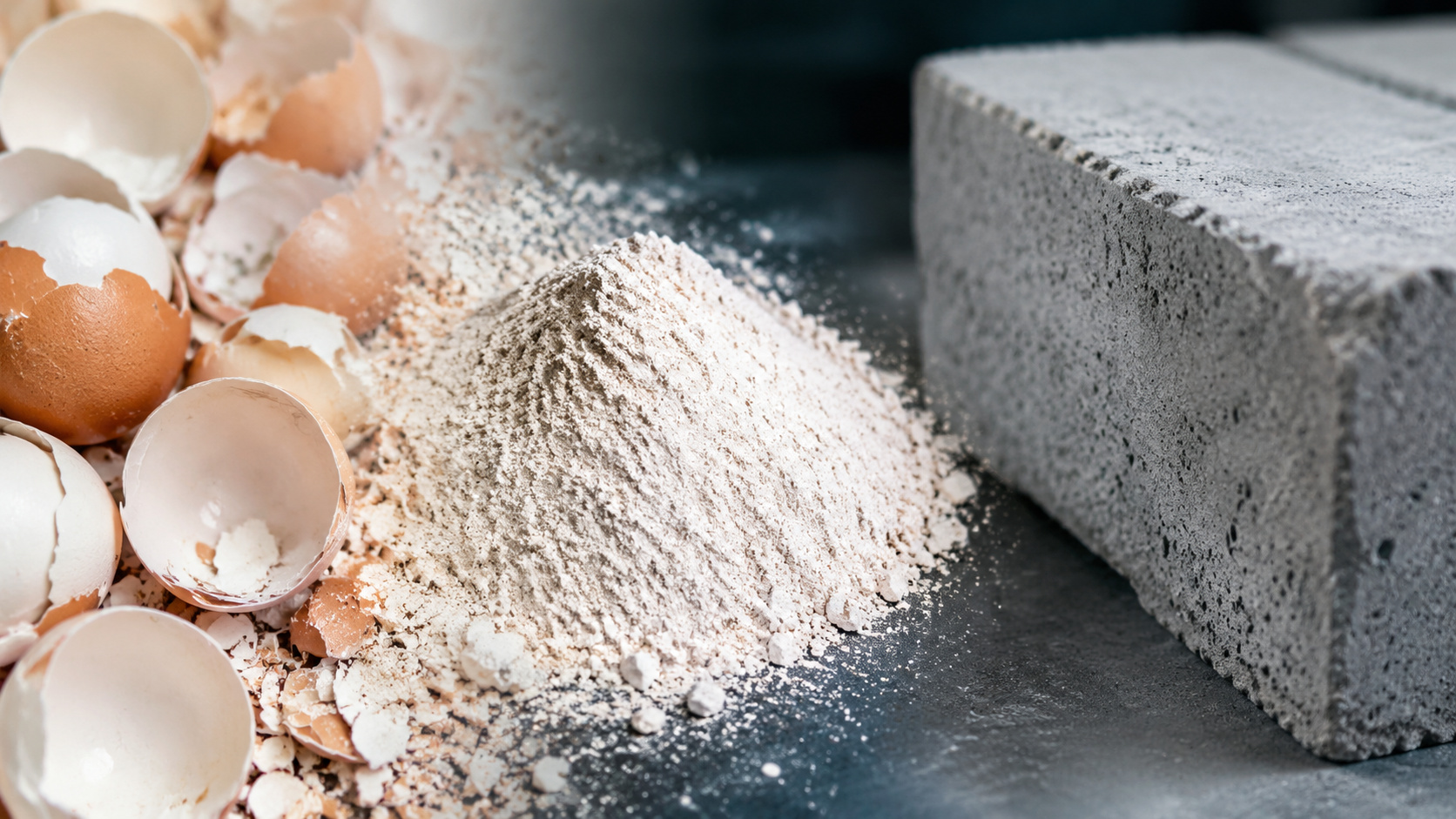
Breakfast waste can become a concrete ingredient, reduce carbon emissions, reuse calcium carbonate, and generate sustainable solutions in civil construction
The ground eggshell powder is transforming the way we think about sustainable concrete. This waste, which usually goes to the trash, can be used as a partial substitute for cement, helping to reduce environmental impacts and adding value to construction materials. In addition to decreasing the carbon emissions associated with cement production, the use of calcium carbonate present in the shells contributes to more ecological and innovative concrete blocks.
For it to work, the material needs to be cleaned, dried, and ground to achieve the correct granularity. The addition of eggshell powder does not replace all the cement but reduces its amount in the mixture in a controlled way, ensuring that the strength and durability of the concrete are preserved. This approach shows how household waste can be transformed into valuable raw material for civil construction.
Why eggshells interest construction and how they reduce cement use
The interest in using eggshell powder comes from two main factors: environmental and technical. Environmentally, it reuses waste that would go to landfills, reducing the amount of organic waste discarded. Technically, the calcium carbonate present in the shells has chemical properties that interact with cement, contributing to the structure of the concrete in specific proportions.
-
A mother of four sought a safer family environment, watched tutorials on the internet, built a 325 m² house with her family, and learned foundation, walls, plumbing, and electrical work without any professional experience.

-
Brazilians build modern houses 10 minutes from Disney, with luxury finishes, 3 bedrooms, 3 bathrooms, a $227 condo fee, and potential for Airbnb, targeting investors who want to use the property in Orlando and rent it out when they are not in the United States.

-
A city with fewer than 2,000 residents believed that 3D-printed houses would solve its housing crisis, but the project stalled, walls cracked, the printer disappeared from the site, and the FBI got involved in the case.
-
India transforms coconut husk into biodegradable mats to reinforce rural roads, uses natural fibers under asphalt, stabilizes unstable soils, and demonstrates how agricultural waste can replace petroleum derivatives in projects subject to heavy rain and traffic.




The information was published by ScienceDirect, a scientific article platform, which detailed research on the partial replacement of cement with eggshell powder. Laboratory studies showed that small fractions of replacement can maintain or even improve the mechanical strength of experimental concretes, especially in light applications or construction blocks.
How eggshell powder is incorporated into concrete
The process requires proper preparation. The shells are washed, dried, and ground until they become a fine powder. Then, this powder is mixed with cement, aggregates, and water. The goal is to replace only a part of the cement, usually between small percentages, so that the concrete maintains its characteristics of strength and workability.
The calcium carbonate acts as a nucleator, promoting chemical reactions that help strengthen the concrete matrix, but the effect depends on the dosage and processing of the powder. Poorly prepared mixtures can reduce the fluidity or final strength of the material.

What results do studies indicate about performance
Research mainly analyzes compressive strength and workability of the mixture. Experiments show that, in controlled proportions, concrete with egg shell powder maintains acceptable strength for blocks, light pavements, or elements that do not support large loads.
The particle size is crucial. Very fine powder alters water absorption and can impact strength. Therefore, there is not yet a universal replacement percentage that works for all applications. Each mixture needs to be tested to ensure safety and adequate performance.
Why it is not a homemade concrete recipe
The use of egg shell powder should not be done improvisationally. Preparation requires rigorous control of cleaning, drying, and grinding, and the dosage needs to be studied in a laboratory. Homemade mixtures without this control can result in fragile, non-durable, and unsafe concrete.
This technique is part of a line of research that seeks more sustainable construction without compromising safety. The reuse of the residue depends on technical tests and is not applicable in civil works without specialized supervision.
The use of ground egg shells in concrete shows how household waste can become valuable resources, helping to reduce cement consumption and carbon emissions. This innovation contributes to more sustainable and potentially more economical construction materials.
Have you ever thought about reusing household waste in construction materials? Share your opinion in the comments or send it to someone who would be interested in this innovation.








Be the first to react!