Portuguese
  Spanish


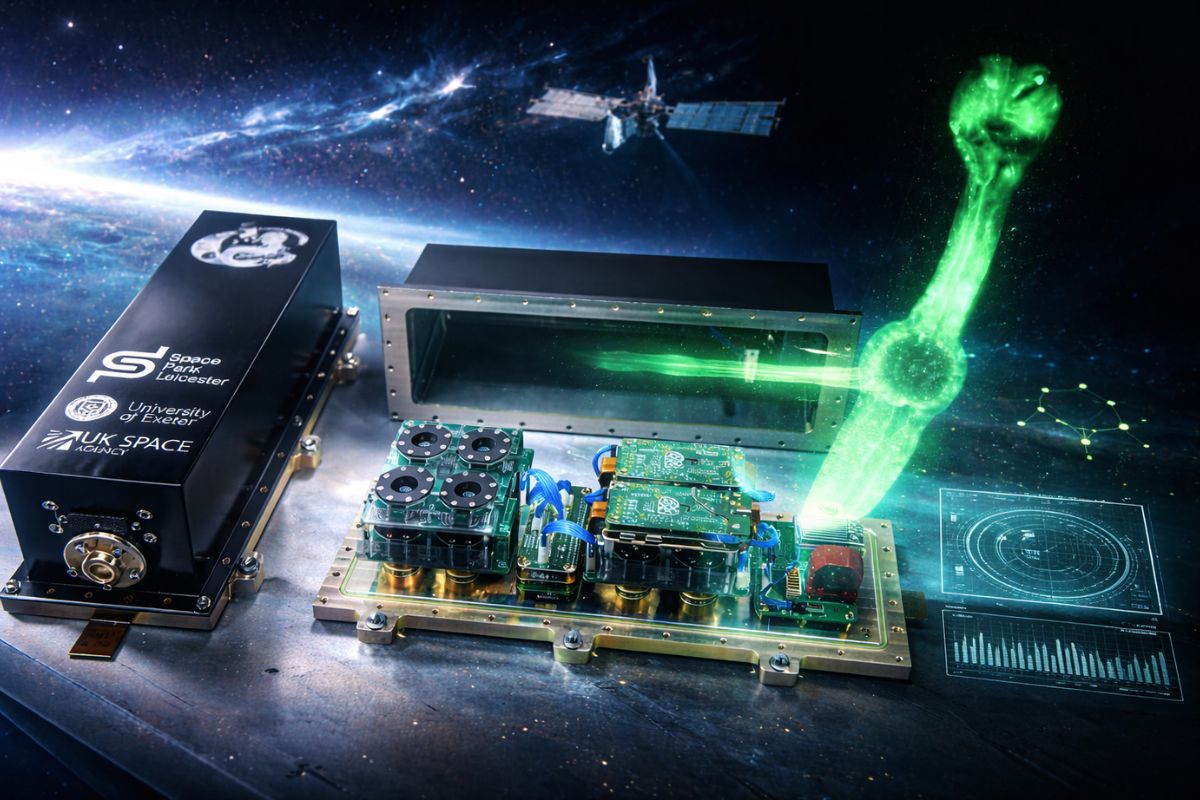

Microgravity and radiation will be monitored outside the ISS in a mini laboratory with cameras and sensors, recording images and data to understand how the body reacts on long space flights, like the future Artemis missions
A mini laboratory has arrived at the International Space Station with a very direct mission: to observe how life reacts when it leaves the “comfort” of Earth and faces the true space environment. The idea is to monitor, in real time, the effects of microgravity and radiation on a model organism, with constant recordings over several weeks.
After some time inside the station, the experiment will be installed outside the ISS. It is there that microgravity and radiation have a greater impact, as the module is exposed to space while continuing to send images and measurements back to Earth. The goal is to gather data that will help plan biological protection and healthcare during long missions, like the future Artemis missions.
A “pocket laboratory” called Petri Pod
The experiment takes place inside a compact box called Petri Pod, a mini autonomous laboratory designed to maintain a stable environment while everything around it is extreme. The module is about 10 x 30 centimeters, weighs around 3 kilograms, and functions as a miniaturized life support system.
-
She spent 73 years breathing inside an iron lung, survived the aftereffects of polio, and became the last woman in the United States dependent on the equipment before dying at 78 years old.

-
Brazilian students created a $1 filter using pine bark, cotton, and 3D-printed parts to clean cassava wastewater, reduce the toxicity of a hazardous waste, and transform contaminated water into biofertilizer.

-
Astronaut from Artemis II steps down after mission to the Moon and decision surprises after a record of 406,771 km, a historic 10-day journey, and an unprecedented achievement for Canada.

-
A fossil kept for years in a small museum in Montreal concealed 450-million-year-old soft tissue, a discovery that has only happened once before in history.


Inside, it has 12 chambers. In four of them, researchers can actively observe what is happening with white and fluorescent light. In practice, this allows for detailed monitoring of changes, almost as if the laboratory is “filming” the adaptation from within.
Why put this outside the ISS
The big difference is not just being on the ISS; it’s going outside of it. The proposal is to keep the organism under continuous exposure to the space environment, where microgravity and radiation act without interruption and without the same type of shielding as inside.
The plan is for this period to last about 15 weeks. This is enough time to capture not only an immediate effect but also slower signals, those that appear when exposure is prolonged, exactly the type of scenario that raises concerns during long journeys.
What will be monitored during the 15 weeks
During this period, the Petri Pod will record the health of the organism using miniaturized cameras, capturing still images and time-lapse videos, like a kind of visual diary of what changes over time.
In addition, the system collects and sends physical data from the environment, including temperature, pressure, and the accumulated dose of radiation. The goal here is to combine the two aspects: what the organism shows in the images and what the environment recorded, connecting cause and effect more clearly.
Why use such a small model organism
Researchers chose a model organism because it is practical for observing and repeating the experiment. It has a transparent body, grows quickly, and is considered suitable for monitoring cellular development under a microscope, making it easier to see changes while microgravity and radiation exert pressure for weeks.
This allows for tracking the process, not just the final result. Instead of “what happened,” you can also look at “when it started” and “how it evolved.”
How the mini laboratory sustains life in a hostile environment
To survive outside the ISS, the Petri Pod needs to maintain a stable microenvironment. The base describes that the system can control temperature and pressure, as well as maintain a trapped air volume for breathing even with the vacuum of space surrounding it.
Food also factors in: the organisms receive a food source through a support with agar, which helps keep the experiment viable during prolonged exposure to microgravity and radiation.
What does this have to do with Artemis and long missions
The logic behind the experiment is simple: if astronauts are going to spend more time outside Earth, we need to understand how the body responds to extreme conditions for long periods.
By observing how a model organism adapts or suffers under microgravity and radiation, researchers aim to identify biological mechanisms that, in the future, could guide strategies to protect people.
It is a small step in size, but with great ambition: to transform an unpredictable environment into something more measurable and manageable before long missions become routine.
If you had to bet, what concerns you more about a long space trip: microgravity and radiation or less “visible” things, like isolation and stress from months away from Earth?