






 Portuguese
  Spanish


In Fundy Bay, Canada, tides of up to 16 m make the ocean “disappear” and come back twice a day, creating the largest sea level difference on the planet and a daily spectacle.
Between the provinces of Nova Scotia and New Brunswick, in eastern Canada, there is a stretch of coastline where the ocean seems to disobey any natural logic. It is the Fundy Bay, officially recognized by institutions such as the Fisheries and Oceans Canada as the region with the largest tidal range in the world, with variations that can reach 15 to 16 meters between low and high tide at certain points.
Twice a day, every day, the same spectacle repeats: the sea recedes so much that boats are left resting on the muddy bottom, stone pillars are fully revealed, and kilometers of previously submerged land turn into a temporary “desert.” Hours later, the water comes rushing back, rising the equivalent of a five-story building and covering everything once again. It is this extreme alternation that makes Fundy Bay a unique case on the planet.
Why Fundy Bay Has the Largest Tides in the World
The explanation lies in a rare combination of geography, bathymetry, and tidal physics. Fundy Bay has a elongated funnel shape, narrowing as it moves away from the open ocean. As the tide from the North Atlantic enters this natural “trough,” the water is compressed into the bay, forced to rise in height.
-
Einstein’s Lasting Advice: “Strive to Be a Person of Value, Not Just Success” Inspires Many Seeking Life’s Meaning

-
Man Spends Weeks Clearing Overgrown Land, Faces Equipment Failures, and His Story on Scott Harrison’s Channel Reaches 94,000 Views

-
Engineer Builds Star Farm Resort on $250,000 Plot Near U.S. National Park, Projected to Reach $6 Million Value by 2030
-
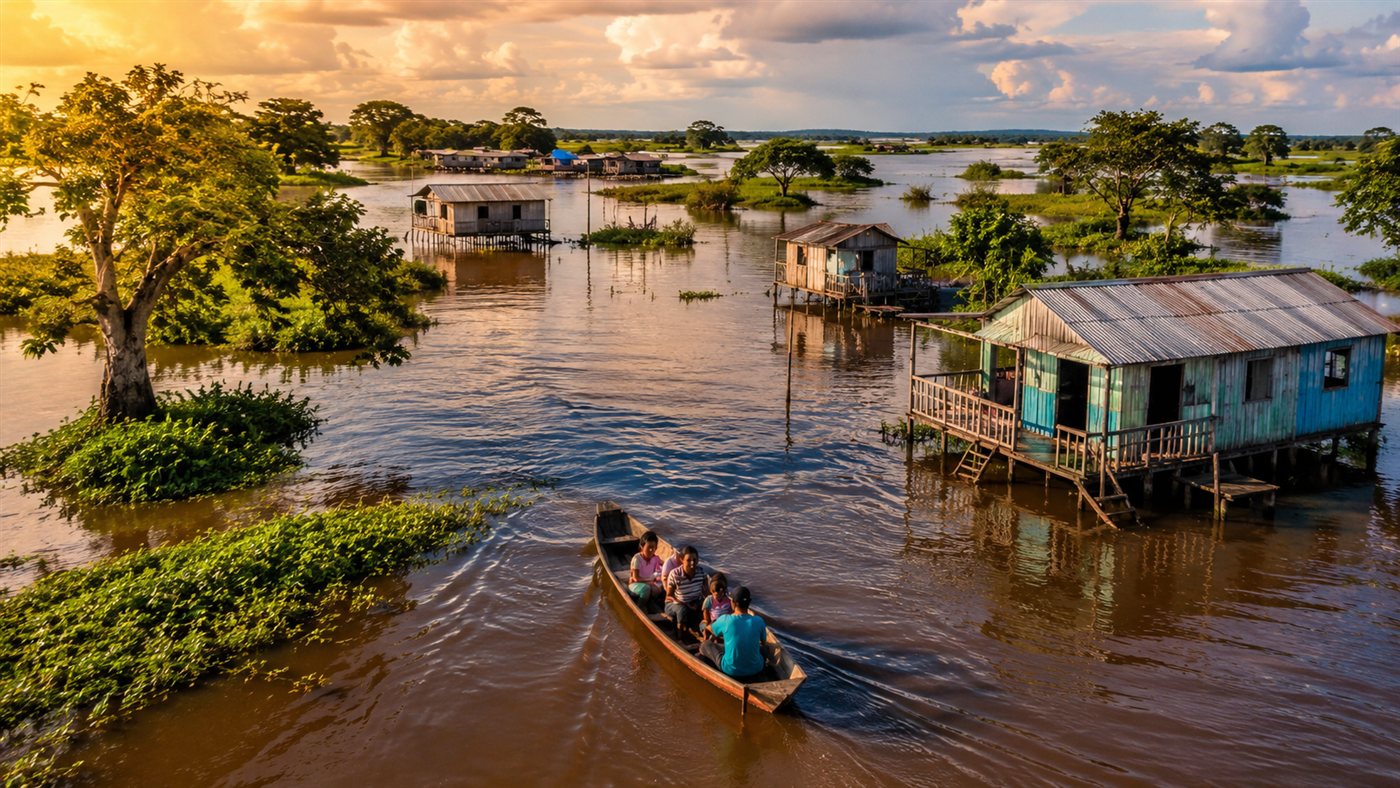
In the Amazon Flood Season, Life Transforms: Riverside Family Near Parintins Relies on Fishing Nets, Stingrays in the Yard, and Canoe-Only Transport





Moreover, the time the tide takes to come in and out coincides with the natural oscillation period of the water body inside the bay. That is to say, there is a resonance effect: the tide cycle and the internal “sway” of the water mutually reinforce each other, as if Fundy Bay itself were a huge musical instrument amplifying the energy of the ocean.
Official measurements indicate that in locations like Burntcoat Head, the difference between low and high tide reaches the largest values. In these areas, the rise of the water in a matter of hours is not just a visual curiosity, but a phenomenon with real impacts on ports, ecosystems, and even power generation projects.
Billions of Tons of Water Moving Every Cycle
The data collected by Canadian researchers show that with each complete tidal cycle, the volume of water that enters and exits Fundy Bay is greater than the combined flow of all the rivers on the planet over the same time interval.
In practical terms, this means that billions of tons of water move in and out of the bay twice a day.
This colossal movement generates:
• extremely strong currents, especially in narrow channels
• areas of turbulence and whirlpools, locally known as “reversing falls”
• strong mixing of surface and deep waters, enriching the environment with nutrients
That is why Fundy Bay is also considered one of the coastal areas richest in biodiversity in the North Atlantic, with whales, seabirds, migratory fish, and an entire chain of life that depend on this constant “pulse” of the sea.
When the Sea Recedes: The Landscape That Transforms in Hours
At low tide, certain areas of the coast transform completely. In stretches like Hopewell Rocks, rock formations sculpted by erosion emerge in full, revealing tall and narrow pillars, crowns of vegetation on top, and bases marked by centuries of wave impact. Visitors can literally walk on the bay’s bottom, stepping where, just a few hours earlier, boats were floating.
The visual contrast is so great that the same fossils, rocks, and cliffs can be observed in two different “worlds” on the same day: one maritime and one terrestrial. This scenario inspired by extreme tides is widely used by geologists and biologists as a natural laboratory to understand processes of erosion, sedimentation, and species adaptation to highly dynamic environments.
When the tide starts to rise, the reaction time is limited. The water advances with increasing speed, filling holes, covering rocks, and once again swallowing the entire stretch of sand. That is why the region operates with strict tidal schedules, consulted daily by residents, fishermen, and tourists.
Fundy Bay as a Scientific and Energy Laboratory
The combination of giant tides and regular frequency has turned Fundy Bay into a global laboratory for tidal energy studies. Pilot projects for electric generation have been tested there for decades, using submerged turbines capable of converting tidal flow into electricity.
Canadian engineers have been analyzing the feasibility of expanding the exploration of this potential without causing major environmental impacts for years.
The force of the water is such that any structure must withstand violent variations in current, sediments, and pressure. Still, the region remains a global reference when it comes to renewable energy from tides.
In addition to energy, Fundy Bay also serves as a base for studies on climate change and sea level rise. As the tidal behavior there is extremely sensitive to changes in water volume and atmospheric pressure, small variations can be detected with great precision by the measurement stations along the coast.
Tourism, Risk, and Respect for the Ocean’s Rhythm
Over the years, the phenomenon has ceased to be merely a subject of study to become one of Canada’s main postcards. Thousands of tourists visit Fundy Bay every year to see the sea recede and return, walk among the rocks at low tide, and then observe the same landscape completely taken over by water.
No local guide, however, ignores the risk. The same tide that creates photogenic scenes can become dangerous for those who underestimate the speed with which the water returns. Therefore, all tourism in the region is strictly guided by official tidal times. The rule is clear: those who enter the bay’s bottom do so with the tidal schedule in hand.
This dynamic reinforces an important message: there, human time adapts to the ocean’s time, not the other way around.
A Daily Reminder of the Earth’s Force
In the end, Fundy Bay is more than a point on the map. It is a daily demonstration of the interaction between gravity, geology, and climate on a massive scale. The place where the ocean disappears and comes back twice a day is not a trick or an optical illusion. It is applied physics, sculpting landscapes and shaping coastal life.
In a world accustomed to the idea of a stable sea, Fundy Bay reminds us that the ocean can also breathe in dramatic cycles, rising and falling as if pulling the planet’s breath. And every day, without fail, this extreme ebb and flow reinforces how much the Earth still holds phenomena capable of surprising even those who spend their lives studying the sea.





A segunda maior maré fica na praia de Arpoeiras, Cidade de Acaraú, no norte di Ceará
Oba eu gostaria sim