





 Portuguese
  English
  Spanish
  5 min of reading
  0 comments


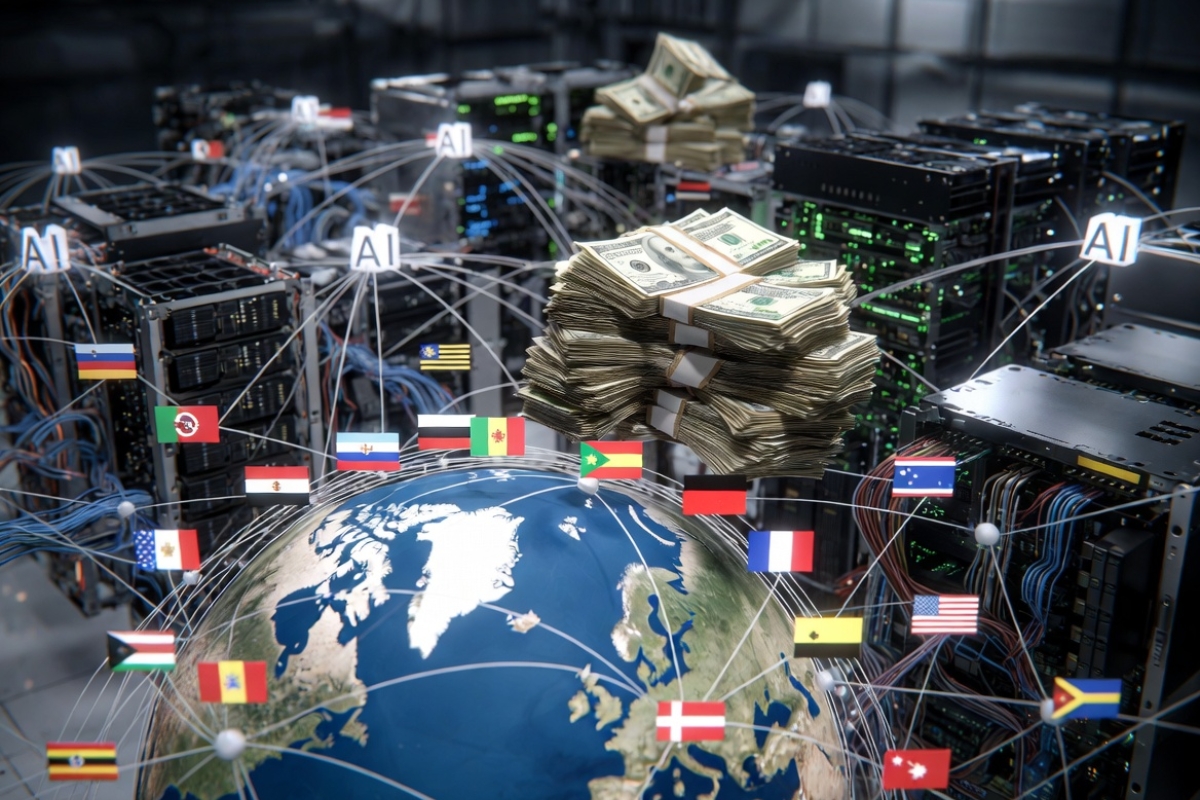
In 2026, Geopolitics Hardens with Sanctions and Coercion, Fiat Money Loses Credibility with More Gold and Alternative Asset Purchases, and the Race for Advanced Artificial Intelligence Faces Energy Limits in Data Centers. These Trends Feed Into Each Other, Redefining Sovereignty and Global Power
We are living in a moment of accelerated transition. Three deep dynamics intersect and reinforce each other: a geopolitics that operates through pressure and punishment, the ongoing weakening of trust in fiat currencies, and a frantic race for advanced artificial intelligence, which today is much more constrained by energy availability than by computational limitations. Together, these forces are fundamentally altering the global rules of the game, in many respects, irreversibly.
The Geopolitics of Coercion and Pressure

The foreign policy of great powers has taken on more assertive and coercive contours. Instead of traditional diplomacy or multilateral agreements, the predominant instrument has become a combination of economic sanctions, technological restrictions, selective tariffs, and in some cases, direct military actions to neutralize adversaries or exclude rivals from strategic regions.
Recent operations in the Western Hemisphere, including the capture of leaders connected to transnational networks and explicit threats over control of crucial trade routes, show that influence is no longer negotiated but imposed. This logic extends to other areas: those who control critical supply chains, digital infrastructure, or maritime routes gain a decisive advantage.
-
More than 100 Chinese ships are surrounding Taiwan, warns the head of the country’s National Security Council.

-
Trump’s announcement about sending 5,000 American soldiers to Poland was received with relief by European allies, but it also raised doubts within NATO about the United States’ strategy, the permanence of the troops, and the division of defense costs on the continent.

-
Yesterday, on the 21st, President Lula stated that he fears an incursion by Donald Trump into the Amazon: while the Brazilian Army advances in a transformation policy that includes troop reorganization, use of technology, and 20% of the forces in a high state of readiness.
-
The war that doesn’t appear on the front: the silent bomb of demographic collapse threatens Russia as Putin loses young people in Ukraine, babies in statistics, and talents in exile.




The result is an increasing fragmentation of the international system, with rival blocs forming and sovereignty being redefined less by territory and more by the ability to control essential flows. While this posture may bring short-term gains, such as greater control over trade routes or reduced illicit flows, it also generates tensions with traditional allies and could accelerate the formation of alternative alliances in response.
One of the most serious risks is the possibility of accidental escalation: a misunderstood incident or a disproportionate response could turn pressure into open conflict. In this scenario, sovereignty is measured by the resilience of critical infrastructures and the capacity to resist external coercion.
The Erosion of the Fiat System

At the same time, the fiat monetary system is facing a silent but steady erosion. Monumental fiscal deficits, persistent inflation, and the frequent use of sanctions as a geopolitical weapon are corroding the credibility of government-issued and central bank currencies.
Central banks from various nations have drastically increased their gold purchases, repatriating reserves and reducing exposure to sovereign debts of countries that lead the current system. The price of gold has reached record levels, while cryptocurrencies and digital assets are consolidating as alternatives for those seeking protection against depreciation.
This trend is not abrupt but cumulative: each new round of monetary printing, each sanction that freezes reserves, or each crisis of confidence accelerates the search for assets that do not solely depend on a government’s word. The practical effect is twofold: real wealth shrinks for those reliant on salaries or traditional savings, while those holding hard or digital assets gain relative power.
An extreme scenario would be a systemic crisis, such as a financial bubble linked to emerging technologies or a large-scale sovereign default, forcing a rapid transition to new monetary standards, whether anchored in commodities, blockchain, or energy. In the meantime, gradual erosion is already altering investment patterns and reserves on a global scale.
Energy: The Real Bottleneck for Artificial Intelligence
The third force is the global obsession with higher-level artificial intelligence. What began as a promise of productivity has transformed into a state strategic priority. Companies and governments invest tens of billions of dollars annually in increasingly powerful models.
However, the primary bottleneck has shifted from chips or algorithms to energy. AI-dedicated data centers consume colossal amounts of electricity, in some countries, equivalent to the consumption of entire cities. Projections indicate that the energy demand of IA infrastructure may double in a few years, pressuring already overloaded power grids and necessitating massive investments in new generation sources.
Those who can secure abundant and cheap energy gain a structural advantage that is almost impossible to overcome. Countries and companies without privileged access to electricity face chronic delays, while those with excess capacity can accelerate the development of more advanced systems.
The risks are multiple: from industrial-scale misinformation and autonomous weapons to unprecedented levels of authoritarian surveillance. One of the most unsettling scenarios is the possibility of an entity, whether a state, a corporation, or a well-funded non-state group, achieving super-human level artificial intelligence before others, without significant external controls. The consequences would be unpredictable and potentially irreversible.

The Interdependence of the Three Forces
These three dynamics do not exist in parallel: they interact and amplify each other. Coercive geopolitics accelerates the use of financial sanctions, which in turn further weakens fiat currencies and pushes capital into alternative assets. The desperate quest for supremacy in AI increases pressure on energy resources, creating new points of strategic vulnerability that can be exploited politically.
Restrictions on the export of chips, control of liquefied natural gas routes, or sanctions on critical minerals for batteries and solar panels become instruments that are simultaneously economic, technological, and military.
A Future of Deep Divisions or Unexpected Leaps
One of the most concerning aspects is the potential for radical asymmetry. If one entity achieves supremacy in AI without accountability, the balance of power could change permanently. On the other hand, the same advances could bring extraordinary leaps in science, medicine, and problem-solving.
Another possibility is the creation of a deep division between blocs that dominate energy, technology, and narrative, and those that fall behind. A kind of digital and energy iron curtain may emerge, resulting in limited circulation of knowledge, infrastructure, and capital between sides.
The year 2026 is not just a chronological milestone. It is the moment when trends that have been accumulating since the beginning of the decade became visible and interdependent. The immediate future will depend on how governments, companies, and societies can navigate these forces simultaneously, without succumbing to the temptation of total control or allowing unchecked innovation to generate catastrophic disruptions.
What is at stake is not just power or wealth. It is the very way the world will be organized over the coming decades.
Consulted sources include Letras Libres, Reuters, The Guardian, and IEA reports. This article is for informational purposes.








Be the first to react!