






 Portuguese
  Spanish


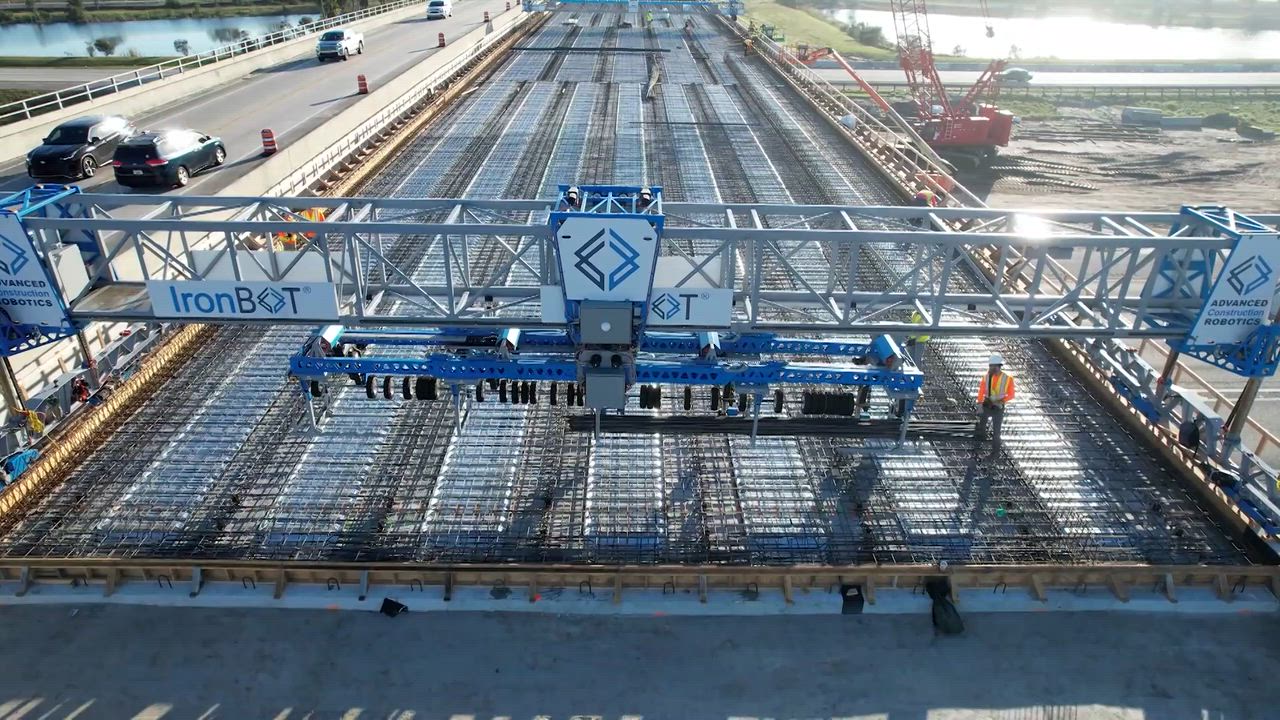

IronBOT and TyBOT robots automate rebar in bridges, with 2.2 t/h, 1,200 ties per hour and promise to cut deadlines.
Heavy construction has begun to enter a phase where even one of the toughest tasks on the site can be handed over to machines. In the United States, Advanced Construction Robotics has developed two robots aimed at installing rebar in bridge projects: the IronBOT, which carries and positions steel bars, and the TyBOT, which ties the reinforcement intersections.
According to the manufacturer, the IronBOT works at an average rate of 5,000 pounds per hour, equivalent to 2,267.9 kg per hour, or about 2.27 tons of rebar per hour. The most aggressive promise appears when it works together with the TyBOT: the company claims that the set can generate up to 50% savings in the reinforcement installation schedule.
IronBOT robot automates one of the heaviest tasks in bridge construction
The IronBOT is designed to lift, transport, and position transverse and longitudinal rebar, including black or epoxy-coated bars. Instead of replacing the entire project, it enters a specific stage: the assembly of the steel reinforcement before the concreting of bridge decks.
-
Couple Transforms Abandoned Seaside Public Restroom Bought for £33,000 into £295,000 Beach House After a Decade of Renovations

-
With 26 Million Brazilian Families in Substandard Housing, Churches to Launch 2026 Challenge: Each Parish to Build or Renovate a Home for a Local Family
-
Wood-Look Aluminum Emerges as a High-Tech Alternative for Facades and Gates, Offering Sophisticated Aesthetics and Low Maintenance

-
Couple Transforms 1964 Concrete Water Tower into Four-Bedroom Home with Views of London Over Four Years





The machine also does not depend, according to ACR, on pre-programming, pre-mapping, or BIM data input to operate. The company claims that the robot automates the positioning of the rebar based on the spacings required in the project.
This detail is important because steel reinforcement is a repetitive, heavy, and critical stage. Positioning errors can delay inspections, generate rework, and compromise the progress of concreting.
Machine works with bars from 9 to 60 feet and expandable structure for different bridge widths
ACR reports that the IronBOT can be expanded to widths between 27 and 117 feet, equivalent to approximately 8.2 to 35.7 meters. The equipment also positions bars from 9 to 60 feet, or about 2.7 to 18.3 meters.
The manufacturer also states that the robot can arrive at the site and start working in 4 to 8 hours, as well as operate day or night, rain or shine. These data are technical claims of the company itself, not an independent measurement presented by a public body.
In practice, the proposal is to reduce human physical effort in moving rebar, one of the heaviest activities in infrastructure works. The worker stops manually carrying and positioning part of the steel and starts to focus more on control, supervision, and operation adjustments.
TyBOT then enters to tie more than 1,200 rebar intersections per hour
The second robot in the set is the TyBOT, an autonomous machine aimed at tying rebar intersections. According to ACR, it locates itself, navigates the work area, and makes the ties without pre-mapping, reaching more than 1,200 ties per hour.

The company claims that the TyBOT can work for up to 10 hours without refueling, operate on side forms or existing tracks, and handle rebar intersections up to #8 by #9, a standard used in the North American market.
In an 8-hour shift, the manufacturer itself calculates productivity exceeding 9,600 ties, with a minimum average savings of 25% in the schedule for contractors in bridge deck projects.
Test on bridge in Florida reduced rebar installation from 14 to 7 days, according to the company
The most striking data comes from an inaugural project cited by Advanced Construction Robotics itself. On the Port St. Lucie West Boulevard Bridge in Florida, the rebar installation was originally estimated to last 14 days, but was completed in 7 days with the support of the IronBOT and TyBOT set, according to the company.
During this pilot, ACR states that the IronBOT positioned 147,032 pounds of rebar, equivalent to approximately 66.7 tons, while the TyBOT performed 58,068 ties over 6.5 production shifts.
On average, this represents about 22,620 pounds of rebar per shift, or just over 10.2 tons per shift, as well as approximately 8,934 ties per shift. These numbers reinforce the operational impact but remain linked to the case disclosed by the manufacturer.
Robots do not eliminate the entire team, but change the type of work on the site
Despite the strong title, the main point is not that all human ironworkers disappear immediately. ACR itself describes the IronBOT as a machine that enhances the team’s capacity, relieving workers of some of the heavy lifting and positioning of rebar.

In the case of the TyBOT, the automation targets a repetitive task: tying bar intersections for hours, in an uncomfortable position and with high physical strain. The promise is to transform part of the team into operators, supervisors, and problem solvers on the site.
It’s a change similar to what has already happened in factories, ports, and warehouses: the machine takes over the heavy repetition, while the human hand becomes more focused on control, preparation, finishing, inspection, and decision-making.
Civil construction enters the era of production robots, not just prototypes
The advancement of IronBOT and TyBOT shows an important shift: construction robotics is no longer limited to futuristic videos of 3D-printed houses. It is entering heavy infrastructure projects, where deadlines, productivity, and lack of skilled labor directly impact the final cost.
The difference is that these robots do not try to build an entire bridge by themselves. They target a specific, repetitive, and costly stage: the installation of the steel reinforcement that supports the concrete.
This is exactly where automation usually advances first. Not on the entire site at once, but in tasks where productivity gains can be measured in tons, ties per hour, and days removed from the schedule.
The question now is no longer whether robots will enter civil construction. They already have. The question is how many heavy functions will still remain human for a long time.


