






 Portuguese
  Spanish


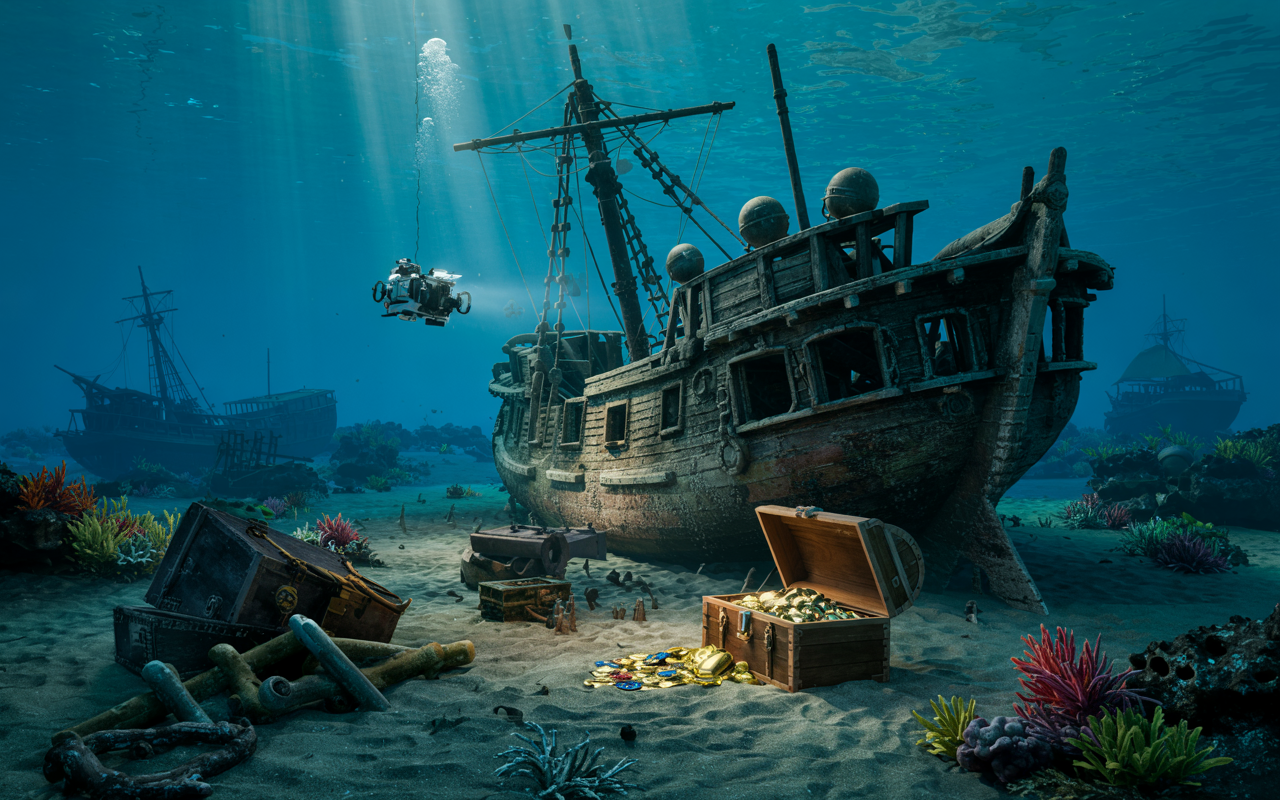


With Gold, Silver, and Emeralds on the Seafloor, the San José Is the Most Valuable Shipwreck in the World and a Symbol of Disputes Among Governments, Archaeologists, and Treasure Hunters.
Sank in 1708 off the coast of Cartagena, Colombia, the Spanish galleon San José is internationally known as the “Holy Grail of Shipwrecks.” Carrying a billion-dollar treasure made up of gold, silver, and emeralds, the ship was found in 2015 at a depth of about 600 meters, after being lost for over 300 years.
It is estimated that its cargo could exceed the value of US$ 20 billion, making the San José one of the most valuable shipwrecks ever recorded in history. The Spanish vessel, with three masts and armed with 64 cannons, was part of a fleet that set sail from the American colonies to Europe during the War of the Spanish Succession.
Sinking During Naval Confrontation
On June 8, 1708, the San José was intercepted by British ships as it approached the Caribbean coast of present-day Colombia. The confrontation ended with the explosion and sinking of the ship. Almost 600 crew members died in the attack, and the treasure disappeared with the vessel, becoming a target for hunters, archaeologists, and governments over the centuries.
-
The U.S. Navy Conducts Submarine Tests in Idaho Lake to Detect Underwater Noises Hidden by the Ocean

-
Nuclear Submarine USS Alexandria Retired After 35 Years, Having Completed Over 1 Million Miles in Missions

-
MODEC Introduces New Hull Design for FPSO Gato do Mato to Produce Up to 120,000 Barrels of Oil Per Day in Brazil’s Pre-Salt Region
-
This Massive 12-Meter, 21-Ton Underwater Drone Can Operate Autonomously for Up to Five Days


On board were large amounts of precious metals extracted from the colonial mines of South America, primarily from present-day Bolivia and Peru. The final destination of the cargo was the Spanish crown, which relied on these resources to finance war efforts in Europe.


Discovery of the Shipwreck in 2015
After more than three centuries lost on the seafloor, the Spanish galleon San José was finally located in 2015 by a covert mission conducted by the Colombian Navy with the help of submersible robots. The exact location of the shipwreck was kept secret by Colombian authorities to prevent attempts at illegal exploitation.
The confirmation that it was the San José was based on images revealing the presence of bronze cannons with unique markings corresponding to the historical records of the vessel.
International Disputes Over Ownership of the Treasure
The discovery of the billion-dollar treasure triggered legal and diplomatic disputes. Spain claims that, as a warship from its fleet, the San José has sovereign immunity under international treaties. Colombia, on the other hand, asserts that the shipwreck is in waters under its jurisdiction and has declared it a national cultural heritage.
In addition to these two countries, the American company Sea Search Armada, which claims to have found the location of the shipwreck in the 1980s, also demands part of the recovered value. Indigenous groups from Bolivia, such as the Qhara Qhara, have also spoken out, alleging that the precious metals aboard the San José were forcibly extracted from their territories during the colonial period.
Ongoing Scientific Exploration
In 2024, Colombia launched an official exploration operation of the ship, using cutting-edge technologies to preserve and study the wreck contents. The mission is led by Colombian public institutions and aims to ensure that the recovered artifacts serve scientific, cultural, and educational purposes, not just financial ones.
The country plans to exhibit the found objects in national museums and turn the episode into a symbol of the fight for the preservation of underwater heritage. The operation includes the recovery of coins, cannons, porcelain, weapons, and other items of invaluable historical significance.
A Global Symbol of Maritime Archaeology
The Spanish galleon San José has become a global reference in discussions about sovereignty, cultural heritage, and underwater archaeology. The complexity of the case reveals the legal and ethical challenges involved in the exploration of shipwrecks with high monetary value and historical significance.
Experts propose that the case of the San José could serve as a model for new international conventions regarding submerged cultural property, seeking a balance between scientific preservation, national interests, and historical justice.
Considered the Most Valuable Shipwreck in the World
Although other ships have sunk with valuable cargo, few compare to the San José in terms of estimated value and symbolic relevance. The figure of US$ 20 billion attributed to the billion-dollar treasure onboard makes the galleon widely cited as the “Holy Grail of Shipwrecks,” a phrase that encapsulates its aura of mystery and wealth.
As of now, the ship remains untouched on the seafloor, with carefully planned operations to avoid damage to the archaeological site. With each advancement in the mission, public and scientific interest in the next steps of this ongoing story grows.








VAI TER MUITA GENTE QUERENDO EXPLORAR ESSE NAUFRÁGIO. ESTÃO DE OLHO NAS RIQUEZAS. ENQUANTO NÃO DESCOBRIRAM O NAUFRÁGIO, NINGUÉM SE IMPORTOU. AGORA QUE DESCOBRIRAM, TODO MUNDO QUE REINVINDICAR A SUA PARTE NAS RIQUEZAS SUBMERSAS. ÊTA POVO GANANCIOSO.