Portuguese
  Spanish


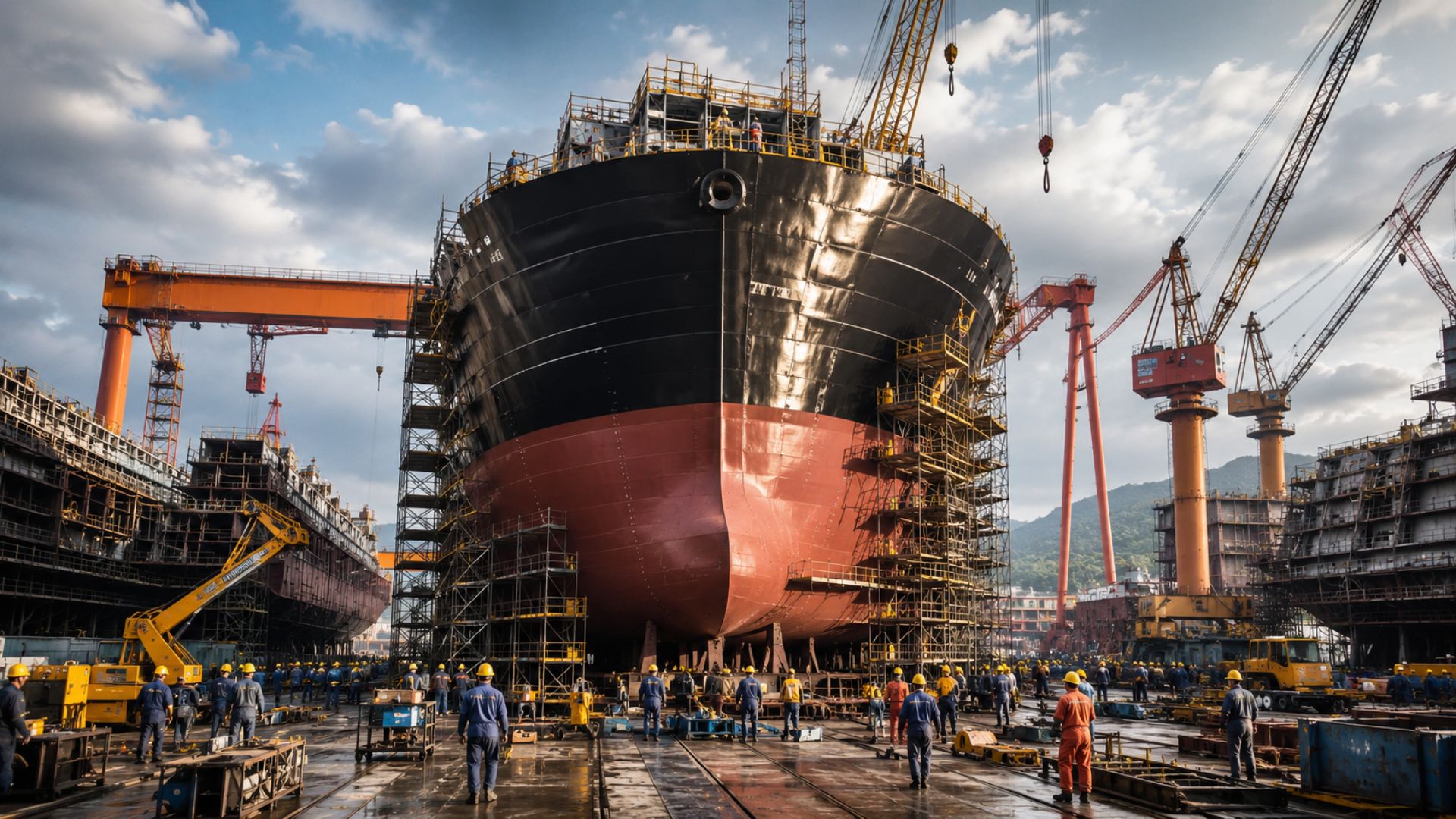

Chinese expansion in shipbuilding increases pressure on South Korea and Japan, as the country’s shipyards concentrate almost 85% of new global ship orders at the beginning of 2026 and reinforce influence over logistics chains, maritime trade, and the renewal of the international fleet.
China’s leadership in global shipbuilding gained even more strength in the first quarter of 2026, during which the country’s shipyards received 59.53 million deadweight tons in new ship orders, a result that represents a growth of 195.2% compared to the previous year.
With this expansion, the Chinese shipbuilding industry came to account for 84.9% of new global orders in DWT between January and March, according to data released by the Ministry of Industry and Information Technology of China.
While South Korea and Japan remain relevant in specific segments of the sector, the scale difference observed in recent numbers shows that Asian competitors face an increasingly challenging environment in the face of Chinese industrial advancement.
-
The U.S. Navy Conducts Submarine Tests in Idaho Lake to Detect Underwater Noises Hidden by the Ocean

-
Nuclear Submarine USS Alexandria Retired After 35 Years, Having Completed Over 1 Million Miles in Missions

-
MODEC Introduces New Hull Design for FPSO Gato do Mato to Produce Up to 120,000 Barrels of Oil Per Day in Brazil’s Pre-Salt Region
-
This Massive 12-Meter, 21-Ton Underwater Drone Can Operate Autonomously for Up to Five Days


China expands global leadership in shipbuilding
In addition to the surge in orders, Chinese shipyards simultaneously advanced in the other two main indicators of the global shipbuilding industry, related to completed production and the accumulated volume of contracts on order.
Between January and March, China delivered 15.68 million DWT, a result 46% higher than recorded in the same period of the previous year and equivalent to 57.3% of all global ship production in the quarter.
At the same time, the order book continued to expand and reached 322.3 million DWT at the end of March, an annual growth of 43.6%, a share that corresponded to 69.8% of global orders in shipbuilding.
In practice, the data indicates that the country not only concentrates new contracts but also maintains sufficient industrial capacity to transform a significant part of this demand into effective deliveries in the coming years.
South Korea and Japan face greater competition
Even maintaining a relevant presence in higher value-added vessels, especially in segments related to liquefied natural gas, South Korea has lost ground when the comparison involves the total volume of orders received.
Japan, historically associated with efficiency and quality in shipbuilding, faces greater difficulties due to higher industrial costs and the growing competition from Chinese and South Korean players.
A large part of the Chinese advantage is related to the combination of production scale, integrated supplier chain, ample steel supply, access to financing, and industrial coordination focused on long-term contracts.
Shipbuilding gains strategic importance in global trade
Responsible for sustaining the international transport of containers, oil, minerals, gas, grains, and vehicles, shipbuilding occupies a strategic position within global trade and supply chains.
In this scenario, the concentration of orders in Chinese shipyards has ceased to represent just business competitiveness and has come to involve industrial capacity, logistical influence, and direct participation in the renewal of the global merchant fleet.
When choosing where to build new ships, shipowners usually evaluate factors such as price, delivery time, technical capacity, and operational safety, a combination in which the Chinese scale has gained significant advantage in recent years.
This movement is also influenced by the need to replace old vessels and adapt part of the international fleet to environmental requirements and alternative fuels, a process that has increased global demand for new naval projects.
Billion-dollar portfolio reinforces the dominance of Chinese shipyards
With a portfolio of 322.3 million DWT in pending orders, Chinese shipyards ensure a production volume sufficient to remain at the center of the global fleet renewal for the coming years.
This scenario increases predictability for suppliers, banks, engineering companies, and logistics operators connected to the Chinese naval chain, further strengthening the industrial structure built by the country in recent decades.
Although South Korea and Japan still maintain technological relevance in specific segments, the difference observed in the share of new orders highlights an increasingly consolidated Chinese leadership in the international market.
More than an isolated short-term result, the index of 84.9% in global orders reflects a continuous trajectory of industrial expansion that has transformed China into the world’s leading shipbuilding power.