





 Portuguese
  English
  Spanish
  4 min of reading
  0 comments


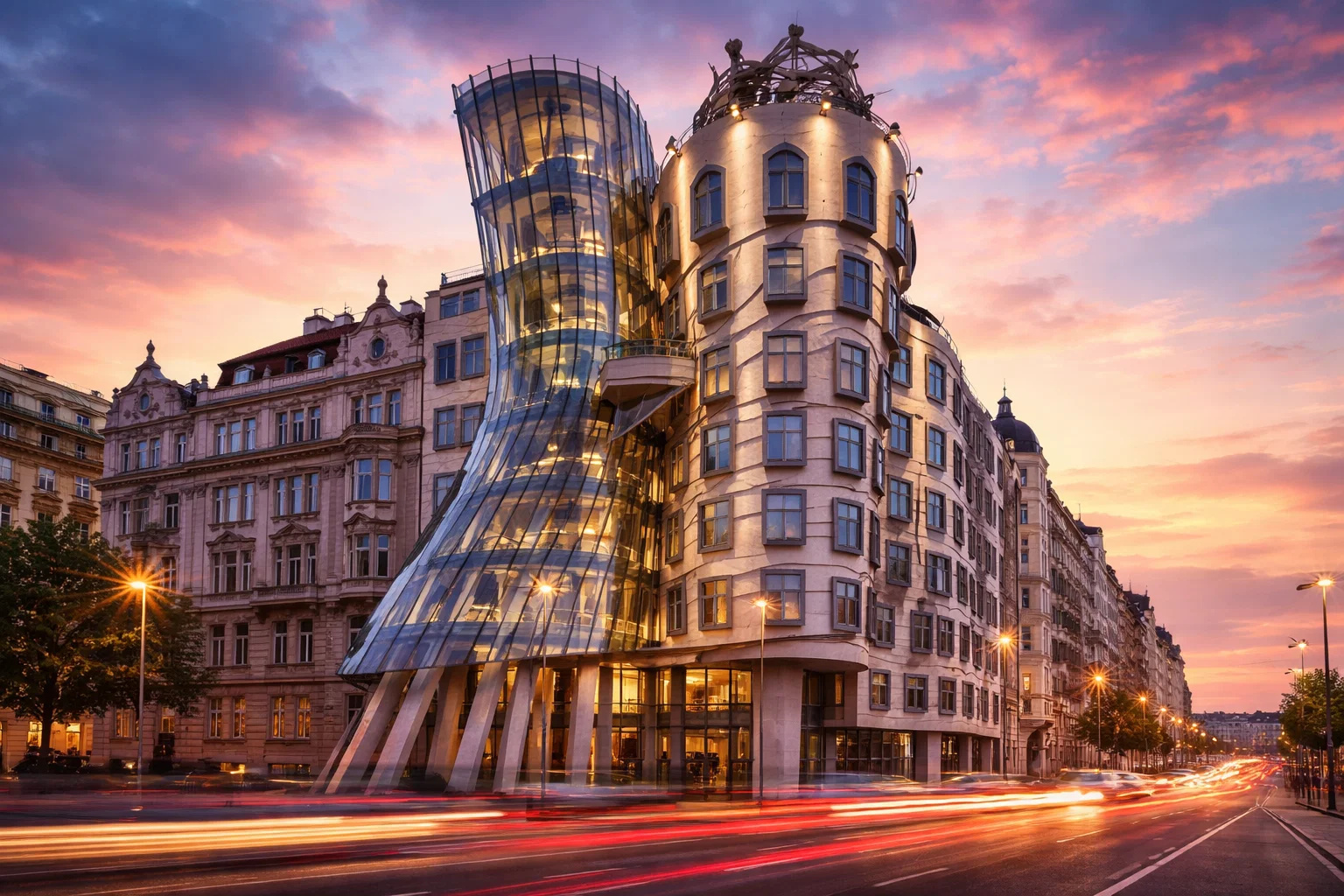
A Building That Looks Like It’s Dancing in the Historic Center of Prague Captured Global Attention and Revealed a Radical Engineering Experience That Blends Custom-Molded Concrete, Curved Glass, and Rare Structural Solutions for Its Time
Those who walk along the banks of the Vltava River in Prague almost always slow down upon noticing the building that seems to dance. Amid aligned and traditional historic buildings, there emerges a construction that appears to ignore any rule of classical architecture.
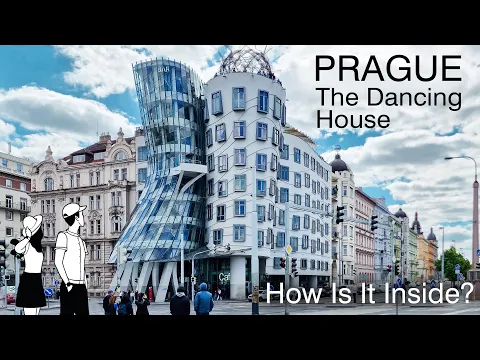

On one side, there is an angled glass tower. On the other, there is a wavy concrete structure, with misaligned windows that seem to spin. The ensemble resembles two figures in motion.
This is the famous Dancing House, a building inaugurated in 1996 that quickly became one of the most discussed works of modern architectural engineering.
-
Family has lived for over 50 years without electricity and running water at home in the South of Minas, 10 minutes from the city, improvising light, bath, and water while facing a lack of basic resources and awaiting property regularization.

-
Children from the 1980s and 1990s who spent hours playing in the street until dark naturally developed spatial intelligence, which today has become the subject of expensive courses, cognitive training, and modern methods of child and adult learning.

-
Without bombs, without electricity, and without drilling the ground, villages in southwestern Morocco have discovered how to extract water directly from the air using only polymer nets, wind, and the humidity of the Atlantic amidst the advancing desert.

-
Son of a Brazilian, a 20-year-old young man defies extreme pressure, wins the world rodeo championship, and takes home a million-dollar prize of nearly R$ 5 million.



Behind the almost surreal appearance lies a set of construction solutions that transformed the building into a true experiment in technology applied to architecture.
The Land Destroyed in World War II Became the Stage for an Urban Engineering Experiment That Changed the City’s Landscape
For decades, that space in the center of Prague remained empty.
The reason dates back to 1945, when a bombing during World War II destroyed the building that occupied the site. The urban gap remained there for years, surrounded by historic buildings that follow rigid standards of façade and proportion.
In the 1990s, the idea emerged to do something completely different.
The project was led by Czech architect Vlado Milunic in partnership with renowned architect Frank Gehry. The proposal did not seek to repeat old styles. The goal was to show that a historic city can also host contemporary architecture.
The result was a construction that appears to be in permanent motion, which explains the popular nickname that it quickly gained.
Many locals found the work strange at first. Today, it has become one of the most photographed spots in the Czech capital.
The Structural Secret That Forced Engineers to Manufacture 99 Totally Different Concrete Pieces
The irregular appearance of the Dancing House is not merely aesthetic.
It arises from a real structural challenge.
The main tower was built with 99 individually molded concrete panels. Each piece has its own shape, which is unusual in traditional civil construction, which typically works with repeated elements.
This decision required a level of precision that was rare for the time.
In practice, each component needed to be designed and manufactured to fit the geometry of the building. Any millimeter error could compromise the alignment of the structures.
Today, advanced modeling software facilitates complex projects. In the early 1990s, such solutions required extensive physical testing and detailed structural calculations.
Experts point out that the work helped to boost the use of three-dimensional modeling in contemporary architecture.
The Curved Glass Tower That Seemed Impossible to Build in the 1990s
If the concrete already represented a technical challenge, the other side of the building elevated the difficulty to another level.
The so-called glass tower presents an inclined structure made up of curved surfaces. The effect creates the impression that the construction leans forward.
This lightweight volume visually represents the feminine figure of the famous nickname of the building that seems to dance, inspired by dancers Fred Astaire and Ginger Rogers.
From an engineering perspective, the challenge lay in the manufacturing and installation of the glass panels.
In the 1990s, the production of curved surfaces on a large scale was still uncommon. Each element needed to be adjusted with extreme precision to maintain structural stability and correct sealing.
The internal metal structure was also designed to follow the curvature of the façade, ensuring resistance to wind and proper load distribution.
The Metal Sculpture on Top That Reveals Another Curious Detail of the Project
Those who observe the building closely notice a curious element at the top of the concrete tower.
There is a twisted metal structure informally known as Medusa. The name arose from its resemblance to twisted or scattered metallic wires or hair.
The piece functions as a sculptural element that reinforces the visual identity of the building.
At the same time, it helps to compose the structural balance of the upper part of the construction.
This type of integration between art and engineering has become one of Frank Gehry’s hallmarks, known for projects that challenge traditional geometric standards.
Why the Dancing House Became a Real Laboratory for New Construction Technologies
Over the years, the building has ceased to be merely an architectural curiosity.
Architecture and engineering universities began to study the project as an example of construction with complex geometry.
The building combines characteristics that now appear in many contemporary works:
- use of non-standardized structural pieces
- facades with curved surfaces
- three-dimensional modeling applied to architectural design
- integration between sculpture and structure
These concepts have become increasingly common in large urban works over the past few decades.
The Dancing House has become a kind of urban prototype for a new generation of experimental buildings.
More than a tourist spot, the building that seems to dance represents a moment when engineering and architecture decided to break traditional boundaries and test new construction possibilities.
This blend of technical daring and visual impact explains why the work continues to arouse curiosity nearly thirty years after its inauguration.
If you already knew this curious building or just discovered this story, feel free to share your opinion. Do constructions like this represent innovation or architectural exaggeration?








Be the first to react!