Portuguese
  Spanish


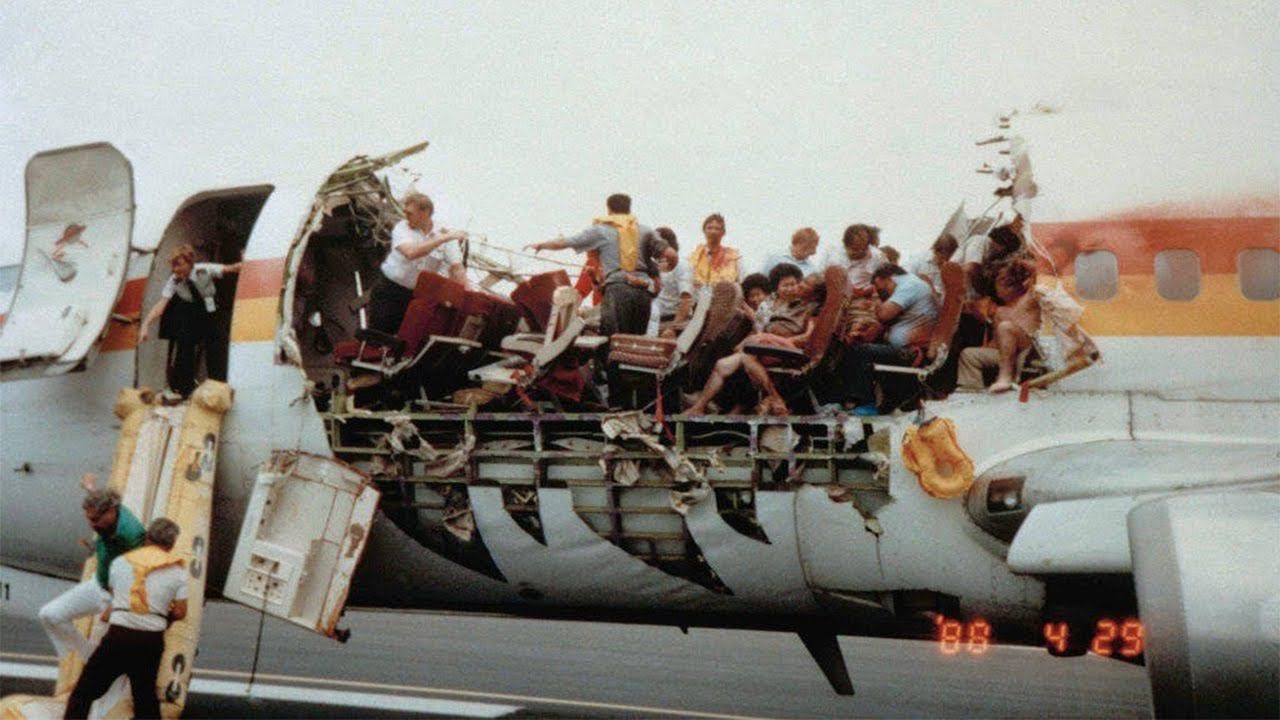


The Boeing 737 That Lost Its Roof at 7,300 Meters and Still Landed Became One of the Greatest Miracles of Aviation, Studied Even Today by Aeronautical Engineers.
On April 28, 1988, flight Aloha Airlines 243, operated by a Boeing 737-297, became one of the most impressive and technically studied episodes in the history of world aviation. The event occurred over Hawaii, when the aircraft was conducting a domestic flight between Hilo and Honolulu. What started as a brief routine ascent would, in just a few seconds, turn into an extreme scenario: an explosive decompression that ripped off much of the roof and left passengers exposed directly to the sky while the aircraft remained in flight.
The case was documented by aviation authorities, analyzed by the National Transportation Safety Board (NTSB), and studied by aircraft structural engineers to this day, due to presenting a set of rare circumstances and having an outcome that is still considered almost impossible.
The Explosive Decompression at 7,300 Meters: The Moment the 737 “Opened” in the Air
At around 24,000 feet (7,300 meters), the Boeing 737 was already stabilizing its ascent when, at 1:48 PM, a metallic boom reverberated throughout the fuselage. In less than a second, a structural panel of the roof detached, triggering a chain reaction: approximately 18 meters of upper fuselage tore away like a lid being ripped off, opening a large cavity that allowed a view of the sky directly from inside the plane.
-
Brazil Welcomes Spanish Wamos Air and Nigerian Air Peace, Potentially Transforming International Routes and Increasing Competition

-
Offshore air transport soars in Brazil, surpasses 2.5 million passengers, and reveals how oil has transformed Rio’s airports into key pieces of national logistics.

-
Latin America becomes the “global champion” of aviation taxes, tickets may become more expensive in Brazil, and IATA’s warning exposes risk for flights, tourism, and passengers.
-
Brazil has lost 85 air routes since 2019 and is still flying less than before the pandemic, leaving passengers with fewer destinations, fewer frequencies, and a more limited air network.




The decompression was so violent that:
- it generated instantaneous winds estimated at up to 500 km/h inside the cabin;
- it ripped off oxygen masks and internal panels;
- it hurled metal fragments backward like shrapnel;
- it left passengers gripping their seats so they wouldn’t be thrown around;
- it compromised part of the electrical systems and cabin sensors.
With the roof torn off, the flight entered what specialists call a “bare hull state”, a situation considered practically incompatible with stable airborne control.
The Surreal Vision Inside the Cabin: Open Sky, Extreme Wind, and Isolation
Witnesses later reported that the cabin resembled “a wind tunnel open to the sky.” The deafening sound of the decompression and wind made any verbal communication between crew and passengers impossible.
The occupants in the front rows were completely exposed to the outside, and objects were sucked out of the plane. The cockpit, which remained intact, maintained basic control of the aircraft, but the flight entered a critical situation: many instruments malfunctioned, and the noise made it impossible to hear alarms and alerts.

The scenario was so extreme that the captain Mimi Tompkins, one of the first women to command a commercial aircraft in the United States, later described the feeling as “flying inside a hurricane with the roof open”.
The Crew’s Performance: 13 Minutes That Challenge Aeronautical Engineering
From the rupture, the Boeing 737 remained in the air for 13 minutes, a time considered extraordinary given the extent of the structural damage.
During this period, the crew:
- immediately initiated an emergency descent without reliable instruments;
- fought against extreme vibrations and completely altered aerodynamics;
- flew with partial control, as part of the panel had been destroyed;
- kept the aircraft within structural limits despite the severe rupture.
NTSB analysts stated that, due to the loss of fuselage stiffness, any excessive maneuver could have caused a total structural failure, leading the Boeing to collapse in mid-air.
Nevertheless, the pilots managed to align the aircraft with Kahului Airport on the island of Maui, performing a landing that many engineers classify as “statistically improbable”.
The Almost Impossible Landing: Damaged Landing Gear and Unstable Fuselage
Even after the decompression, the crew opted to land the 737 with an open fuselage. The forward landing gear exhibited instability, and there was a real risk of collapse during the approach.
Still, at 1:58 PM, the Boeing touched down, skidded for a few meters, and finally came to a stop. Against all odds, all 89 passengers and crew members — with the exception of one flight attendant — survived.
The NTSB classified the act as one of the most technically complex emergency landings ever recorded.
The Investigation: Why Did the Boeing 737 Lose Its Roof?
The NTSB analysis concluded that the accident was caused by:
- severe structural fatigue;
- advanced corrosion in critical areas of the fuselage;
- accumulation of undetected microcracks;
- prolonged exposure to the marine environment, typical of the Hawaiian archipelago.
The aircraft had 35,000 pressurization cycles, a high number for aircraft operating short segments with frequent climbs and descents.
The investigation led to global changes in maintenance for short-haul aircraft and inspection protocols.
Why the Case Still Intrigues Engineers?
The episode became a permanent subject of study because:
- the extent of the rupture should, theoretically, make the aircraft uncontrollable;
- the loss of structural mass profoundly altered the aerodynamics;
- the open cabin created severe instability and internal turbulence;
- the resilience of the remaining systems surpassed engineering predictions.
The case of Aloha 243 is considered one of the greatest examples of structural resilience of the Boeing 737 and human skill under extreme pressure.