Portuguese
  Spanish


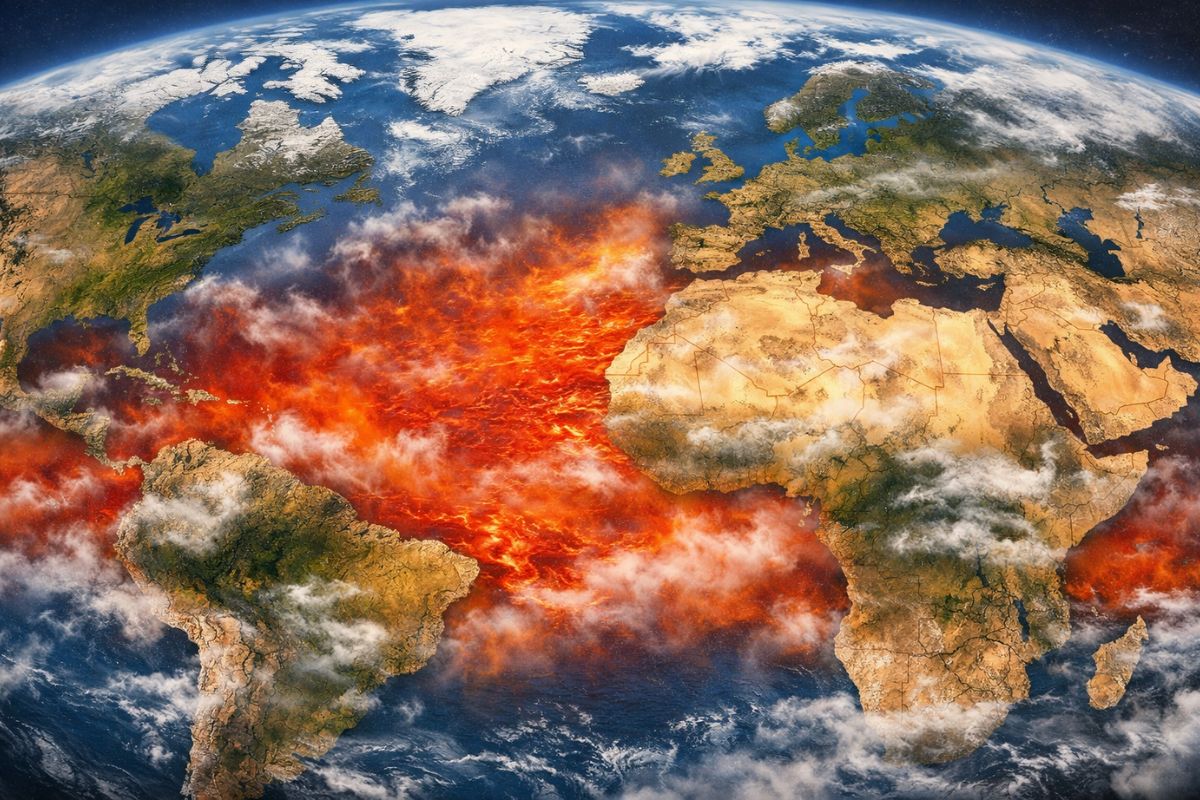


Ocean warming advances with sea surface near recent highs, Arctic at minimum ice for winter and Earth’s energy imbalance at highest level in 65 years
The feeling is strange because it mixes two things that, until recently, many people thought went together. In 2024, ocean warming hit a record, and there was an easy “culprit” to point to: El Niño. However, in 2026 the story begins to get more uncomfortable. The numbers have returned to levels seen in 2024, but now without an active El Niño to explain the jump.
And this does not appear alone. The text points out a combo that draws attention: Arctic sea ice at a record low for winter, average temperature 1.43 degrees Celsius above pre-industrial levels, and an energy imbalance of the Earth at the highest level in 65 years. It’s the kind of combination that sets off alarms even when no one wants to.
What is happening with ocean warming in 2026
The base uses a strong metaphor, saying that “the oceans are steaming.” And, even if this is not literal, the message is quite direct: ocean warming has risen more than seemed reasonable and has caught the world off guard.
-
She spent 73 years breathing inside an iron lung, survived the aftereffects of polio, and became the last woman in the United States dependent on the equipment before dying at 78 years old.

-
Brazilian students created a $1 filter using pine bark, cotton, and 3D-printed parts to clean cassava wastewater, reduce the toxicity of a hazardous waste, and transform contaminated water into biofertilizer.

-
Astronaut from Artemis II steps down after mission to the Moon and decision surprises after a record of 406,771 km, a historic 10-day journey, and an unprecedented achievement for Canada.

-
A fossil kept for years in a small museum in Montreal concealed 450-million-year-old soft tissue, a discovery that has only happened once before in history.


According to data from Copernicus cited in the text, in March the global average temperature was 13.94 degrees Celsius. This was 0.53 degrees above the average from 1991 to 2020 and 1.48 degrees above pre-industrial levels. It was not the hottest March on record, but it came close.
Why the “no El Niño” is more frightening than the record itself
The text reminds us that February 2026 was one of the three coldest months in the last 14 years. At the same time, the sea surface remained very warm. This contrast makes things more unsettling.
The explanation is that we are in neutral ENSO conditions. In 2024, El Niño helped to “pump” heat from the Pacific, and the record came with that push. Now, the sea is almost at the same level without this crutch, and that is what worries experts.
It was not an isolated peak: the sea was rising the whole month
Another important point is that the sea surface temperature does not appear as a peak that rises and falls quickly. The base states that it was a steady increase throughout the entire month of March.
This changes the risk assessment because it signals a trend. When ocean warming consolidates day after day, it becomes harder to treat it as a “statistical accident.”
Regions Already at Record Levels and the Uncomfortable Question of What Comes Next
The text mentions specific areas that are already at record levels, such as the North Atlantic subtropical and northeast, as well as the North Pacific and South Pacific.
And then comes the question that lingers: what happens at the end of the year and, especially, at the beginning of the next, when El Niño is at its peak intensity. If ocean warming is already high without El Niño, the fear is that the system will push even more when the pattern changes.
The Mediterranean as a “Laboratory” for Climate Risks
The basis positions the Mediterranean as a laboratory for climate risks, stating that it can warm up to 20% faster than the global average. The consequence is not abstract: the text talks about mass extinction of vertebrates, retreat of seagrass meadows, and significant fish mortality.
The image is harsh, but it helps to understand the chain effect: a warmer sea changes ecosystems and also changes the type of event that the atmosphere can “pull” from there.
Why Warmer Seas Become Fuel for Extreme Events
The reasoning is simple: more heat in the sea means more water vapor available. And this vapor becomes food for extreme precipitation phenomena.
The basis mentions brutal storms in Valencia and Almería and cites the DANA of Valencia as a reminder of this type of risk.
In other words, it’s not just about ocean temperature. Ocean warming becomes part of the machinery that increases the intensity of heavy rains and extreme episodes.
In your daily life, does this still seem like a “distant” problem, or do you already feel that the rains have become more unpredictable and stronger than they were a few years ago?