






 Portuguese
  Spanish
  3 min of reading
  0 comments


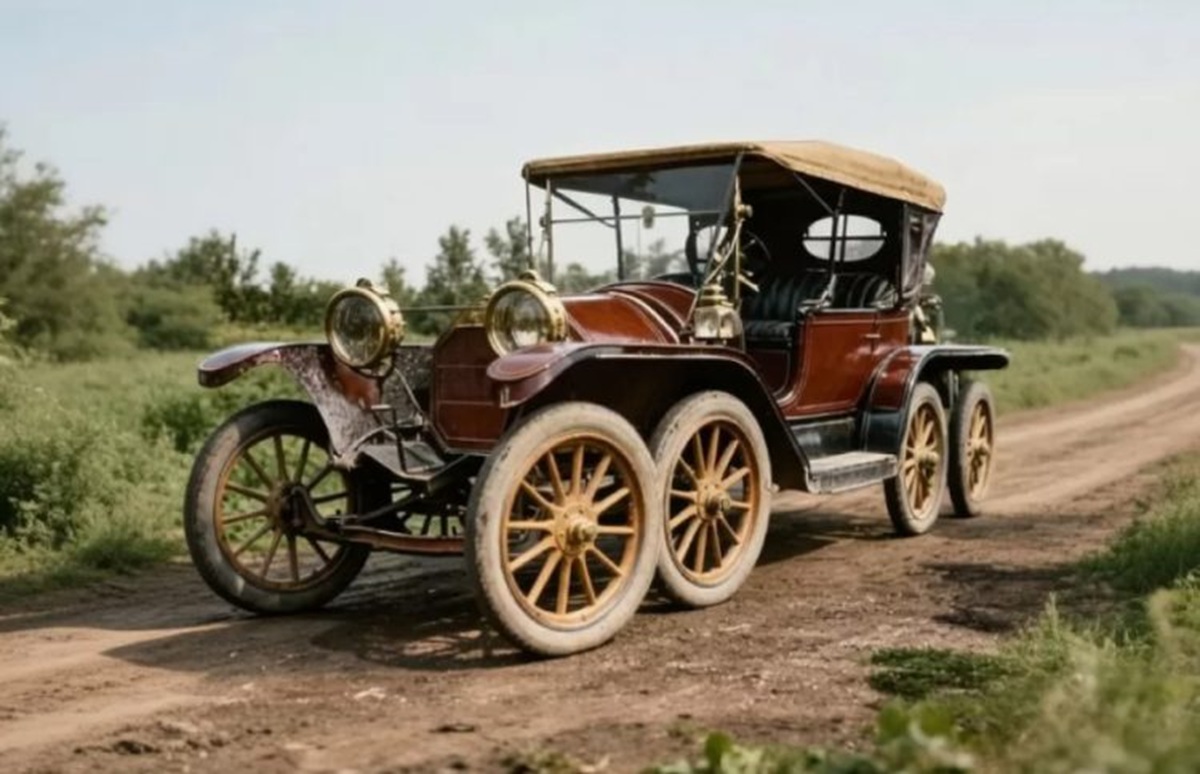
Created in 1911 by Milton Reeves, the Octoauto tried to solve one of the biggest problems of the early automobiles with an extreme solution: eight wheels, four axles, room for four occupants, and a price of $3,200, in a proposal that caught attention even at the debut of the 500 Miles of Indianapolis
In 1911, American inventor Milton O. Reeves introduced one of the most unusual automobiles ever produced in the United States: the Reeves Overland Octoauto. Created at a time when car suspensions were still limited and roads were much more uneven than today, the model emerged with an ambitious proposal: to make travel smoother and reduce tire wear through more efficient weight distribution.
A project inspired by the logic of trains
The solution imagined by Reeves was radical. Instead of following the traditional configuration of early 20th-century automobiles, he developed a vehicle with four axles and eight wheels.
The inspiration came from the logic used in trains and carriages, where load distribution helped to soften impacts during travel.
-
Uber Faces Shareholder Scrutiny as Board Accused of Ignoring Safety, Compliance, and Harassment Warnings Amid Over 3,500 U.S. Lawsuits

-
Ferrari’s First Electric Car Divides Fans, Priced at $630,000, Amid Concerns Over Limited Editions; Brand Clarifies It’s Not Just for Future Perks
-
BYD Dolphin Mini: The Electric Car That Defies Depreciation, Losing Only 3.58% in a Year and Becoming the Best-Selling Retail Model Under $22,000

-
Electric Car JAC E-JS4 Loses $19,000 in Value in One Year, Leading Record Depreciation of Used Cars in Brazil Due to Expensive Battery and New Models


In the Octoauto, the two front axles were steerable, while at the rear there were two more axles, with only the first rear axle responsible for traction.
The axle furthest back also participated in steering. Reeves believed that this arrangement could better distribute the vehicle’s weight, reduce jolts transmitted to the structure, and offer a more comfortable ride for passengers.
The promise of a smoother ride
The proposal was bold for the time and was used as the main marketing argument for the car. The Octoauto was advertised as an automobile with exceptionally smooth handling, something especially valued in an era marked by poor roads and still quite rudimentary suspension systems.
The model had four seats and stood out precisely for trying to solve one of the biggest problems of early automobiles: the lack of comfort for drivers and passengers on longer trips.
The appearance in Indianapolis and the visual impact
The Octoauto drew attention in 1911 when it appeared linked to the first edition of the 500 Miles of Indianapolis. Its unusual appearance and promise of comfort made the model a separate attraction, arousing curiosity similar to that of the racing cars displayed at the event.
However, the buzz was not enough to turn it into a commercial success. The car caused astonishment, attracted glances, and became a topic of conversation, but this did not translate into enough orders to make it viable in the market.
The high price and the driving difficulties
The vehicle cost $3,200, a high price for the time. This price placed it well above more affordable alternatives available in the American market, which limited its sales potential from the outset.
In addition to the cost, the configuration with so many axles made driving more complex and reduced the practicality of the design for everyday use. The idea of multiplying wheels to improve comfort seemed interesting on paper, but it brought mechanical and operational challenges that were hard to ignore.
The attempt with the Sextoauto
Milton Reeves even tried to adapt the idea in a six-wheeled version called Sextoauto, in an attempt to correct some of the driving difficulties and make the concept more viable. Even so, the proposal did not win over the public.
In a market that was beginning to consolidate with simpler, cheaper, and easier-to-maintain models, there was little room for such an out-of-the-box solution.
How the Octoauto entered into history
Over time, the Reeves Overland Octoauto ceased to be remembered as a commercial gamble and began to occupy a special place in automotive history as an extreme experiment.
More than an exotic car, it symbolizes a moment when inventors sought creative answers to real problems of comfort, durability, and mobility, even if the final result seemed too strange to survive in the market.





Be the first to react!