






 Portuguese
  Spanish
  6 min of reading
  0 comments


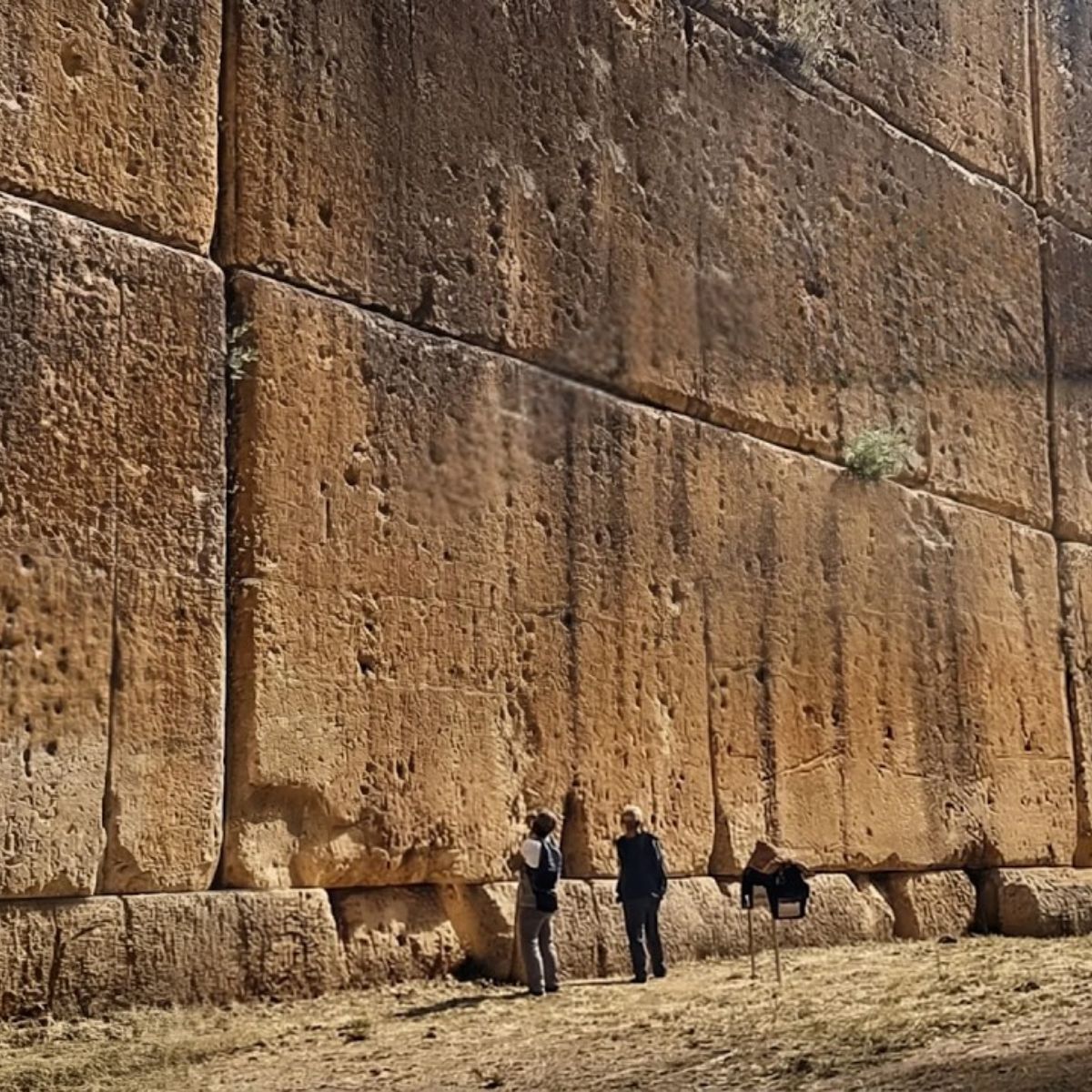
The ruins of Baalbek in Lebanon house megalithic stones known as trilithons, blocks of up to 900 tons transported from a quarry 800 meters away, raised to 9 meters and fitted with joints so precise that a sheet of paper cannot pass between them, a feat that no Roman crane could achieve.
The stones of Baalbek represent one of the most disturbing enigmas of archaeology. The megalithic complex is located in Lebanon, about 100 kilometers from Beirut, at an altitude of 914 meters above the fertile Beqaa Valley, in a site that had been occupied thousands of years before the Romans and Phoenicians arrived in the region. Under the Temple of Jupiter, one of the largest constructions in the entire Roman Empire, there is a foundation layer composed of colossal stones known as trilithons, each measuring more than 19 meters in length, 4.2 meters in height, and 3.6 meters in thickness, with an estimated weight of 900 tons. To put this scale into perspective: each block is about 36 times heavier than a Stonehenge megalith and approximately 10 times larger than the largest blocks of the Great Pyramid of Giza.
What makes these stones particularly puzzling is the absence of any documentary explanation. The Romans were known for the meticulousness with which they recorded their construction projects, but no Roman source describes how the trilithons were moved, raised, or integrated into the temple’s base. This gap becomes even more intriguing when considering that the effort required to transport, elevate, and position blocks of this magnitude had no precedent in any other construction site of the empire. The stones were extracted from a quarry located approximately 800 meters from the complex, carried uphill over uneven terrain and stacked on smaller blocks of 400 tons, all with fittings that eliminate any visible gaps between the surfaces.
Why the Romans Probably Did Not Build the Foundation of the Stones of Baalbek

The hypothesis of Roman authorship encounters serious technical obstacles. The largest documented Roman cranes had a maximum capacity of approximately 60 tons, and the standard lifting technique used Lewis holes drilled into the stones for securing metal clamps. The trilithons of Baalbek do not exhibit Lewis holes. If no known Roman engineering method can explain how 900-ton blocks were moved and positioned with millimeter precision, the question of who built the original foundation becomes inevitable.
-
He started with a jigsaw, his father’s screwdriver, and many drawings made during classes; years later, the young man who built a roller coaster in his own backyard went viral on the internet, was hired by Cacau Park, and now coordinates Brazilian and foreign professionals in the installation of an attraction weighing 737 tons, 55 meters high, one kilometer long, featuring moments of zero gravity and a speed of 120 km/h, in a journey that turned curiosity, calculations, and persistence into a professional career.

-
Between Egypt and Sudan, Bir Tawil is no man’s land that neither country wants on paper, but in practice has gold mining, nomadic tribes, and even fake “kings.”

-
Swimming champion Shavarsh Karapetyan dove about 40 times into a frozen lake in Armenia to rescue a sunken bus, saved 20 lives, and lost his career because of it.
-
Júlia Pimentel, an 11-year-old from Minas Gerais, independently invented a new formula to calculate the square root using simple addition and multiplication, and her method was published in one of the most important mathematical scientific journals in Brazil.


The complex itself displays visibly distinct construction styles. The megalithic stones at the base have a refined finish and extraordinary precision joints, while the Roman masonry above them is notably coarser and more irregular. This contrast suggests that Baalbek underwent different phases of development, and that the initial phase may belong to a culture whose technical mastery, in certain aspects, surpassed that of the Romans. The trilithons also show signs of wind erosion that do not appear in the Roman masonry above, which led researchers like Graham Hancock to suggest that the foundation may be up to 12,000 years older than the Roman construction, a hypothesis supported by archaeological evidence of continuous occupation of the site since 9,000 B.C.
The stones from the quarry that no one could move

The Baalbek quarry, located about 800 meters from the main complex, contains unfinished monoliths even larger than the trilithons. The so-called Pregnant Woman Stone measures approximately 20 meters long, 4.2 meters high, and 4.2 meters wide, with an estimated weight of 1,200 tons, and remains partially connected to the bedrock at an upward angle, as if the work had been abruptly interrupted. These stones seem to indicate that the builders planned to move blocks even larger than those they had already transported and installed.
In 2014, a team from the German Archaeological Institute, led by Jeanine Abdul Massih from the Lebanese University, discovered an even more colossal monolith beneath the Pregnant Woman Stone. The so-called Forgotten Stone weighs approximately 1,650 tons and is the largest block of rock ever extracted anywhere in the world. In a park in Switzerland, a model demonstrates how many modern cranes would be needed to lift the Pregnant Woman Stone: even with current technology, there would not be enough physical space to position all the equipment around the monolith.
The marks on the stones that challenge conventional explanation


In addition to their size, the stones of Baalbek display finishing details that intrigue researchers. Parallel scratches about 3 meters long appear on different blocks of the complex, including on the trilithons themselves, and their regularity makes it hard to believe they were produced with primitive hand tools. The marks resemble striations left by industrial equipment, and similar patterns have been identified at other megalithic sites, such as the Yangshan quarry in China, where an unfinished block of 16 thousand tons exhibits the same type of grooves.
At the edges of the megalithic blocks, researchers have documented chamfers composed of multiple facets, with a finish that approaches jewelry precision. A continuous line less than one-third of a millimeter thick runs along the joints between adjacent faces of the stones, a detail that no rudimentary tool could produce. The contact surfaces between the blocks are so tightly fitted that, in many places, it is practically impossible to identify where one stone ends and the next begins, whether vertically or horizontally.
The pink granite columns that traveled 700 kilometers to Baalbek
The megalithic stones of the foundation are not the only pre-Roman element of the site. Archaeologists have identified remains of approximately 200 pink granite columns that, unlike the Roman columns made of local limestone and assembled in stacked sections, were monolithic, each carved from a single block of granite extracted in Aswan, Egypt, over 700 kilometers away. This is the same type of granite used in the king’s chamber of the Great Pyramid of Giza.
Transporting monolithic columns from Aswan to Baalbek would require crossing the mountain ranges of Lebanon, which reach an average altitude of 2,500 meters. The finish of these columns is another element that challenges conventional explanation: granite is one of the hardest natural materials on the planet, and shaping it with the precision observed in the stones of Baalbek typically requires tools with diamond tips or equivalent materials, technology that only became widespread from the late 19th century. Even after thousands of years of exposure, the columns show no visible imperfections, and their edges remain sharply defined.
What the quarry reveals about the age of the stones of Baalbek
The amount of earth accumulated over the quarry suggests that the site may be much older than conventional archaeology recognizes. This possibility would place the extraction of the stones in a pre-flood era, tens of thousands of years in the past, which would help explain why the quarry was suddenly abandoned with monoliths still attached to the bedrock. A catastrophic event, such as an earthquake or flood, may have abruptly interrupted the work.
The local legends of Lebanon reinforce the idea of extreme antiquity. Ancient traditions claim that Baalbek is the oldest construction in the world, attributing it to Cain, the son of Adam, who supposedly built it with the help of giants. Regardless of the lens through which one views the site, the stones of Baalbek continue to challenge engineers and archaeologists. Blocks weighing up to 1,650 tons were extracted, transported uphill in Lebanon, and stacked with precision that rivals modern industrial manufacturing, constituting a set of evidence that science has yet to satisfactorily fit into any conventional explanatory model.
And you, do you think there was an advanced civilization before the Romans capable of moving stones weighing a thousand tons? Or do you believe that conventional archaeology will still find the explanation? Leave your opinion in the comments.


-

1 person reacted to this.