Portuguese
  Spanish


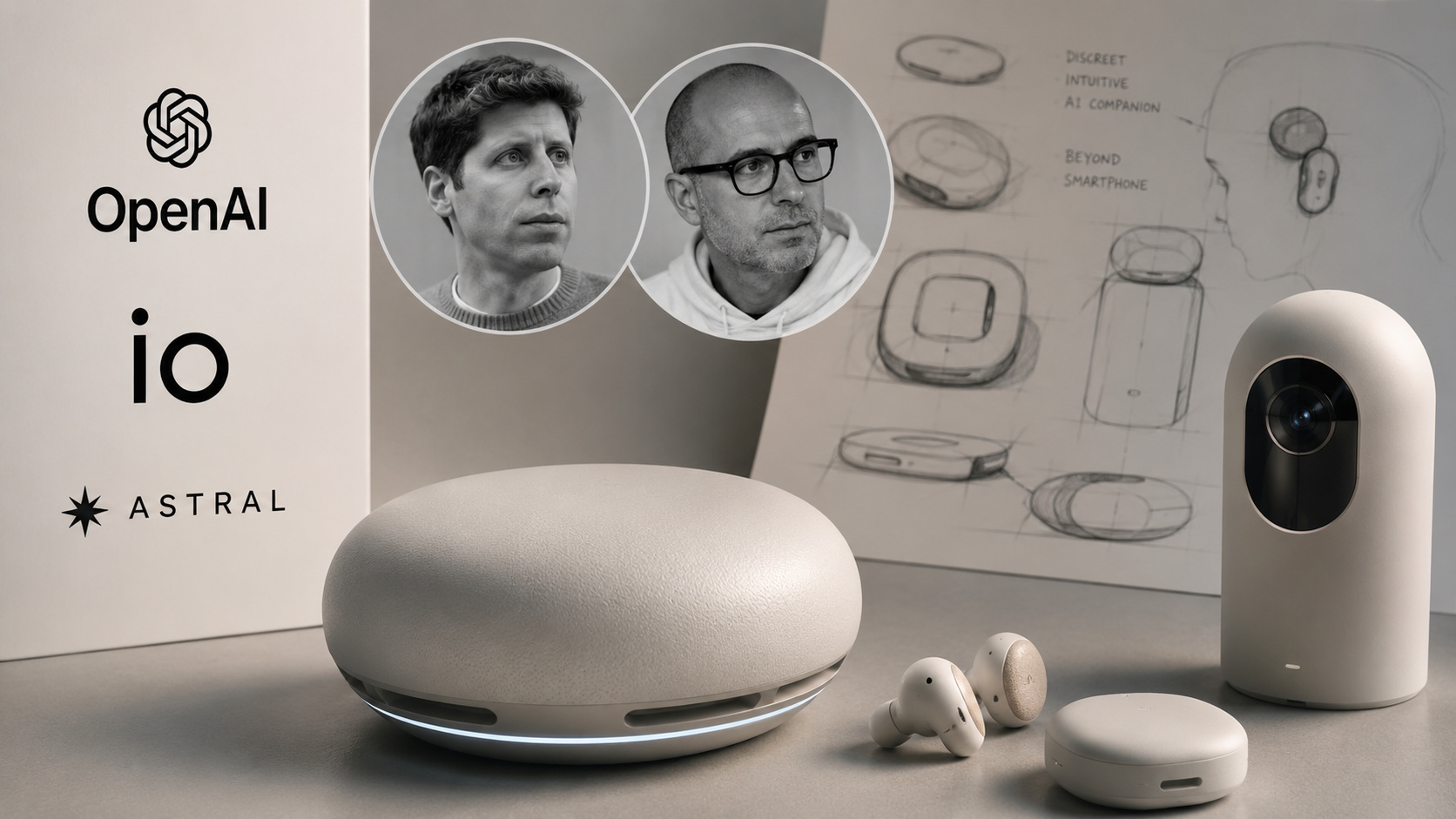

OpenAI advances in hardware with the purchase of Jony Ive’s io for $6.5 billion, acquires Astral and prepares a screenless AI device beyond the smartphone.
OpenAI has fully entered the race for artificial intelligence hardware by turning the purchase of io, a startup created by Jony Ive, into its largest publicly disclosed acquisition. In a letter signed by Sam Altman and Jony Ive, the company confirmed on May 21, 2025 that io would join OpenAI, and updated on July 9, 2025 that the startup’s team was officially integrated. The operation was treated as a decisive step to create a new family of products specifically designed for the AI era.
The movement didn’t stop there. On March 19, 2026, OpenAI officially announced the acquisition of Astral, a company known for open tools aimed at the Python ecosystem, such as uv, Ruff, and ty. The company stated that the purchase aims to accelerate the growth of Codex and deepen its presence among developers, expanding the reach of AI throughout the software development cycle.
The weight of this offensive shows that the race for artificial intelligence has already moved beyond pure software into a broader phase. OpenAI wants to dominate the model, the code ecosystem, and now also the physical device through which the user will interact with AI on a daily basis. This is the most ambitious part of the entire strategy.
-
A newly discovered caterpillar in Hawaii wears the remains of its prey that it devoured as a macabre armor, stitching bones and insect shells to its own back for camouflage.

-
She heard for decades that space was not a place for women, became a pioneer in aviation, was part of the Mercury 13, and at 82, finally traveled with Jeff Bezos before dying at 87.
-
Scientists investigate microplastics in the airways of patients with sleep apnea and reveal a new focus for research on environmental pollution, human exposure, and possible impacts on breathing quality.
-
For the first time, scientists have seen the ocean floor open up in real-time—plates moving apart by two meters in a few days and 160 million cubic meters of lava emerging on the seafloor.




Jony Ive became a central figure because OpenAI wants to do in AI hardware what the iPhone did in smartphones
The purchase of io drew attention less for the age of the startup and more for the name behind it. Jony Ive was the principal designer of products that marked Apple’s most influential phase, including iPhone, iPad, iPod, and MacBook. By bringing him closer, OpenAI not only acquired a young company but also a design and hardware core that helped shape consumer electronics over the past two decades.


According to Reuters, the acquisition of io was closed for US$ 6.5 billion in shares, and OpenAI began incorporating a team of about 55 professionals linked to the project. The agency reported that the company already had a previous stake in io and turned this relationship into a much larger bet by placing Ive in the creative leadership of the new hardware front.
The value of the move lies precisely there. Until then, OpenAI was a powerhouse of software and research. With the arrival of Ive and his team, it shortens years of industrial learning in product design, physical integration, and consumer electronics construction. Instead of assembling a team from scratch, it bought ready-made experience in an area it never truly mastered.
The new AI device from OpenAI should be small, screenless, and designed to work alongside the phone
Although the device has not yet been revealed, the information already made public points to something quite different from the industry’s dominant standard. According to a report compiled by Built In, the device should be pocket-sized, screenless and designed to complement smartphones and laptops, rather than trying to directly replace them.
The idea of a screenless product is what stands out the most. For decades, the personal computer was defined by a visual interface, whether on a notebook, tablet, watch, or phone. What OpenAI seems to want to build is a device where AI ceases to be just an app within a screen and starts to occupy a more constant, contextual, and invisible role in the user’s routine.
Reuters reported that Altman and Ive had been discussing AI hardware even before the purchase and that OpenAI’s ambition is to develop its own platform, outside the direct dependency on iOS and Android. This helps explain why the company is willing to invest so much in a product that still remains shrouded in secrecy.
OpenAI is trying to enter where Humane and Rabbit stumbled
The bet on a dedicated AI device comes after other experiments that failed to convince the market. In the coverage of the io purchase itself, Reuters recalled the mixed results of devices like the AI Pin from Humane and the products from Rabbit, which attracted attention at launch but faced difficulties justifying their place alongside the smartphone.

This history makes OpenAI’s project more risky, not less. The problem is no longer imagining AI hardware. The problem is making a device that truly works better than the cell phone already does, without becoming just another expensive and dispensable accessory.
This is exactly why Jony Ive’s entry carries so much strategic weight. The company believes that if there is someone capable of redesigning the dominant interface of a generation, it is someone with Ive’s track record.
At the same time, OpenAI enters this race with an advantage that other projects did not have: the strength of ChatGPT as an already established product. Instead of launching hardware in search of convincing software, the company tries to do the opposite, bringing to a new physical format an AI system that has already gained global scale.
The race for hardware and acquisitions gained traction with a US$ 110 billion round
The financial scale behind this strategy became even clearer on February 27, 2026, when OpenAI announced a fundraising of US$ 110 billion, in a round that valued it at US$ 840 billion, according to Reuters. The size of the operation shows that the company has begun to operate on a capital scale typical of the largest technological disputes on the planet.
With this cash, OpenAI gained the momentum to finance research, computational infrastructure, acquisitions, and above all, high-risk projects like the yet-to-be-revealed AI device. It is no longer a company just trying to keep up with the race. It is a company trying to define the next standard before the competitors.
The purchase of io, the acquisition of Astral, and the billion-dollar round form the same strategic design. OpenAI wants to control the entire chain of the next phase of AI, from the model to the code, from the developer ecosystem to the physical object that can place this technology at the center of everyday life.
OpenAI’s big bet is to create native AI hardware before the smartphone absorbs everything
At the center of it all is a simple and billion-dollar question. Will the next big technological platform be a new device, or will the smartphone absorb all relevant artificial intelligence before that? OpenAI is clearly betting on the first hypothesis.
If successful, the company could open a new product category and do with AI what the smartphone did with mobile internet: create a dominant interface, a new habit, and a new layer of technological dependency.
If it fails, the project could join the list of devices that promised to change everything but arrived late, without a clear function or real advantage over the cell phone.
For now, OpenAI has already made one thing clear. The company doesn’t just want to own the world’s most famous chatbot. It also wants to be the company that will decide what the physical format of artificial intelligence will be in the next decade.