






 Portuguese
  Spanish
  6 min of reading
  0 comments


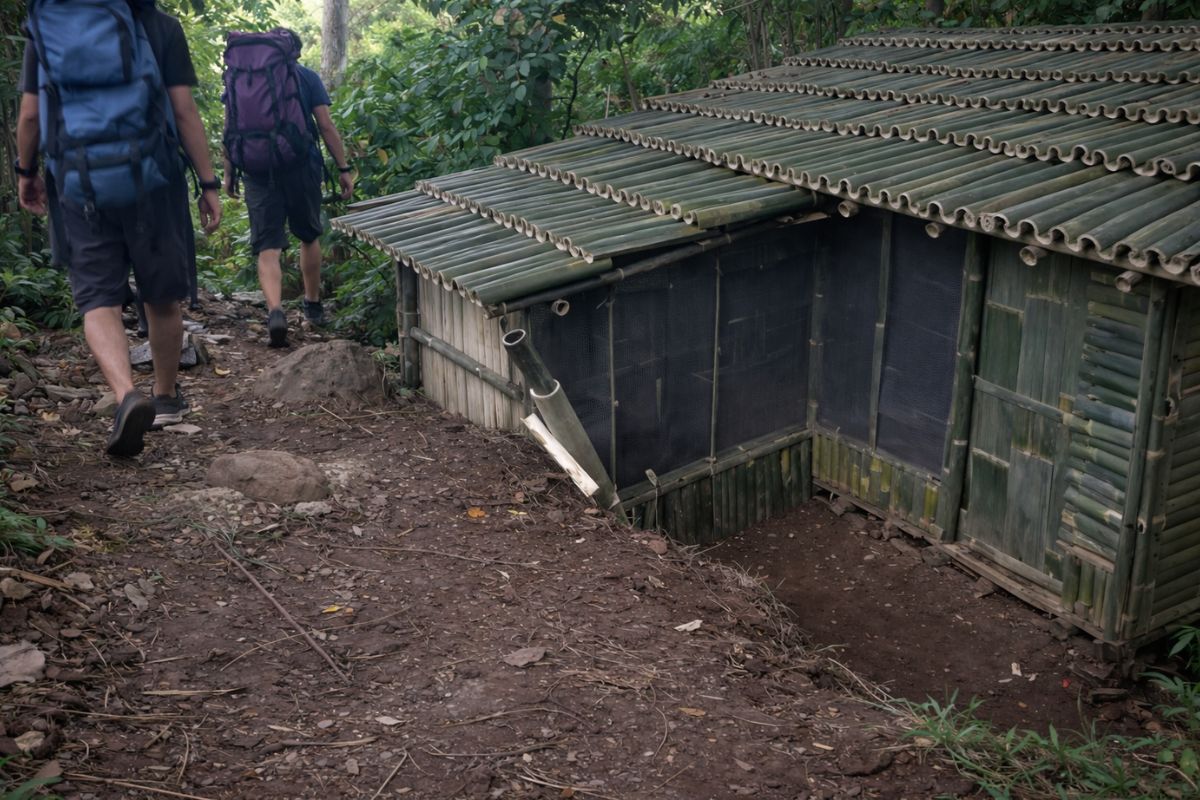
In The Dense Forest, An Off-Grid Shelter Becomes A Bamboo Hut And A Bamboo House In The Forest With Simple Bamboo Construction And Off-Grid Living Facing Heavy Rain And Strong Winds.
In a dense forest, father and son show that an off-grid shelter can be made solely of bamboo, leaves, and clay, without cement, nails, or electric power. Using simple techniques and much observation of nature, they erect raised huts, houses over the river, and two-story structures that withstand heavy rain, wind, and long periods of monsoons.
Each bamboo hut and each bamboo house in the forest they raise is a bamboo construction designed for true off-grid living, with an elevated floor, a roof that drains rainwater, and a lightweight structure that withstands strong winds and monsoons.
How An Off-Grid Shelter Is Created In The Heart Of The Forest

To raise a real off-grid shelter, everything begins well before the first stake is driven into the ground. Father and son walk through the forest carefully choosing the bamboo they will use, paying attention to the thickness, flexibility, and the growth point of each clump.
-
Bolivian Female Construction Workers Form Association to Combat Discrimination and 38% Pay Gap in the Industry

-
Near Amsterdam, residents buy land and discover they must also build streets, manage drainage, handle waste, and grow food on half their plot.
-
Brazil’s WEG to Open New Factory in China by 2027, Expanding Production of Large Rotating Electric Machines and Low to Medium Voltage Motors in Rugao

-
Chinese Shipyard Secures $1 Billion in Orders for Low-Carbon Container Ships Amid Global Fleet Renewal Efforts


Nothing is cut randomly: they look for material strong enough to withstand weight, wind, and rain, but also lightweight enough to be transported by hand.
Under constant rain and a cloudy sky, they cut each stalk with simple machetes, form bundles, and carry everything to the chosen location. There, they avoid waterlogged soil and flood-prone areas.
Instead of building directly on the ground, they assemble elevated platforms, supported by well-driven trunks and stems, which helps avoid moisture, crawling insects, and nocturnal animals.
The father guides the son to test the firmness of each support by stepping, shaking, and correcting whatever is necessary before moving on.
The Logic Of An Off-Grid Shelter: Bindings, Floor, And Waterproof “Skin”
In the first hut, the design is simple but filled with smart structural decisions. The main frame is made in triangles, a naturally stable shape, and the structure is anchored to nearby trees, using the forest itself as part of the off-grid shelter.
Instead of nails and screws, they use fibers from the bamboo itself, strong strips that are woven around the joints.
These bindings make the structure more flexible, able to sway with the wind without cracking. The floor is woven with crossed bamboo poles, forming a raised and ventilated surface, which dries quickly after rain and reduces direct contact with moisture.
On the sides, overlapping layers of leaves form a kind of waterproof “skin.” When placed in order and in the right direction, the leaves help divert rainwater away from the hut.
Inside, the off-grid shelter has enough space to lie down, store simple tools, and set up a small stove, always with planned openings in the ceiling and sides for smoke to escape without filling the interior.
Every detail, from the fitting of the poles to the direction of the leaves, was designed to ensure that the shelter withstands strong winds and heavy rain while remaining a habitable place.
Off-Grid Shelter Over The River: Natural Cooling And Rainwater
In another project, father and son take the concept of off-grid shelter even further: they build a small house directly over the river.
The base receives extra reinforcements, with bamboo at crossed angles, to support the weight of the structure and the constant movement of the water.
The column of humid air under the floor helps cool the environment, creating a more pleasant thermal sensation even on stuffy days.
The walls are woven with strips of bamboo and receive a layer of clay taken from the forest itself, sealing gaps and improving insulation.
The sleeping area is always elevated, protected from splashes, moisture, and cold. The roof is designed to catch and direct rainwater into simple containers, ensuring a water reserve without relying on any external infrastructure.
The cross ventilation, planned with openings on opposite sides, reduces humidity and keeps the interior breathable even with the river just below.
The result is a functional off-grid shelter that uses the environment to its advantage: the river cools, feeds, and protects, while the hut, light and flexible, adapts to weather conditions.
Two-Story Huts: When The Off-Grid Shelter Becomes A Tree House
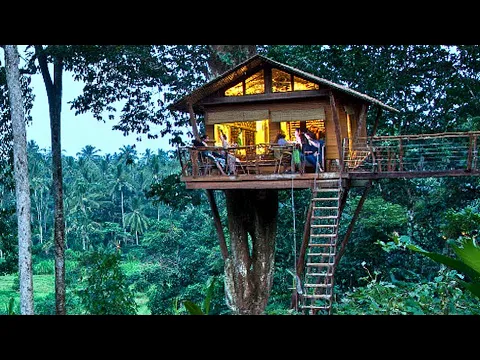

When the duo ventures into larger projects, two-story huts emerge connecting trees through bamboo bridges.
The off-grid shelter ceases to be just an emergency refuge and begins to resemble a small forest house, with well-defined functions between the levels.
On the lower level, the kitchen is usually located, away from the sleeping area to reduce risks of fire and smoke. The stove is built on a firm base, with space for firewood and food preparation.
On the upper level, the focus is on rest and protection, with a more closed floor and denser walls. Bamboo guardrails surround the edges, increasing safety for climbing, descending, and moving around at night.
Each part of the off-grid shelter takes on a specific function: cooking below, sleeping above, storing tools in dry and airy spots, making daily life in the forest easier.
The combination of bamboo, leaves, and clay, repeated with variations, creates a unique construction language, where everything is reusable and can be adjusted according to the terrain and needs.
Roof That Drains Rain And Structure That Withstands Monsoons
In all projects, the roof is a separate chapter. For an off-grid shelter to survive days of continuous monsoons and strong winds, it’s not enough to cover: it must drain.
The leaves are organized in layers, always with the ends pointing down, and the bamboo forms a structure that directs the flow of water outside the hut.
This ensures that the rain flows quickly, without infiltrating the interior. When the roof works, the off-grid shelter can keep the interior dry even with soaking wet ground and the forest soaking along with it, which is essential to preserve food, clothes, and tools.
At the base, the fact that the huts are elevated reduces the pressure of water from the ground, prevents constant mud, and gives the floor a better chance to dry between storms.
The combination of height, flexible bindings, and well-constructed roofs creates a structure that does not fight against nature but moves with it. The wind sways, the rain beats, the river rises, and the hut responds with lightness, rather than trying to face everything with rigidity.
What These Off-Grid Shelters Reveal About Living In Nature
After several projects, the shelters that father and son build cease to be simple video examples and become real refuges, tested in strong winds, waterlogged soil, and weeks of rain.
The fact that they remain standing and usable after so many trials shows that the forest is not just a backdrop: it is a construction partner.
These off-grid shelters reveal three important things. First, it is possible to create protection and comfort with local resources, without relying on industrial materials.
Second, bushcraft techniques and traditional knowledge gain another dimension when passed from father to son in daily life, in each knot and each bamboo cut.
Third, a more self-sufficient life does not need to be synonymous with confrontation with nature, but with tuning into the rhythm of the forest.
In the end, the off-grid shelter is less of a hut and more an exercise in observation: learning to see a home where once it seemed just weeds.
And you, would you dare to spend a few days in an off-grid shelter like this, made only of bamboo, leaves, and clay in the middle of the forest, or do you still prefer the comfort of the city?





-

-

-

-

-

40 people reacted to this.