






 Portuguese
  Spanish
  6 min of reading
  293 comments


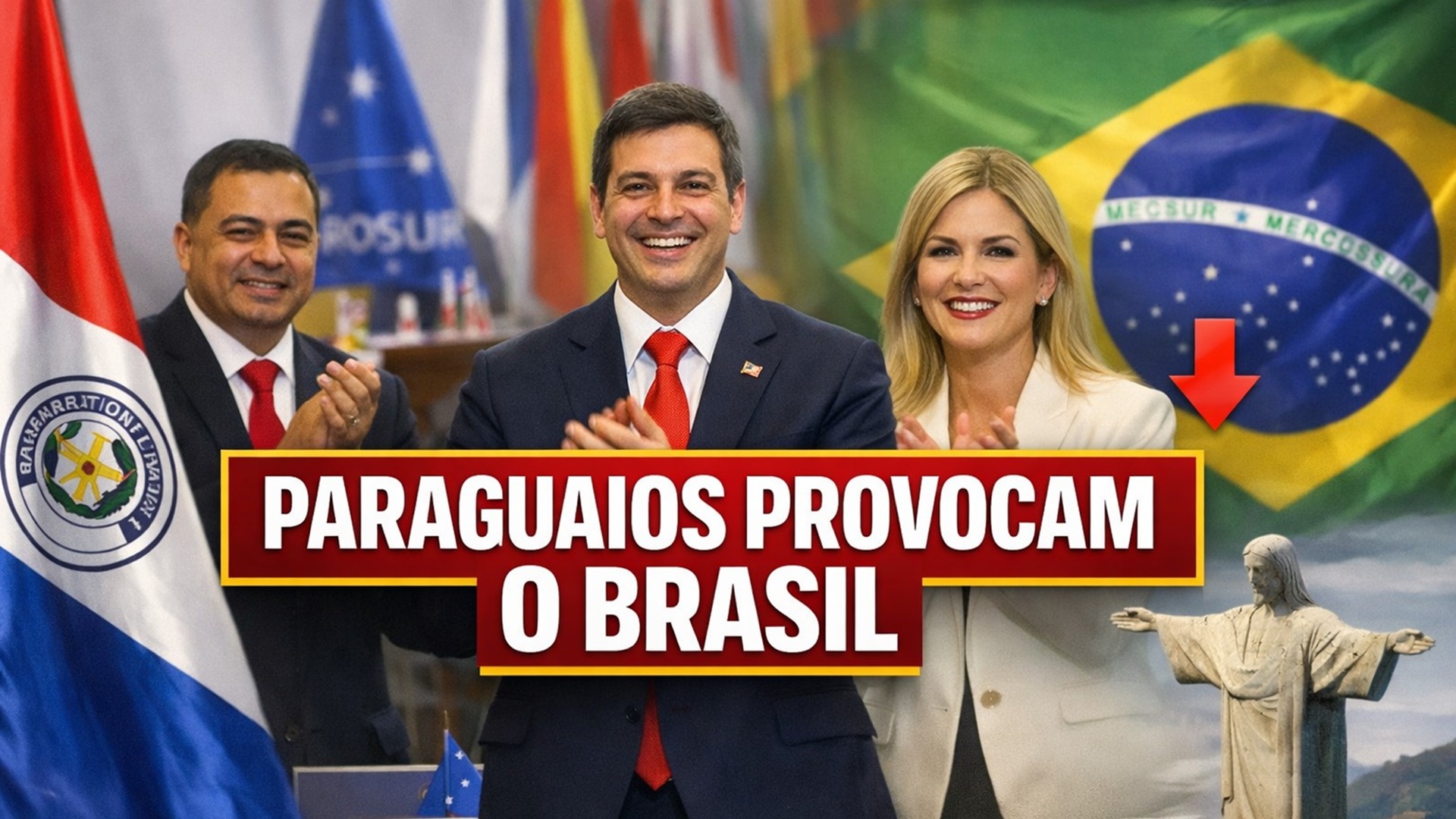


The Repercussion On Paraguayan Social Media Gained Strength After Asuncion Hosted The Signing Of The Largest Commercial Agreement Ever Signed By Mercosur, Reigniting Symbolic Disputes, Economic Comparisons, And Ironies Directed At Brazil Amid The New Political And Commercial Balance Of The South American Block
The signing of the commercial agreement between Mercosur and the European Union, held on Saturday, 17, in Asuncion, triggered a wave of reactions on social media, especially in Paraguay, where users began to provoke Brazil and interpret the episode as a gesture of regional prominence.
The formal context of the act is known. The choice of location followed the institutional criterion of the block: Paraguay currently holds the rotating presidency of Mercosur, a position passed in a semiannual rotation among member states, following alphabetical order.
Brazil held the position until the end of last year, when the presidency passed to Asuncion, and Uruguay will be the next country to take on.
-
Central Bank changes rule that lasted decades and allows dollar and euro accounts in Brazil for exporters and companies with foreign capital, eliminating the need for currency exchange in some transfers starting in October 2026.

-
The Central Bank ends the R$ 500 limit on Pix by approximation, and account holders will be able to use the general Pix limit to pay any amount by tapping their phone on the terminal starting in October 2026.
-
A collective political will that allows for the creation of a cross-party and state agenda, focusing on concrete actions such as reducing the Custo Brasil; commitment to fiscal balance; feasible goals that enhance professional qualification and the adoption of a myriad of incentives aimed at innovation.

-
PIX from BRICS becomes reality: BRICS Pay advances to enable international payments without the dollar; system inspired by Pix and based on blockchain could move up to 20% of global trade by 2030, while bloc countries already account for 40% of the world economy.



Even so, the combination of the historical symbolism of the city, the absence of the Brazilian president, and the intense circulation of comments on digital platforms broadened the political reach of the episode beyond the diplomatic protocol.

Asuncion, Rotating Presidency And The Symbolic Weight Of History
The ceremony held in Asuncion was, from an institutional perspective, an expected procedure. Experts consulted by CNN highlighted that the location was not the result of an isolated strategic decision but a direct consequence of Paraguay’s pro tempore presidency in Mercosur.
The founding countries of the block – Argentina, Brazil, Paraguay, and Uruguay – have rotated the leadership every six months since the creation of the mechanism. This system defines not only political coordination but also the location of meetings and formal acts of greater relevance.
However, there is a historical element frequently cited in the debate. Asuncion was also the city where, in March 1992, the member countries signed the treaty that gave rise to Mercosur.
Analysts point out that this temporal and geographical coincidence symbolically reinforced the perception of Paraguay’s centrality at the current moment, even if it did not influence the official decision.
Lula’s Absence And The Political Reading On Social Media

Ricardo Stuckert/PR
The main source of tension identified in the digital reactions was the absence of Brazilian President Luiz Inacio Lula da Silva at the ceremony in Asuncion. Instead of attending the event, Lula maintained an agenda in Rio de Janeiro, where he met with the President of the European Commission, Ursula von der Leyen, in a separate meeting.
On Paraguayan social media, especially on X, this decision was interpreted in various ways, but most viewed the Brazilian president’s absence as disrespectful.
Users claimed that Brazil had shown discomfort with the fact that the signing occurred under Paraguay’s presidency of Mercosur, attributing the presidential absence to a gesture of disdain or regional rivalry.
Some posts suggested that the Brazilian government would have preferred the agreement to be formalized during Lula’s presidency of the block, a reading that began to circulate as a recurring narrative among political and nationalist profiles.
“This was a disrespect to Paraguay. They wanted the agreement signed during Lula’s temporary presidency, and now they show discomfort because the signing occurred under our leadership,” highlighted another comment on X.
Discourses Of National Assertion And Historical Memories
A significant portion of the analyzed comments resurrected sensitive historical episodes in the relationship between Brazil and Paraguay, especially the War of the Triple Alliance.
Although the 19th-century conflict has no direct relation to the contemporary commercial agreement, it was evoked in messages reinforcing the idea of historical overcoming and Paraguay’s sovereign assertion in the regional scenario.
In some texts, users claimed that the country had ceased to occupy a secondary role in South America and had begun to exercise diplomatic prominence.
Others associated the signing of the agreement with a kind of symbolic reparation, highlighting Paraguay’s leadership at the moment as a source of national pride.
This type of discourse, while limited to the digital environment, contributed to expanding the emotional reach of the event, shifting the focus from the technical content of the agreement to identity and political interpretations.
“We know it bothers them that Paraguay is taking on a leadership role and being a global power. They harmed us in the War of the Triple Alliance, but they could never destroy this country. History has a debt with Paraguay, and it will be paid sooner or later,” said a user.
The Paraguayan Reading Of The Brazilian Gesture
Among the most shared comments, Lula’s decision to meet with Ursula von der Leyen in Rio de Janeiro, on the eve of the official signing in Asuncion, was described as a “diplomatic affront.”
Users claimed that the gesture indicated an attempt to centralize Brazilian prominence at a moment that, formally, belonged to Paraguay.
This perception was reinforced by the contrast between the agendas. While Asuncion hosted presidents and representatives from Mercosur countries, along with European authorities, Brazil was promoting a parallel high-level meeting, without the participation of the other heads of state from the block.
From a diplomatic standpoint, specialists emphasize that parallel bilateral meetings are not uncommon in multilateral negotiations. However, the chosen moment was politically interpreted on social media, fueling readings of exclusion or competition.
The Institutional Reaction Of The Paraguayan Government
At the official level, the tone was distinct from what was observed on social media. The President of Paraguay, Santiago Pena, publicly commented on Lula’s absence in an ironic manner, stating that the Brazilian leader was likely watching the signing of the agreement on television.
The statement was seen as a calculated diplomatic message, maintaining institutional formality while evidencing discomfort with Brazil’s non-participation in the central event of Paraguay’s presidency in Mercosur.
Despite this, there were no records of formal protests or official questioning from the Paraguayan government regarding Brazil’s conduct, indicating that the controversy remained, for now, concentrated in the symbolic and communicational sphere.
The Mercosur–European Union Agreement Beyond The Controversy
As discussions intensified on social media, the content of the agreement itself became secondary in the immediate public debate. The treaty is the result of more than two decades of negotiations and involves sensitive topics such as market access, tariffs, environmental rules, and regulatory commitments.
The signing represents a milestone for Mercosur, regardless of location or the presence of certain leaders. Analysts highlight that the economic and political impact of the agreement is likely to unfold over the coming years, surpassing isolated disputes of prominence.
In this sense, the episode illustrates how formal diplomatic events can gain additional layers of meaning when crossed by narrative disputes on social media.
Social Media And Diplomacy: A New Field Of Symbolic Dispute
The case illustrates the growing influence of digital platforms in shaping perceptions about foreign policy.
Comments, agenda snippets, and subjective interpretations begin to circulate rapidly, often detached from the technical criteria that guide diplomatic decisions.
For researchers in the field, this phenomenon does not replace traditional diplomacy but creates a parallel environment of symbolic pressure, where protocol gestures are reinterpreted as intentional political signals.
In the episode involving Brazil and Paraguay, the signing of the Mercosur–European Union agreement temporarily became a catalyst for identity discourses and historical rivalries, even without concrete changes in the institutional relationships between the countries.
A Short-Term Episode, Impacts Still Uncertain
In the medium and long term, the trend is that the controversy will lose strength as the implementation of the agreement progresses and new regional agendas occupy the public debate.
Still, the episode leaves a significant record of how symbols, absences, and agenda choices can be amplified in contexts of high digital polarization.
Beyond provocations and emotional readings, the event reinforces the centrality of Mercosur as a space for political and economic coordination, where institutional rules continue to determine formal decisions, even when parallel interpretations gain prominence on social media.




Acho que eles tão querendo mais uma surra de novo … Já reduzimos esse paísinho a nada no passado , não custa anexar ele nessa onda de invasão ae …
Grandes coisa depois que o ilustre Lula fez todo trabalho e articulação fica fácil só assinar, se não fosse Lula isto jamais teria acontecido vocês nunca teria assinado este papel se enxerga Paraguai.
Agora não, até que enfim. Além disso foi passado de quem mesmo? Kkkkkkk. O próximo será o Uruguai.