






 Portuguese
  Spanish
  5 min of reading
  0 comments


Discover How Paraná Achieved 1 GW in Distributed Energy in Rural Areas, Transforming Agricultural Production and Promoting Sustainability and Economy for Producers.
Recently, Paraná reached the historic mark of 1 gigawatt (GW) of energy produced in distributed generation in rural areas.
Consequently, the state has consolidated itself as one of the most advanced in Brazil in adopting renewable sources in the field.
Moreover, this amount of energy would be enough to supply a city with over a million inhabitants, highlighting the potential of the rural sector to significantly contribute to the country’s energy matrix.
-
Brazilian scientists are simultaneously advancing two research projects on clean hydrogen and driving solutions that could transform the energy matrix, enhance industrial competitiveness, and accelerate large-scale emission reduction targets.

-
Advancement in renewable energy: A R$ 150 million project launched by Petrobras and Finep aims to create state-of-the-art electrolyzers for green hydrogen, strengthening national research and preparing Brazil to compete in a billion-dollar energy market.
-
Illiterate or semi-literate grandmothers were trained to repair solar systems, open rural workshops, and light up homes that still depended on kerosene.
-
The world has bet on green hydrogen as the fuel of the future, but now faces the side effect: producing 1 kilogram requires about 9 liters of ultrapure water, and the largest projects on the planet are precisely in the driest regions of the Earth, where water is already scarce for people.





Furthermore, about 86.25% of this production comes from the Paraná Renewable Energies Program (RenovaPR), which in four years has become a reference in promoting clean energy in rural areas.
Historically, the Brazilian rural sector has faced major challenges related to accessing electricity in a sustainable manner.
Until the mid-20th century, rural areas had low electrification and relied on traditional sources, such as firewood and diesel oil.
In fact, many rural communities still struggled to transport products and maintain agro-industrial activities due to the lack of reliable electricity.
Therefore, the development of distributed energy systems in rural areas emerges as a strategic solution to reduce costs, while also increasing the energy autonomy of farmers.
This practice promotes sustainability and economically strengthens the countryside.
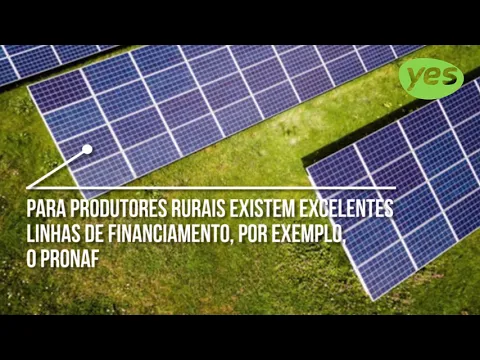
Additionally, RenovaPR plays a fundamental role, offering differentiated financial conditions through the Paraná Farmer’s Bank.
In other words, the program provides interest subsidies for renewable energy generation projects, allowing family farmers to have zero interest rates, while medium and large producers receive proportional discounts.
Typically, the amounts of the financing installments are paid with the resources saved on the energy bill, making the investment even more accessible.
Moreover, to date, the program has registered over 700 companies to develop solar energy projects and 25 specialized in biogas and biomethane.
In addition, the program offers technical support and guidance for project implementation, ensuring that the installed systems operate efficiently and safely.
Thus, producers who are less familiar with energy technologies can adopt modern solutions, increasing the uptake of distributed generation in rural areas.
Strategic Investments and Economic Impacts
Since 2021, the financing that has gone through the Paraná Farmer’s Bank totals R$ 5.8 billion, with an additional investment from the State Government of R$ 260 million for interest equalization.
Therefore, this investment demonstrates the strategic importance of the State in fostering distributed energy in rural areas, strengthening agricultural production and promoting energy autonomy for producers.
Additionally, the impact of distributed generation in rural areas goes beyond financial savings.
By controlling their own energy, producers reduce dependence on utilities and minimize the effects of price fluctuations in the traditional market.
In fact, the coordinator of RenovaPR, Herlon Goelzer de Almeida, highlights that 11.8% of rural units in Paraná already produce their own energy, representing almost 18% of the installed capacity in the sector.
Thus, producers save between 85% and 95% on their electricity bills, reducing production costs and increasing the competitiveness of Paraná agriculture.
Additionally, the saved resources can be reinvested in productive improvements, equipment acquisition, or property expansion.
Consequently, this reinvestment strengthens the rural production chain, generates jobs, and stimulates local economic development.
Therefore, the implementation of distributed energy in rural areas creates a virtuous cycle of investment, savings, and sustainability.
Furthermore, the trajectory of distributed energy in Paraná shows that technological innovation and government support go hand in hand.
In the past, the lack of incentives and resources prevented small and medium farmers from adopting sustainable solutions.
However, with programs like RenovaPR, the scenario has changed, offering financing, technical assistance, and support from specialized companies.
Today, a significant transformation in the countryside can be observed, where clean energy generation has become a strategic asset.
This allows producers to redirect resources for improvements in production and rural infrastructure.
Social and Environmental Benefits of Distributed Energy in Rural Areas
Moreover, distributed generation directly influences the social development of rural communities.
With access to clean and autonomous energy, schools, health posts, and small industries operate more efficiently.
This improves the quality of life and strengthens the local economy.
Furthermore, energy production in the countryside reduces environmental impacts, promoting sustainability and aligning agricultural production with responsible practices.
Another relevant point is the impact of the program on the animal protein sector.
Almeida emphasizes that the self-generated energy facilitates the production of animal-based food in Paraná.
This ensures that the energy cost does not compromise the competitiveness of producers.
In other words, distributed energy in rural areas involves not only technology but also strategy for the entire production chain.
Additionally, the success of Paraná serves as an example for other regions in Brazil and the world.
The combination of effective public policies, financial incentives, and technical support demonstrates that implementing clean energy systems in rural areas is feasible and efficient.
Thus, the experience of RenovaPR proves that sustainability and agricultural productivity can walk hand in hand, making the Paraná model a benchmark for future renewable energy projects.
Energy Diversification and Resilience
Moreover, the diversification of energy sources, such as the integration of solar and biogas systems, strengthens the energy resilience of the rural sector.
Consequently, generating energy locally reduces vulnerability to energy crises or market fluctuations.
This ensures greater stability for producers and the production chain.
This long-term vision establishes distributed energy in rural areas as a pillar of sustainable and competitive development.
In addition, the expansion of clean technologies in the countryside promotes the adoption of innovative agricultural practices.
For example, digital monitoring of energy consumption and the use of energy for smart irrigation increase productivity.
These advancements position Paraná as a national reference in sustainable rural innovation, reinforcing the value of distributed generation in the economic and environmental transformation of the state.
In summary, the mark of 1 gigawatt achieved by Paraná in distributed generation in rural areas represents more than just a number.
It symbolizes a historic change in how energy is produced and used in the countryside.
Furthermore, it reinforces the importance of sustainability, energy autonomy, and government support.
With appropriate public policies, accessible financing, and available technology, producers transform the countryside into a space of innovation and efficiency.
This significantly contributes to the national energy matrix and the economic and social development of the state.
Moreover, the future of distributed energy in rural areas in Paraná indicates continuous expansion.
More producers are adopting renewable solutions, and more regions are benefiting from technological advancements.
Therefore, the success of RenovaPR shows that strategic investments in clean energy generate lasting impacts, influencing not only the agricultural sector but the whole society.
They promote a model of sustainable and resilient development that other regions can replicate.








Be the first to react!