






 Portuguese
  Spanish


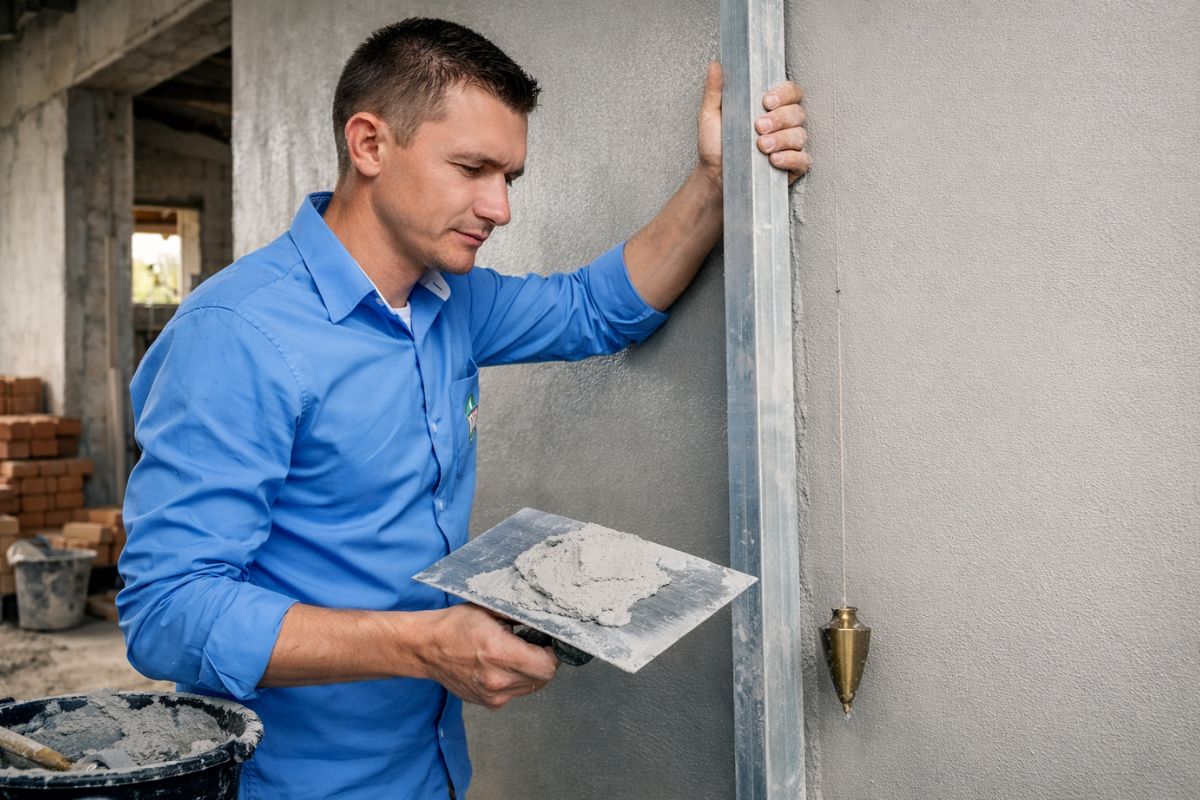


Mason Presents New Method To Speed Up Plastering: Creates The Master With The Same Thickness, Checks The Plumb, Crosses The 3-Meter Ruler Between Guides, And Claims To Finish The Wall In Three Hours, Seamlessly, With Corners And Window Squared Still With The Wet Mix
The new method appears as a simple yet risky promise to believe without context: plastering in three hours with no seams. Those who watch see a direct sequence, with the master mounted on the 3-meter ruler and the mix being beaten to plumb to maintain thickness.
The scene is a real construction site, with window, corners, and finishing done at the same time the wall is being filled. The tension point is clear: speed and quality rarely go hand in hand, and that’s what makes the new method so talked about.
The Promise of the New Method and What Can Be Checked in Practice

The starting point is the phrase that guides everything: plastering a house in three hours.
-
Neymar’s 14-year-old son, Davi Lucca, launches 3D dinosaur brand “Amigo Dino,” gaining attention on social media for his entrepreneurial spirit.

-
Improper Outlets Can Cause Fires and Damage Devices: How to Identify the Correct 10A or 20A Model for Each Appliance
-
Entrepreneur Who Started at 13 Delivering Flyers by Bike in São Paulo Now Runs a 4,000 m² Culinary Complex in Brazil

-
In China, Workers Use VR Goggles and Body Sensors to Train Humanoid Robots for Tasks Like Folding Clothes and Stocking Stores



The new method presents itself as a shortcut to eliminate the seam, that mark that usually appears when plastering is done in parts or when the wall surface dries at different times.
What can be verified is the control procedure: the master is created quickly, the 3-meter ruler is used to cross from one master to another, and the plumb is constantly checked to avoid “running” the thickness.
The promise of three hours becomes less magical when it’s understood that the trick lies in preparing stable guides before spreading the plaster.
Master on the 3-Meter Ruler and the Obsession with the Same Thickness

The technical center of the new method is the master.
Instead of starting by spreading the mix and correcting later, he hits the mix to plumb, lifts a first master, and repeats the process to create another reference.
The logic is straightforward: with two firm masters, the plaster becomes filling between the rails.
The 3-meter ruler acts as a verification tool and as a tolerance limit.
By crossing the 3-meter ruler between the masters, he tries to prove that everything is straight and on the same plane, reducing the chance of undulations and “bellies” in the wall.
When the master is correct, the rest of the plaster tends to follow.
Seamless Plaster: Why the Mark Appears and How He Tries to Avoid It

The seam in plaster usually arises when there is a break, a difference in humidity, or a restart of the mix at a different time.
The new method tries to eliminate this source with an operational decision: fill the wall “at once,” maintaining the same thickness guided by the masters.
It’s this continuous rhythm that sustains the final image of a smooth, seamless wall: fewer pauses, fewer cuts, fewer patches.
Still, the phrase “with no seams” depends on the detail that the procedure suggests all the time: mix with consistent behavior from start to finish.
If the mix changes, the plaster reveals it.
Squaring, Corners, and the Risk of Staining When Left for Later
After filling the surface, he moves to the corners and the squaring, insisting on doing this while the wall is still wet.
The reasoning is practical: if the squaring is left for later, the edge can mark and create shadow, and the stain appears even with the plaster in plumb.
The window becomes a showcase for the new method: he claims to leave a protrusion to “set back” and start drying, and then cleans and squares in sequence.
The corner finishing is where many jobs reveal fatigue, and that’s why he reinforces plumb, thickness, and the promise of a mark-free wall.
What the New Method Does Not Resolve Alone: Preparation, Team, and Expectation


Even with a well-made master, plastering in three hours is not a universal standard.
The actual time varies with the area size, number of people available, mix formulation, and how ready the base is to receive the plaster.
The preparatory work also doesn’t show up: cleaning the substrate, fixing loose spots, moistening, prior alignment, and logistics of materials.
This does not invalidate the new method, but it sets a limit that often disappears when the focus shifts solely to “three hours.”
The risk is to turn a control technique into an absolute promise of three hours for any house.
The new method draws attention because it ties three desires into one package: fast plastering, seamless plastering, and stain-free plastering.
The master made on the 3-meter ruler and checked for plumb helps to understand why the result can remain clean, but the promise of three hours remains dependent on preparation, rhythm, and execution.
If you have ever plastered, what usually trips you up: keeping the master plumb, achieving the same thickness, or avoiding seams and stains when needing to stop in the middle of the job? And if someone told you “three hours,” would you believe it or ask to see the 3-meter ruler on the wall?


