






 Portuguese
  Spanish
  3 min of reading
  0 comments


Inspired by Gliders, New South Korean Drone Uses Retractable Wings and Artificial Intelligence for Quick Maneuvers with More Precision and Safety.
Drones, also known as unmanned aerial vehicles, have become essential tools in various fields. They are present in film production, agriculture, security, construction, logistics, and even defense.
With this versatility, researchers continue to seek ways to make them even more efficient.
A team from South Korea has just introduced a novelty in this field: a drone with foldable wings inspired by the glider squirrel.
-
While scientists test giant balls on the seabed, a startup wants to sink concrete and steel tanks held by cages filled with stones up to 700 meters deep to transform compressed air into an invisible underwater battery.

-
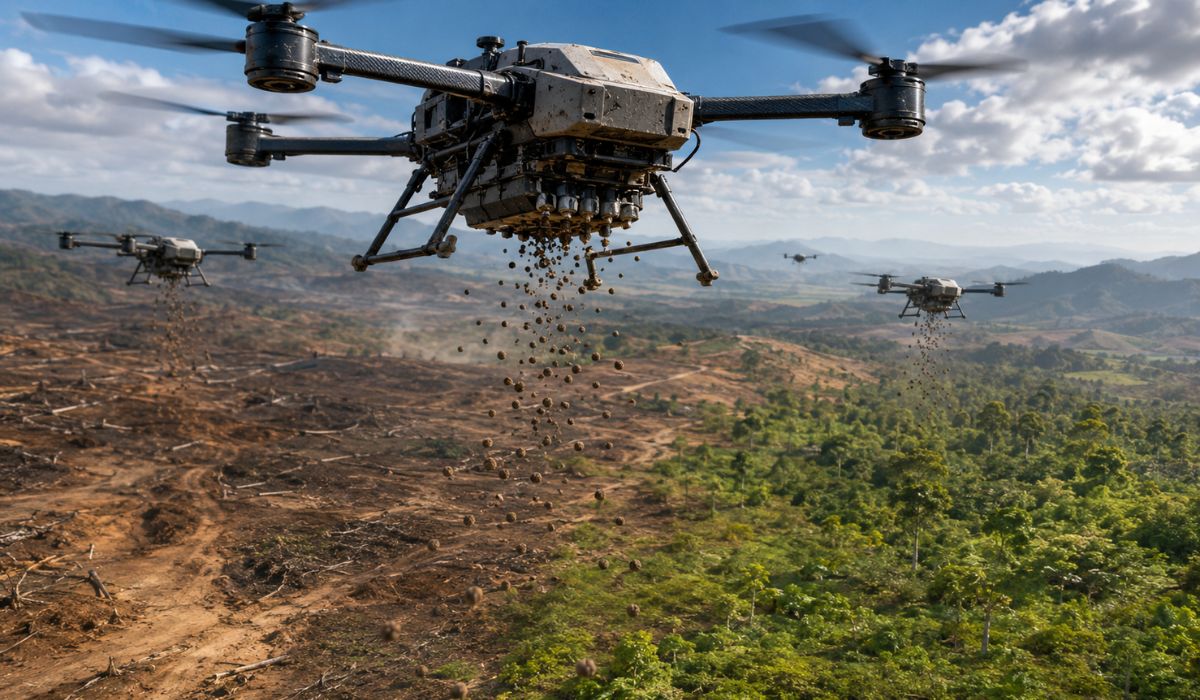
Former NASA engineer transforms drones into “seed helicopters” capable of firing 300 balls per minute, targeting degraded areas with half-meter precision, and planting up to 40 million trees per year in a new race for aerial reforestation.

-
Brazil deploys drones to scatter seeds on nearly inaccessible slopes and attempts to transform degraded hills into forests with aerial planting up to 100 times faster, in a green offensive launched in Rio de Janeiro.
-
Second half of June brings more intense cold, polar air mass, and above-average rainfall in Brazil




Inspiration from Nature
The research is led by engineers from the Pohang University of Science and Technology and the AI Autonomy Technology Center of the Defense Development Agency (ADD).
The model they developed has retractable wings that open and close as needed during flight, mimicking the ability of glider squirrels to glide from tree to tree.
According to researchers Dohyeon Lee, Jun-Gill Kang, and Soohee Han, the goal was to allow the drone to slow down efficiently, just as squirrels do by opening their wings moments before landing.
The idea arose from observing how these animals use the aerodynamic drag of their bodies to control their landing.
Superior Performance in Maneuvers
The team’s new paper, published on the arXiv preprint server, follows up on previous work that already presented the squirrel-inspired robot.
In the latest version, engineers included deployable wing membranes. This modification provided better performance in demanding maneuvers, such as tight turns and quick stops.
In conventional straight flights, the aerodynamic drag of the wings can be detrimental to performance. However, when the drone needs to react quickly to avoid obstacles, that same drag turns into an advantage.
The force generated by opening the wings helps the drone to slow down or change direction efficiently.
Smart Control with Neural Networks
To improve movement precision, researchers trained artificial neural networks. They were taught to predict the drag caused by the silicone wings.
Based on this data, scientists developed a Thrust-Wing Coordination Control (TWCC) strategy, which adjusts both the wings and the motors in real-time.
The TWCC system allows the drone to decide when to open or close the wings, depending on the environment. This ensures greater safety during flights in obstacle-rich locations, as well as improving performance in unexpected situations.
Another important point was to maintain the traditional shape of a quadcopter, even with the foldable wings.
Lightweight and Efficient Hardware
One of the most notable advantages of the project is the use of an integrated MCU chip.
This eliminates the need for external computing systems. This is only possible because the algorithm that controls the drone is lightweight and consumes little energy.
Even simple microcontrollers, like those in the Arduino class, are sufficient to run the system.
With this type of technology, the drone becomes more accessible and portable.
It can operate autonomously in remote locations, without relying on extra equipment. This feature broadens its possibilities for use in different sectors.
Future Application Possibilities
The glider squirrel drone is still under development, but tests indicate great potential.
According to researchers, it could be used for environmental monitoring, aerial filming, search and rescue missions, and even defense activities.
The team is also exploring new improvements.
Among them is the creation of a special landing gear that would allow the drone to land on vertical surfaces, such as trees and walls. This maneuver would simulate even more faithfully the landing behavior of glider squirrels in nature.
Another focus is on real-time movement planning of the drone.
As aerodynamic characteristics change during flight, researchers aim to enhance controls so that the device responds even more efficiently to different situations.







Be the first to react!