






 Portuguese
  Spanish
  5 min of reading
  0 comments


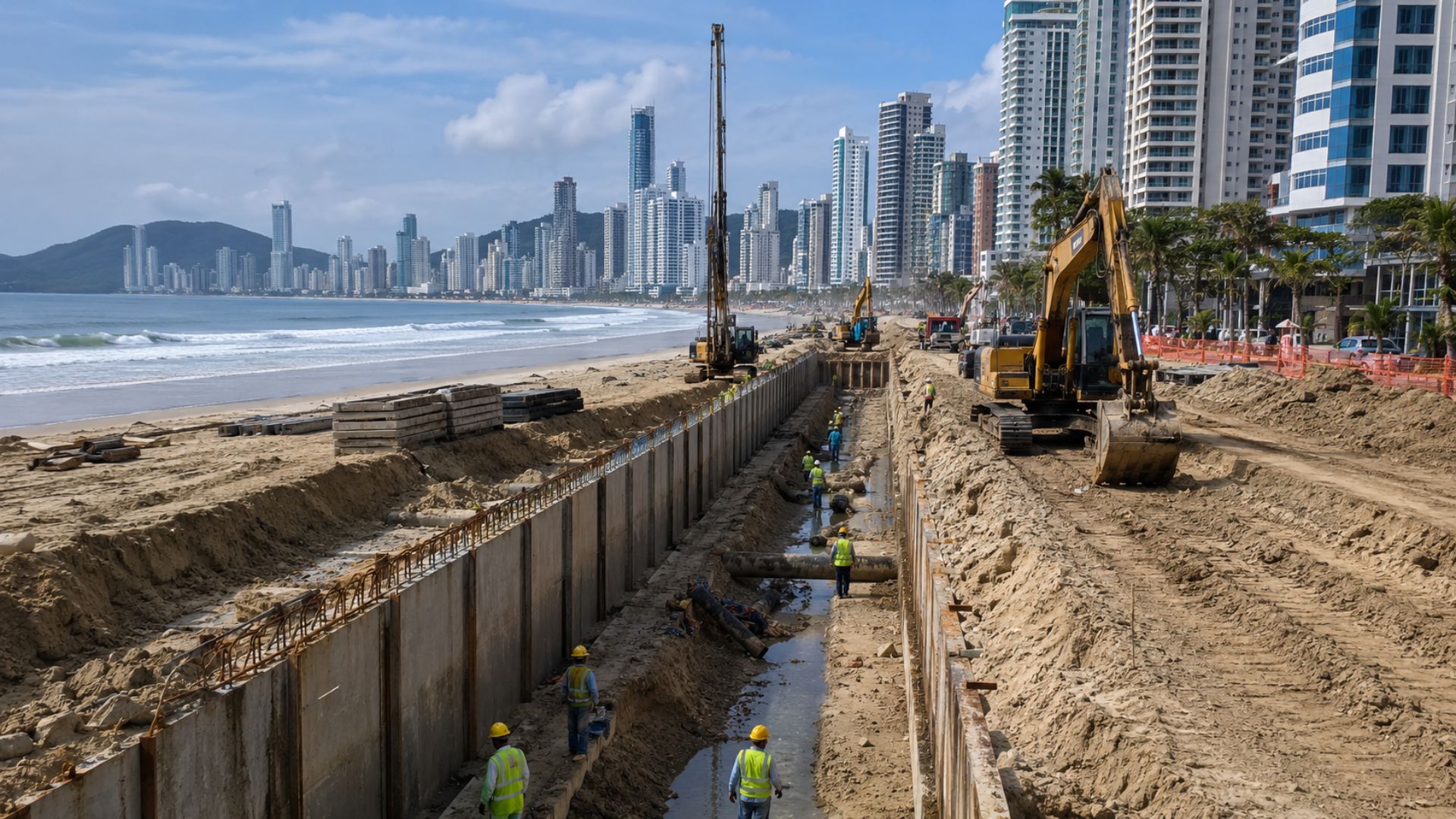
According to NSC, the underground coastal protection wall in Balneário Camboriú has surpassed 50% completion in the Barra Sul region, while the reurbanization of Praia Central’s waterfront is progressing faster than expected with several simultaneous fronts that include landscaping, a new boardwalk, and commercial structures in the city with the most expensive square meter in Brazil.
The underground wall that will protect Praia Central’s sand strip against marine erosion has already surpassed the 50% completion mark in the Barra Sul region, in Balneário Camboriú. Work has reached the vicinity of the Barra Sul Pier, where hoardings were installed last Friday (8) for the start of a new phase of the intervention. The structure is part of a larger waterfront reurbanization project that has already exceeded 20% of the total foreseen in the contract and which, according to the city hall, is progressing faster than the original schedule anticipated.
While the underground wall takes shape beneath the sand, the surface of Avenida Atlântica is also transforming. Teams are simultaneously working on landscaping, tree planting, preparing the base for the new boardwalk, and implementing structures for commercial points along the waterfront. The project includes a complete transformation of Praia Central, featuring a linear garden, a running track, micromobility spaces, 61 kiosks, and areas dedicated to sports, leisure, and coexistence. For the city that boasts the most expensive square meter in Brazil, the work represents the largest urban intervention in recent decades.
What is the underground wall and what is it for

The underground coastal protection wall is a containment structure installed below the sand level with the function of preventing the sea from advancing over the beach strip and damaging public equipment on the waterfront. In Balneário Camboriú, this protection is especially critical because Praia Central’s sand strip was artificially widened in 2021, when millions of cubic meters of sediment were dredged from the seabed and deposited on the coast. Without the underground wall, this sand would be exposed to the action of waves and currents, with the risk of being returned to the sea in a few years.
-
Bolivian Female Construction Workers Form Association to Combat Discrimination and 38% Pay Gap in the Industry

-
Near Amsterdam, residents buy land and discover they must also build streets, manage drainage, handle waste, and grow food on half their plot.
-
Brazil’s WEG to Open New Factory in China by 2027, Expanding Production of Large Rotating Electric Machines and Low to Medium Voltage Motors in Rugao

-
Chinese Shipyard Secures $1 Billion in Orders for Low-Carbon Container Ships Amid Global Fleet Renewal Efforts


The underground wall functions as an invisible barrier that ensures the durability of the beach widening. On the surface, nothing will be visible: the structure will be completely buried under the sand and the boardwalk. But its presence is what will allow the new waterfront, with its trees, playgrounds, and gyms, to exist without the constant risk of erosion compromising the foundations of the equipment. It is a work that the public does not see, but upon which everything built above depends.
The accelerated pace of waterfront works

According to the Secretary of Planning and Urban Development, Carlos Humberto Silva, the reurbanization of Praia Central’s waterfront is progressing faster than expected. With over 20% of the total contract executed, teams are working on several simultaneous fronts, from the construction of the underground wall in Barra Sul to the preparation of the new boardwalk pavement in section 1, near Rua 3920. Tests are already being carried out with the interlocking concrete pavement model that will be used throughout the waterfront’s extension.
In the section between streets 4400 and 4600, teams are working on implementing structures for corn and churro vending points, basic services, and infrastructure that will be part of the beach’s new commercial profile. The complexity of the work requires coordination between different specialties, from coastal engineering to landscape architecture, and each work front needs to advance synchronously for the final result to be coherent. The fact that the schedule is ahead is considered by the city hall as a positive indicator of project management.
1,820 trees and a linear garden by the sea
The transformation of Balneário Camboriú’s waterfront is not limited to the underground wall and boardwalk. The landscaping project foresees the planting of 1,820 trees along Praia Central, equivalent to one tree for every 137 square meters of reurbanized area. The chosen species include shade trees, native vegetation, shrubs, and palm trees, selected for their resistance to the coastal environment and their ability to offer shade to beachgoers.
A linear garden will run the length of the waterfront, accompanied by permeable planters that help absorb rainwater and reduce surface runoff. For a city facing urban drainage problems exacerbated by intense verticalization, these permeable gardens serve a technical function beyond aesthetics. The current waterfront landscaping, with few trees and large expanses of concrete exposed to the sun, will be replaced by an environment where vegetation and urban infrastructure are integrated in a planned manner.
Playgrounds, gyms, dog parks, and surf spots
The numbers from the reurbanization project reveal the ambition of the transformation Balneário Camboriú plans for its Praia Central. There will be 12 playgrounds with 53 pieces of equipment distributed along the waterfront, six dedicated pet areas, 10 bocce courts, four assisted gyms, and 16 stretching points. The diversity of equipment aims to cater to different public profiles, from children to the elderly, from tourists to residents who use the waterfront daily.
The project also includes two surf support points, located at Pontal Norte and near Rua 1101, recognizing that Balneário Camboriú has an active community of surfers who use the beach regularly. Additionally, 61 standardized kiosks will replace the current commercial structures, and three fishing shacks will preserve the fishing tradition that has existed in the city since before the real estate boom. The service road planned for the waterfront will separate the flow of maintenance vehicles from the space designated for pedestrians and cyclists.
The underground wall that supports the new Balneário Camboriú
The reurbanization of Praia Central’s waterfront is the visible face of a transformation that begins beneath the sand. The underground coastal protection wall, which has already exceeded 50% completion in Barra Sul, is the foundation upon which the entire rest of the project relies. Without this structure, the playgrounds, trees, kiosks, and boardwalk would be built on a base vulnerable to erosion. With it, Balneário Camboriú bets that the new waterfront will withstand the decades of tides and inclement weather to come.
Are you following the works on Balneário Camboriú’s new waterfront? Tell us in the comments what you think of the project, if you’ve visited the city during the works, and which feature of the new Praia Central most catches your attention: the playgrounds, the dog parks, the gyms, or the surf spots. We want to know your opinion on this transformation.





-

-

-

-

-

35 people reacted to this.