






 Portuguese
  Spanish
  5 min of reading
  0 comments


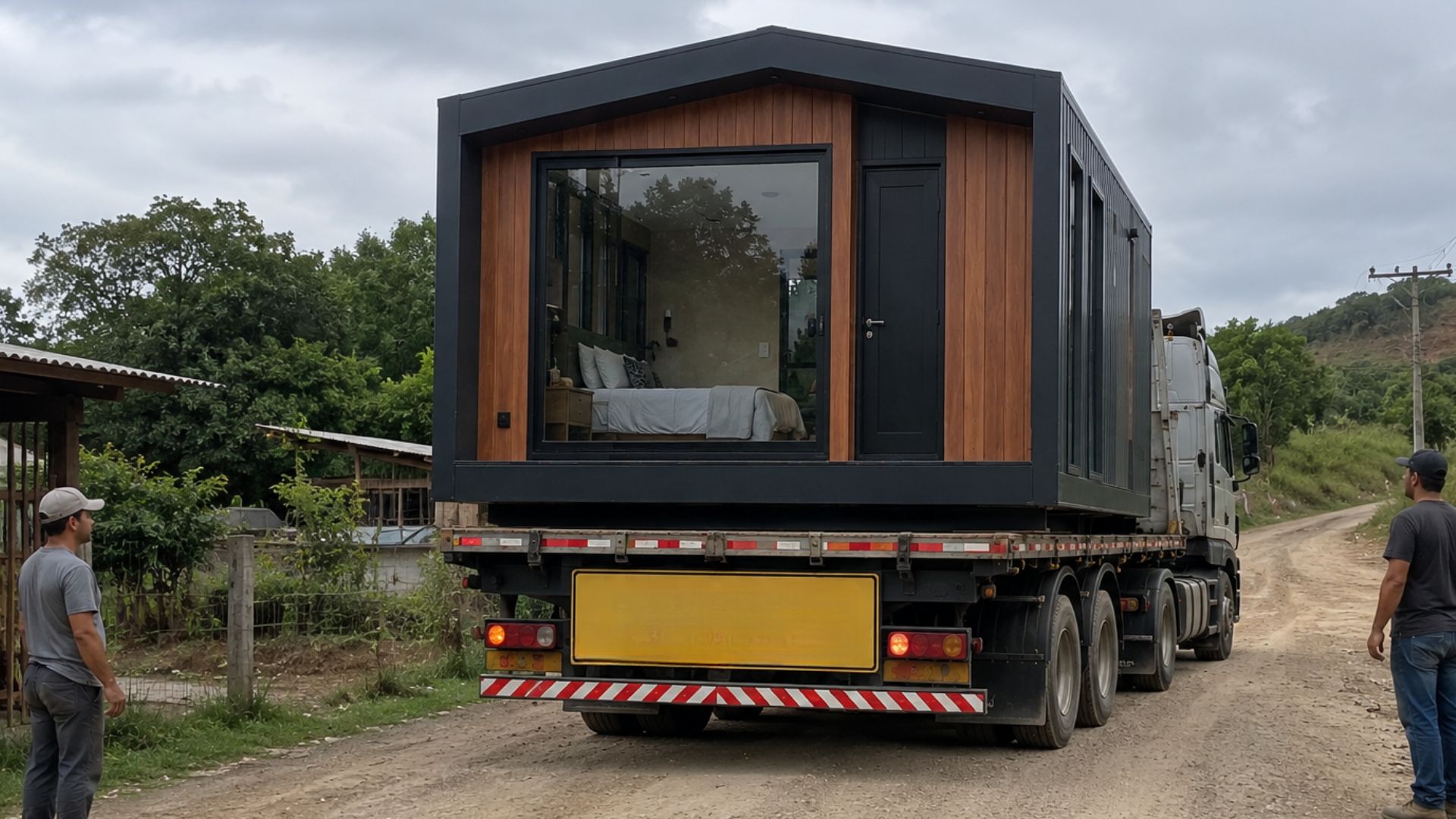
Modular project concentrates five environments in a single industrialized structure, delivered ready for installation on the land and equipped with integrated finishing items, kitchen, and bathroom. Compact model relies on internal organization, speed of implementation, and maximum use of space in a reduced floor plan.
Designed to concentrate different environments in a compact structure, the TOPOL modular house, by DublDom, brings together 26 m² of usable area with a bedroom, kitchen, living room, bathroom, and closet integrated into a single industrialized module delivered practically ready for use.
Unlike models that depend on the joining of separate parts on the land, the unit arrives whole by truck and can be positioned directly on the prepared foundation, reducing construction steps and accelerating the housing implementation process.
26 m² modular house relies on a compact floor plan
Although it has a reduced area, the project tries to reproduce the dynamics of a conventional residence by distributing five functional areas within the same piece, avoiding the typical fragmentation of some compact modular houses currently available on the market.
-
Bolivian Female Construction Workers Form Association to Combat Discrimination and 38% Pay Gap in the Industry

-
Near Amsterdam, residents buy land and discover they must also build streets, manage drainage, handle waste, and grow food on half their plot.
-
Brazil’s WEG to Open New Factory in China by 2027, Expanding Production of Large Rotating Electric Machines and Low to Medium Voltage Motors in Rugao

-
Chinese Shipyard Secures $1 Billion in Orders for Low-Carbon Container Ships Amid Global Fleet Renewal Efforts


According to the manufacturer, the proposal was developed to reduce external interventions during installation, concentrating most of the structural execution and internal finishes, which would normally require more time in a traditional construction, at the factory.
The usable area reported for TOPOL is 26 m², while the built area reaches 35.2 m², according to data released by DublDom.
The difference considers the implementation of the structure and additional elements associated with the module.

Inside the unit, the bedroom appears as its own environment, separated from the living and food preparation areas.
The kitchen and living room follow the same compact housing logic, while the bathroom and closet complete the configuration with functions that usually require more space in conventional floor plans.
Among the elements that most differentiate TOPOL is the presence of a closet integrated into the floor plan, a solution uncommon in compact projects, where storage areas often end up reduced to expand circulation between environments.
In this case, the internal organization was designed to maintain functions considered essential in daily life without transforming the house into an excessively minimalist space or limited only to the basics.
Structure arrives ready and reduces construction steps
According to DublDom, the module is transported already finished and can be installed directly on the previously prepared base on the land, a characteristic that significantly reduces the volume of services performed after delivery.
Since most of the production takes place in a controlled industrial environment, the system reduces interferences typical of conventional construction and concentrates most of the structural definitions even before the unit arrives at its destination.
Even so, ready delivery does not eliminate the need for prior planning on the land.
Foundation, transport, installation, assembly, crane use, and eventual taxes appear among costs that do not necessarily integrate the basic value of the module, according to the conditions described by the manufacturer.
The proposal differs from traditional construction because it transfers a significant part of the execution to the factory.
With this, activities such as structure, installations, and finishes no longer depend entirely on the construction site, which tends to make the process more predictable.
Internal height and terrace enhance the feeling of space

To enhance the feeling of internal space, the structure was designed with a variable height between 2.38 meters and 2.89 meters, a measure that helps reduce the perception of confinement normally associated with compact residences.
In addition, the model incorporates a terrace measuring 3,000 by 3,350 millimeters and a 1,500-millimeter staircase with ten steps, components that expand the daily use area and reinforce the architectural design of the unit.
These elements expand the possibilities for daily use, especially on plots where the outdoor area is part of the living experience.
The configuration shows that the model was not conceived merely as a temporary shelter, but as a compact residence with defined functions.
For the finish, DublDom reports the use of treated wood at the base of the structure and insulating materials for the floor, walls, and roof.
The interior includes carpet, walls and ceiling in oak-veneered MDF, as well as a bathroom with ceramic mosaic or tile combined with MDF.
Modular house includes equipped kitchen and complete bathroom
According to the technical sheet released by the manufacturer, the residence already comes equipped with different integrated systems, preventing the owner from having to start an extensive installation phase immediately after positioning the structure on the plot.
This package includes built-in electrical installations, lines for outlets and lighting, as well as internal water and sewage networks, a central electrical panel, and lighting planned for both internal and external areas.
Among the listed equipment are heated bathroom floor, washbasin, bathtub, Grohe faucets, toilet, bidet shower, 100-liter boiler, stove with chimney, heating cable, and heat pump.


The kitchen also appears furnished, with a built-in refrigerator, electric stove, sink, mixer tap, shelves, table, and chairs.
The package informed by the manufacturer also includes a mattress, utensils for four people, fabrics, and decorative objects.
This composition reinforces the idea of a dwelling delivered with a high degree of finish, although external implementation costs still depend on the plot and logistics.
Production can take up to ten weeks
When the unit is not available in stock, DublDom informs that the manufacturing period varies between six and ten weeks, the time needed to complete industrialized production and the finishes planned for the model.
After this stage, the manufacturer states that transport and installation can be completed in up to three days, provided that the foundation and the logistical conditions of the plot are already adequately prepared to receive the structure.
This timeline contrasts with the pace of conventional residential construction, where foundation, structure, enclosures, installations, and finishes progress in successive stages on the plot itself.
In the case of TOPOL, industrialization anticipates a good part of these phases.
The combination of reduced square footage, defined environments, and single-piece delivery explains the interest in the model.
For those looking for a compact house, the appeal is not just in the size, but in the attempt to transform 26 m² into a functional, equipped, and ready-to-use dwelling after installation.





Be the first to react!