






 Portuguese
  Spanish


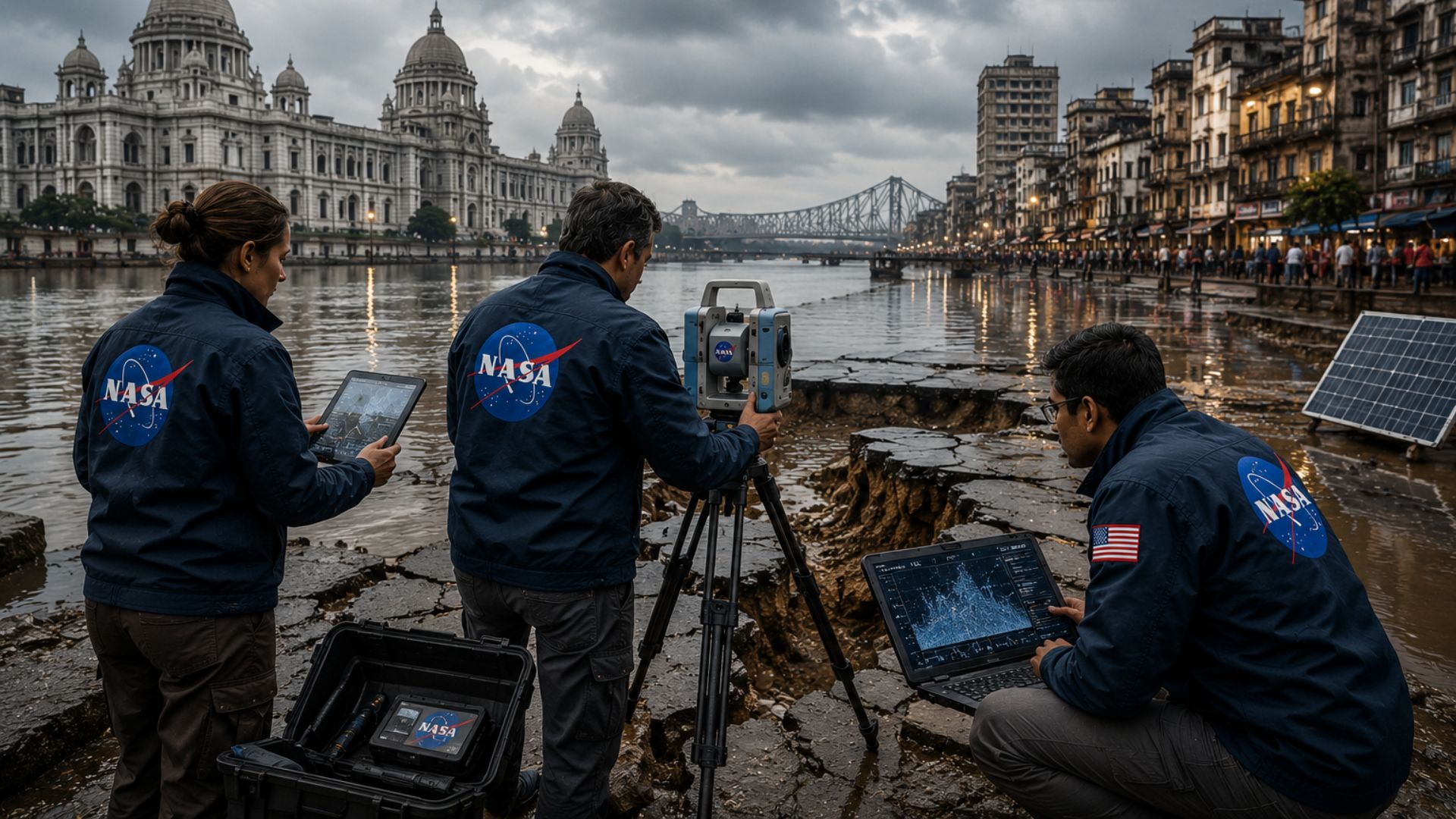
Satellite monitoring has placed Kolkata among the delta cities most vulnerable to sea level rise and gradual land subsidence, a phenomenon that increases the risks of floods, salinization, and pressure on urban infrastructure in one of India’s historically most important regions.
Kolkata, the capital of West Bengal and former seat of British power in India, has joined the group of delta cities observed with increasing attention by experts due to the combination of land subsidence, relative sea level rise, recurrent floods, and saline intrusion.
According to analyses associated with NASA, metropolises built on deltas face silent and continuous pressure, as the land gradually sinks while water advances over historically vulnerable urban areas.
Subsidence in Kolkata worries experts
The problem is not linked to a single extreme episode, but to a gradual process that slowly modifies the relationship between the city, the rivers, and the coastal strip that supports urban occupation.
-
In Somaliland’s Desert, Greenhouse Uses Sun and Seawater to Grow Lettuce, Cucumbers, and Tomatoes Without Rain: 1-Hectare Project Cools Crops, Desalinates Water, and Converts Brine into Commercial Salt

-
Trump Unveils $400 Million Boeing 747 Donated by Qatar as Temporary Air Force One Amid Boeing Delays, Sparking Debate on National Security, Costs, and Foreign Influence
-
Chinese Company Unveils Robotic Toilet That Comes to You, Featuring Lidar Sensors, Voice Command, Bidet, Hot Air Drying, UV Light, and Self-Cleaning Waste Disposal
-
Rotterdam Develops Floodable Square to Absorb Nearly 2 Million Liters of Rainwater, Doubling as Sports, Theater, and Leisure Space When Dry to Combat Urban Flooding



In sedimentary regions like Kolkata, the soil tends to subside due to natural compaction, intense groundwater extraction, and also the accumulated weight of urbanization, a scenario that amplifies impacts on drainage, foundations, and basic infrastructure.
In NASA material on future sea level projections, researcher Manoochehr Shirzaei stated that the combination of human-induced subsidence and sea level rise represents a “maximum alert” for several delta cities.

Among the examples cited are Kolkata, Yangon, Bangkok, Ho Chi Minh City, Jakarta, and New Orleans.
Kolkata’s situation draws attention because the city grew in a region shaped by the hydrological dynamics of the Ganges-Brahmaputra-Meghna delta and by river systems connected to the Hooghly River.
This territorial base favored historical occupation but also made the metropolis more exposed to flooding, erosion, salinization, and loss of drainage capacity.
Sea Level Rise Increases Urban Risk
In addition to the natural rise of the oceans, the lowering of the land itself alters the dimension of the climate problem faced by cities built in low-lying and densely occupied areas.
As the land loses height, the sea level appears higher in relation to the city, even when the oceanic rise, in isolation, does not explain all the impacts recorded in coastal regions.
Consequently, the so-called relative sea level rise increases, an indicator considered decisive by experts to measure the degree of urban vulnerability to floods and erosion.
Recent studies on deltas reinforce this concern.
Research published in Nature magazine in 2026 indicated that subsidence threatens deltas worldwide by increasing risks of flooding, land loss, and salinization, especially in densely populated and economically important regions.
In Kolkata, the danger appears less as a sudden scene and more as an accumulated pressure on infrastructure.
Canals, low-lying streets, underground networks, drainage systems, and areas near rivers can suffer gradual effects for years, until recurrent floods and urban failures make the process more visible.
Saline Intrusion and Impacts on Infrastructure


Among the most concerning effects of this process is saline intrusion, a phenomenon that alters the hydrological balance of coastal regions and hinders the preservation of essential natural resources.
As saltwater advances over rivers, canals, aquifers, and wetlands near deltas, risks increase for urban water supply, peri-urban agriculture, and the quality of water available to the population.
NASA highlights that the analysis of coastal cities needs to consider not only the rising sea but also the sinking land.
Without this consideration, risk projections may underestimate the vulnerability of low-lying neighborhoods, transport routes, hospitals, housing, and essential networks installed on unstable ground.
Satellite monitoring has made this phenomenon more measurable.
Radar techniques allow detecting vertical ground displacements on a scale of centimeters or millimeters, which helps researchers and managers identify more critical areas before damage becomes widespread.
Satellites help measure ground subsidence
Similar phenomena have also been observed in other large metropolises spread across sedimentary and densely urbanized regions around the planet.
In April 2026, for example, NASA released data from the NISAR mission, developed in partnership with the Indian space agency, indicating extreme subsidence in Mexico City, where the sinking is also associated with groundwater extraction and sediment compaction.
Although Kolkata has its own characteristics, the case fits into a pattern observed in large urban centers built on young, humid, and densely occupied soils.
In these areas, population growth, pressure on aquifers, and infrastructure expansion can accelerate a process that already occurs naturally in many deltas.
The former Indian colonial capital, recognized for its cultural, historical, and economic relevance, now symbolizes an urban threat that is not always apparent at first glance.
The ground that seems stable may be gradually yielding, while floods and salinization advance as external signs of a subterranean transformation.
For experts, including subsidence in urban planning is no longer a technical detail.
In deltaic cities, this data can alter priorities for drainage, coastal protection, groundwater management, real estate expansion, and climate adaptation, especially where millions of people live in low-lying and flood-prone areas.





-

1 person reacted to this.