Portuguese
  Spanish


Innovative Technology Patented in the USA Uses Grapefruit Peels to Generate Electricity, Exploring the Potential of Triboelectricity with Natural Waste.
Researchers at the University of Illinois in the United States have developed an innovative technology that transforms grapefruit peels into devices capable of generating electricity.
The process, which utilizes the natural properties of the fruit, can provide renewable energy and motion sensors without needing external batteries. This discovery opens new possibilities for the use of organic waste in the production of clean energy.
Porous Structure and Technological Potential
The grapefruit, a citrus fruit grown in various regions of the planet, has a thick and spongy peel, often discarded after consumption.
-
Boat Made from 10 Tons of Plastic and 30,000 Discarded Flip-Flops Sails Along African Coast, Serving as a Floating Classroom on Ocean Pollution

-
Welder Discovers 16th-Century Diamond Ring in England After 7 Hours with Metal Detector; Gold Jewel Linked to Edward I Pattern Auctioned for £17,000
-
Former Merchant Marine Captain Invents Fuel-Free Barrier, Removes 20,000 Tons of Trash from Chennai Rivers
-
14-Year-Old Maxim Harris Turns School Project into Anti-Rage Gaming Accessory, Sells 1,000 Units Across 46 U.S. States, Donates 20% of Profits to Charity




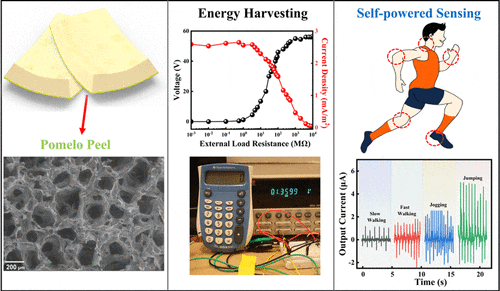
This outer layer is composed of two parts: a thin colored peel and an inner white part with a sponge-like texture. Researchers observed that this porous structure is ideal for manufacturing triboelectric devices capable of generating electricity from mechanical movements.
The transformation process begins with the separation of the peel, followed by the removal of the outer layer and cutting the inner part into small pieces.
These fragments undergo freeze-drying, a technique that preserves the three-dimensional structure of the biomass. Subsequently, the samples are stored at different moisture levels for later analysis.
Triboelectric Generators and Contact Electrification
The devices created utilize the phenomenon of triboelectric charging, which occurs when two materials rub against each other and exchange electric charges.
In the experiment, the grapefruit biomass was combined with a polyimide sheet, a type of plastic with insulating properties. Copper electrodes were inserted between these layers to capture the generated electricity.
With a simple touch of a finger on the device, it was possible to light up to 20 LEDs simultaneously. In additional tests, researchers were able to power calculators and sports watches without the use of external batteries. The energy efficiency was considered promising, primarily due to the natural structure of the fruit’s peel.
Practical Applications: Biomedical Sensors and Wearables
In addition to generating electricity, the devices showed potential for use as motion sensors. When applied to joints, they accurately detected the angle of flexion and walking patterns.
This functionality may be useful in rehabilitation treatments, allowing healthcare professionals to monitor patient progress in real time.
The sensitivity of these sensors, combined with low production costs, makes this technology viable for biomedical applications and wearable devices, explained the lead researcher of the study, Dr. Alan Thompson. Integration with sports equipment is also a possibility, facilitating non-invasive analysis of athlete movements.
Sustainability and Circular Economy
The initiative not only utilizes an abundant organic waste but also contributes to reducing food waste.
It is estimated that up to 50% of a grapefruit’s weight is made up of the peel, resulting in large volumes of waste in the juice and processed food industry.
With this technology, the peel gains a new function in the context of the circular economy, being repurposed to generate energy and biodegradable sensors. Unlike synthetic materials, grapefruit biomass decomposes naturally at the end of the device’s life, preventing electronic waste generation.
This research shows that food waste can have significant value when analyzed creatively, explained Professor Maria Gonzalez, an expert in renewable materials. She emphasized that waste is often seen as something useless, but this study provides a concrete example of how science can change that perception.
Next Steps and Market Potential
The Illinois group has already filed a provisional patent for the technology. Now, the researchers plan to expand testing, evaluating the performance of the devices under varied temperature and humidity conditions.
The expectation is that the technique can be adapted for other fruits with similar characteristics, such as oranges and lemons.
In addition to the biomedical sector, the technology has potential for applications in energy harvesting systems in floors and high-traffic surfaces. With the growing demand for sustainable solutions, this innovation may represent an important step in the quest for renewable and efficient alternatives.
The full study was published in the scientific journal ACS Applied Materials & Interfaces, under the title: “Valorization of Food Waste: Utilizing Natural Porous Materials Derived from Grapefruit Biomass to Develop Triboelectric Nanogenerators for Energy Harvesting and Self-Powered Sensing”. The article can be accessed via DOI: 10.1021/acsami.4c02319.
With information from eco.