






 Portuguese
  Spanish


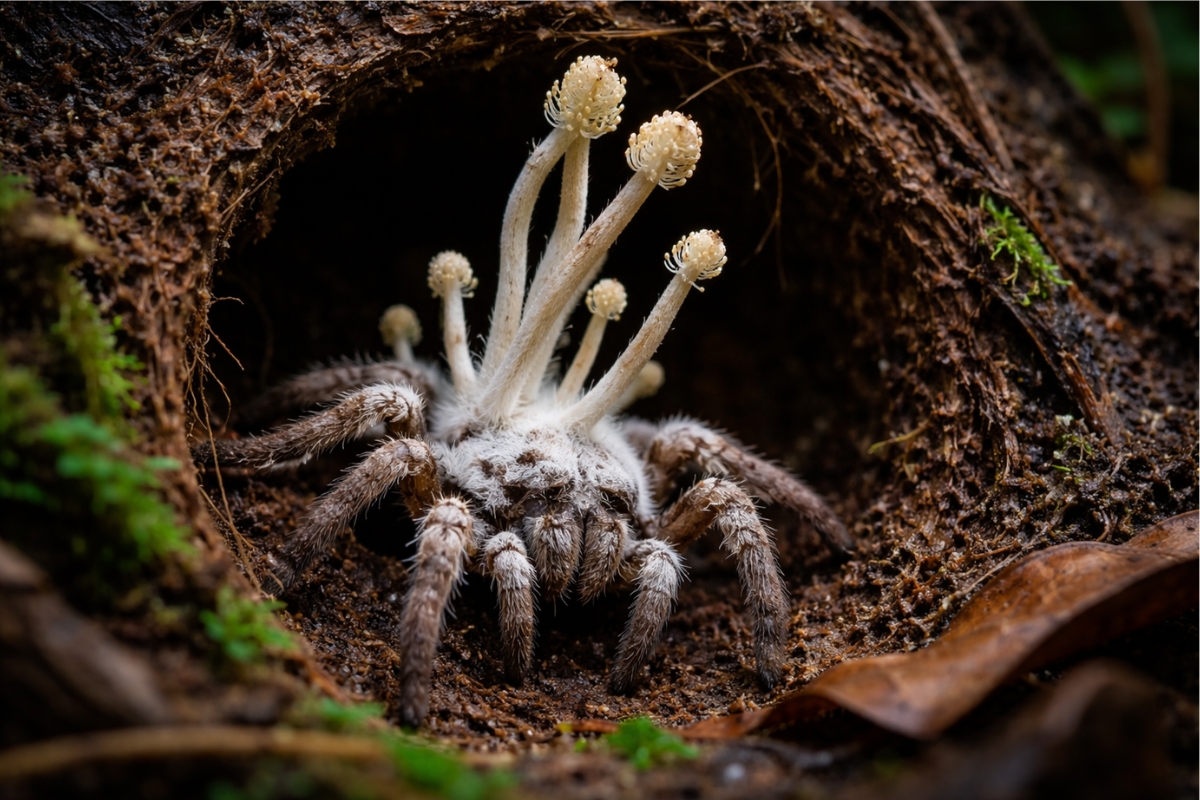


Researchers Recorded Purpureocillium Atlanticum Parasitizing Trapdoor Spiders; The Case Exposes Gaps in Fungal Taxonomy and Pressures on the Atlantic Forest
Scientists identified a new species of parasitic fungus in the Brazilian Atlantic Forest that infects spiders known as trapdoor spiders, animals that live in burrows beneath the forest floor and hunt by ambush. The organism, described as a “zombie fungus” due to its strategy of growing on the host, was named Purpureocillium atlanticum and is presented as a fungus that feeds on spiders.
The behavior of the host is central to the described cycle. Trapdoor spiders build a burrow with a camouflaged “door,” which opens and closes quickly to capture prey. In the case of the newly named fungus, after infection, the spider’s body becomes enveloped by white mycelial filaments. The fungus then emerges from the corpse in the form of a fruiting body that rises through the burrow opening and passes through the “door” hole, a position that favors the release of spores and the repetition of the cycle.
Portable Genomics Allowed Decoding of the Genetic “Signature” at the Discovery Site
One of the highlights in the reference material is the use of portable genomic technology to clarify the origin and evolution of the fungus’s strategy. According to the description, the equipment allowed for the decoding of the organism’s genetic “blueprint” in the field, which is presented as an advantage in biodiversity-rich and hard-to-reach environments, where sample collection and preservation can be a logistical challenge.
-
James Webb Telescope Uncovers Unexpected Clues on Mysterious Moon, Potentially Redefining Planetary Origins

-
$1.5 Billion Sleipnir Vessel Transforms Ocean into Floating Construction Site with 12 Hybrid Engines and Capacity to Lift 20,000 Tons

-
23 Years After Tragedy, Brazil’s Alcântara Space Center to Launch New Suborbital Rocket in 2026 with South Korean SEBIT Project Targeting Near-Space Tests
-
Entrepreneur Turns Neighbor’s Coffee Grounds Waste into Eco-Friendly Pellets, Earning Up to $40,000 Monthly in Brazil


The identification and formalization of the scientific name are treated as relevant steps for a species to genuinely exist in the cataloging system that supports research, comparisons, and conservation actions. Without this formalization, documenting occurrences tends to remain fragmented and of lesser utility for environmental policies.

Discoveries Accelerate Amid a Global “Deficit” of Described Species
The record of Purpureocillium atlanticum was contextualized within a broader panorama of species recently described by scientists affiliated with the Royal Botanic Gardens, Kew, and international partners. The material points to estimates that there are still up to 100,000 plant species to be discovered in the world and between 2 million and 3 million species of fungi. Despite this, only about 200,000 species of fungi are believed to have been named so far, reinforcing the scale of the pending taxonomic work.
In the mentioned context, researchers associated with Kew and partners reportedly named 125 new plants throughout 2025, and some of these findings were compiled into a highlights list. The presented reading is that science is racing against time, as habitat loss and other environmental pressures may drive species to extinction even before they are formally described.
Atlantic Forest Appears as a Scenario of High Ecological Specialization and Environmental Risk
The choice of the Atlantic Forest as the site of the record is not trivial. The biome is recognized for its high diversity and significant degree of fragmentation, creating mosaics of microenvironments and at the same time increasing the vulnerability of species with restricted distributions and highly specialized ecological relationships.
At the center of this discussion is the idea that describing new species is a prerequisite for protecting them. The material mentions the assessment by Kew researchers that it is difficult to conserve what is not known and does not have a scientific name, especially in a scenario of habitat destruction associated with human activities.

International Repercussions Highlight the Case and Reinforce the Importance of Cataloging
In the media coverage, The Guardian detailed the dynamics of the parasitic fungus and the use of portable genomics in the identification of the organism, in addition to relating the record to a broader set of botanical and mycological discoveries formalized in 2025.
The Royal Botanic Gardens, Kew, cited as a scientific source in the material, framed the case as an example of an Underdimensioned Frontier of discovery, with a significant volume of fungal species remaining unnamed and, thus, off the radar of many research and conservation initiatives.


