






 Portuguese
  Spanish


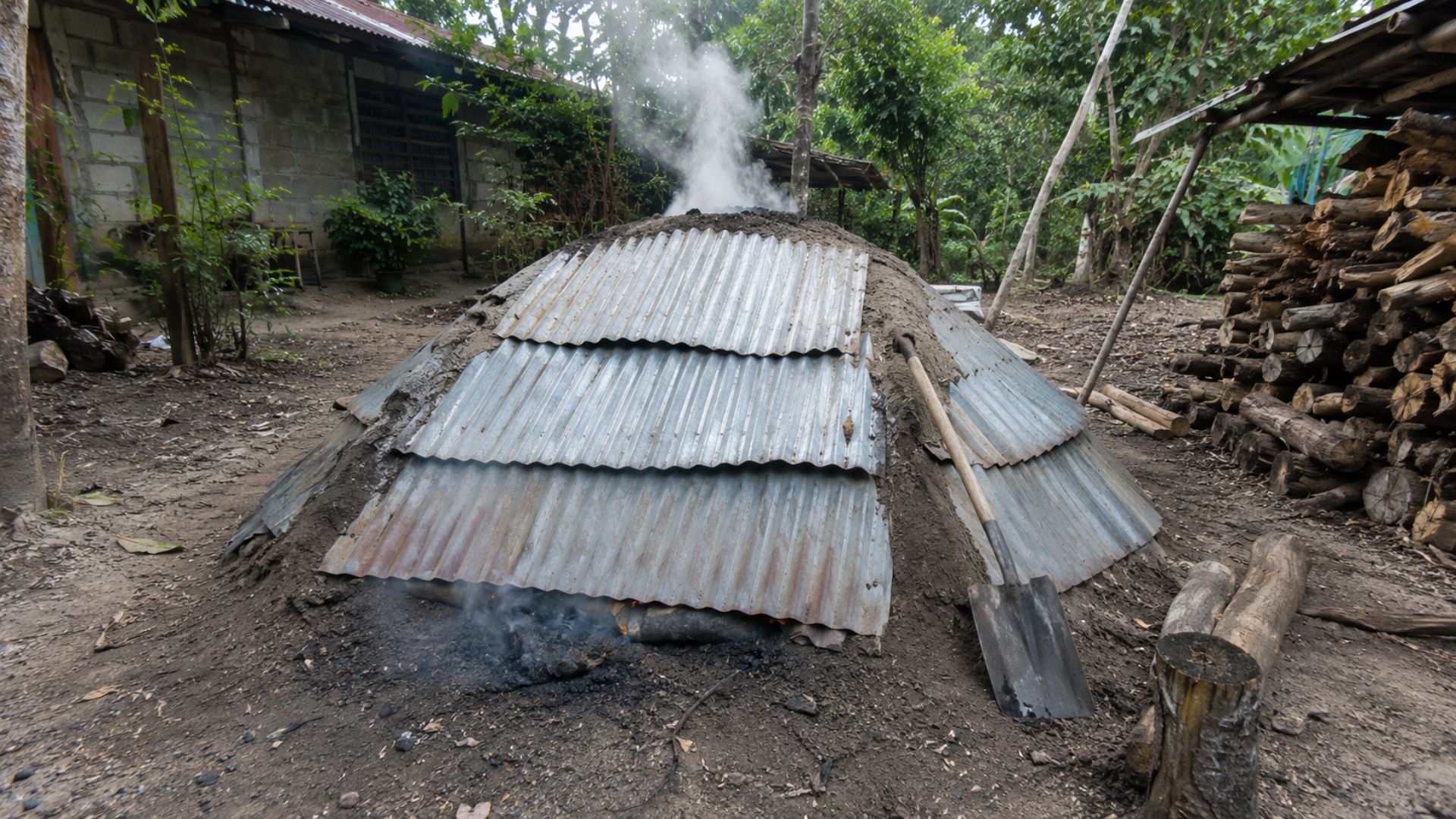


The charcoal production method known in the Philippines as the pugon kiln shows how a kiln covered with galvanized sheets and sealed with fine earth can deliver good results for homemade burning. The technique has resurfaced in videos as an alternative to industrialized charcoal in various countries around the world.
In 1997, in the Ulingan community, within the Tondo district, in the Philippine capital Manila, about 15 residents began producing charcoal in small earth kilns locally named pugon, using discarded wood collected by scavengers from different parts of the city. The method consisted of setting up a buried kiln, covering it with galvanized sheets, sealing everything with fine soil, and precisely controlling the oxygen intake during the wood burning until obtaining the charcoal ready for sale. The motivation was practical: to generate income with leftover wood and meet families’ demand for cheap cooking fuel.
Fifteen years later, in May 2012, the Philippine Daily Inquirer reported that the same community was producing around 6,000 sacks of charcoal per month, processing about 360 tons of reused wood during that period. At that time, the NGO Urban Poor Associates had announced the arrival of smokeless pugon kilns, in partnership with 1M Agro-Fuel Development Ventures and supported by the Archdiocese of Manila, aiming to reduce the impact on the environment and health of the traditional process. The story helps to understand why the pugon, now replicated in internet tutorials and adapted by enthusiasts in backyards, remains active as a model of small-scale charcoal production in different regions of the planet.
How the pugon kiln works in charcoal production
The physical principle behind the pugon is the same as any artisanal charcoal kiln: the so-called pyrolysis, a process in which wood is heated in an environment with very little oxygen, loses water and volatile compounds, and transforms into charcoal. Instead of burning, the wood slowly decomposes under controlled heat. The result is a light, dark, and highly energetic material used in barbecues, wood stoves, smokers, and some industrial activities.
-
Artesian Well Becomes Lifeline for Small Brazilian Farm: Drilling Reaches 60 Meters, Finds Marble, Navigates Rock Fissures, and Strikes Fresh Water

-
Street Cleaner in Brazil Finds Discarded Books That Helped His Wife Pass Civil Service Exam and Become Police Captain
-
July’s Night Sky to Feature Planetary Alignments, New Moon, Venus at Sunset, Buck Moon, and Two Meteor Showers

-
Fisherman Catches 18kg Catfish Near Brazil’s Itaipu Lake, Among Largest Recorded in Recent Years



In the Filipino format, the kiln is usually dug into the ground or built with walls of compacted earth and clay, leaving an air intake at one end and a smoke outlet at the other. Larger pieces of wood are stacked inside, with thin branches serving as kindling, and the setup is covered with galvanized sheets to concentrate the heat. This simple structure is what differentiates the charcoal made in pugon from other more industrial systems.
The step-by-step from lighting to fire stabilization
The assembly starts with the thinner layers. Small branches are placed at the bottom, forming a bed that allows free air passage through the base of the kiln. Above them go medium branches, then larger logs, and finally, near the air intake, a portion of twigs that acts as an initial igniter. The fire is started from this entrance, and in the first few minutes, the producer needs to fan the opening to distribute oxygen and help the flames gain strength.
When the fire is consistent, new batches of small twigs are added to fill gaps and ensure a uniform combustion front. This is a moment of real risk: flames can escape through the air intake and reach the operator. Those who produce small-scale charcoal need to work with long-sleeved clothing, closed shoes, sturdy gloves, and a bucket of water or sand within reach to contain any fire outbreak.
The role of galvanized sheets and fine soil in sealing


With the burning stabilized, the stage that defines the quality of the charcoal begins. The kiln is covered with galvanized sheets supported on iron bars, forming a kind of temporary roof. Then, all the gaps between the sheets and the edges of the kiln are sealed with fine soil or sifted soil, except for the opening near the air outlet, where smoke needs to escape. Proper sealing is what prevents excess oxygen from entering and turning everything into ash.
The choice of fine soil is not aesthetic. Coarse soil or soil full of stones leaves microchannels through which air passes, compromising pyrolysis. A thick layer of sifted soil, on the other hand, seals the set and forces the burning to occur with little oxygen, a necessary condition for the wood to turn into high-density charcoal instead of black powder. When the smoke also starts to come out through the ventilation opening, a tube extension is fitted to direct the gases upwards, away from people and neighbors.
How long the burning lasts and why cooling requires 24 hours
The total time varies depending on the wood used. Dry firewood tends to complete carbonization in about 6 to 8 hours, while fresh wood, with more moisture, may take 12 hours or more to reach the point. The operator needs to observe the smoke: it starts dense and white, goes through a yellowish phase, and finally becomes thin and bluish, indicating that the volatiles have already left and the wood has turned into charcoal. This is the moment to seal all the air inlets and outlets of the kiln.
Sealing oxygen is what prevents the newly formed charcoal from continuing to burn and turning into ash. After this step, it is essential to wait at least 24 hours before opening the oven, ensuring that the internal material is cool. Pouring water over hot charcoal to speed up cooling is discouraged because it can crack the pieces and impair the burn yield. A well-maintained artisan charcoal oven, the size described in Filipino tutorials, usually yields between one and one and a half bags of charcoal per cycle.
Safety precautions when making charcoal in the backyard
Despite the apparent simplicity, the process involves serious risks. The main one is carbon monoxide released by pyrolysis, a colorless, odorless, and potentially lethal gas in closed or poorly ventilated environments. Therefore, ovens like the pugon should always be installed in open areas, away from windows, garages, and bedrooms. Prolonged inhalation of smoke emitted during burning is also harmful to the respiratory system and is associated with lung diseases in producers who work without protection.
Another critical point is the risk of fire. Burning wood in rudimentary ovens can release sparks and embers, especially in the first few hours when the fire is still stabilizing. Those who decide to test homemade charcoal production need to choose a plot isolated from dry brush, wooden roofs, and flammable materials, keep firefighting equipment within reach, and never leave the oven unattended during the initial stages of burning.
What Brazilian legislation says about charcoal production
In Brazil, charcoal production is regulated by IBAMA and state agencies. The Forest Origin Document, known as DOF, is mandatory for the transport and trade of native-origin charcoal, according to current regulations for forest products. In states like Paraná, there are additional restrictions: IAT Ordinance No. 204, of 2020, expressly prohibits the installation of charcoal ovens within urban areas, in Permanent Preservation Areas, and in Legal Reserves of rural properties.
Those who intend to produce charcoal even on a small scale need to check the legislation of their state and municipality before setting up any oven in the backyard. This applies both to personal consumption and any attempt at sale. Regularization involves registration with agencies like IBAMA and state environmental institutes, especially when tree cutting is involved. Informality can constitute an environmental crime and result in significant fines, even for a small volume of burning.
The pugon shows how an ancient and replicable technique of charcoal production remains relevant in the 21st century, especially in low-income communities where the use of discarded wood becomes a source of fuel and income. For those curious in Brazil, it’s worth noting: the method is interesting from a cultural and technical standpoint, but it requires extra care with safety and full attention to local environmental legislation before any practical test.
Have you ever heard of the Filipino technique of pugon? Do you think it makes sense to produce charcoal in the backyard even in a small town, or do you prefer to buy it ready-made at the market? Leave your comment, tell us if you’ve ever seen an artisanal charcoal production up close, and share the article with those who enjoy barbecue, rustic gastronomy, or biomass energy.


