






 Portuguese
  Spanish


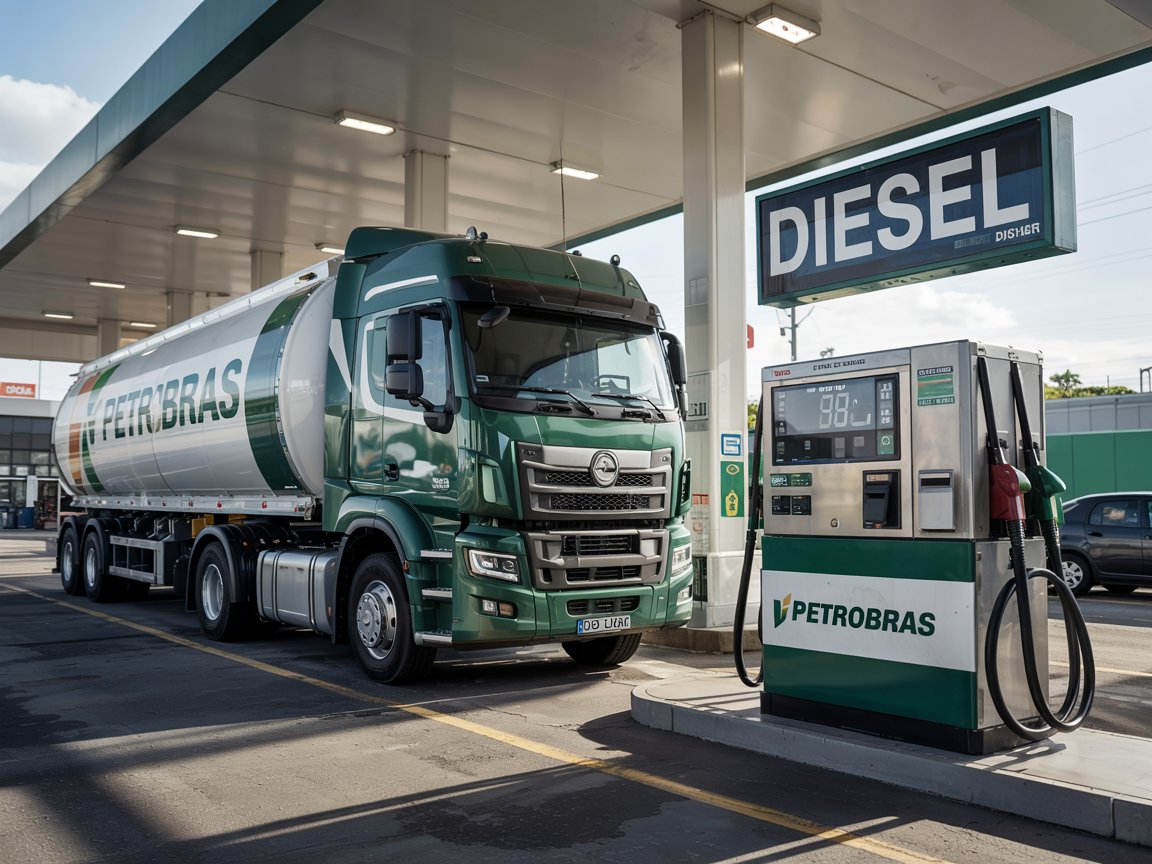

Recent Measure Reduces Fuel Price, But State Policy Remains Linked to International Market Parameters; Experts Analyze Economic and Operational Impacts
Petrobras announced on March 28, 2025, a 4.6% reduction in diesel prices, effective April 1, 2025. The new price of R$ 3.78 per liter represents a drop of R$ 0.17 at refineries. According to a statement from the state-owned company, this is the first reduction of the year — the last one occurred in December 2023, with a drop of 6.6%. Prior to that, in February 2025, diesel prices had been adjusted upward by 6.8%, according to data from the National Petroleum Agency (ANP).
Economic Factors Explain the Reduction
According to the Central Bank, the real appreciated by about 8% against the dollar in the first quarter of 2025. In addition, the price of Brent crude oil experienced a average drop of 7.2% during March, according to data from OilPrice. These variations contributed to internal prices at Petrobras exceeding the import parity level — the reference for price formation of the company. According to analyst Felipe Perez from Ativa Investimentos, the state-owned company utilized this space to realign values to the market while respecting the competitiveness and supply margin.
What Is the Import Parity Price Policy (PPI)
The import parity price policy, officially implemented in October 2016, aims to align internal fuel prices with import costs. This calculation includes the international price of oil (mainly Brent), the exchange rate (commercial dollar), shipping and insurance costs, as well as risk margins and port handling costs in Brazilian ports. Even though Petrobras announced a more flexible commercial policy in May 2023, experts assert that prices continue to be, in practice, influenced by international parameters.
-
Drivers are falling for these scams without realizing: operation reveals closed gas stations, adulterated fuel, and hidden losses when refueling.

-
New Fiat EV, priced at R$ 77,000, will bring a reinterpretation of the 147 and a consumption equivalent to 70 km/l.

-
Petrobras surprises the market by cutting diesel by R$ 0.35 per liter, and the decision may ease the tax impact for drivers and transport companies.
-
Gasoline at R$ 4.99 makes drivers wait more than an hour at Havan gas stations in Santa Catarina, during a “zero tax” promotion with a limit of 15 liters per car and 25,000 liters available across five units of the network.





Technical Entity Challenges International Alignment
The Association of Engineers of Petrobras (AEPET), in an article published on April 1, 2025, criticized the continuation of the PPI. According to the entity, the state-owned company has sufficient production and logistics capacity to form prices based on national costs. Additionally, it is argued that the underutilization of Brazilian refineries and the dependence on international prices compromise the strategic function of the company. AEPET advocates that alignment with parity limits Petrobras’s potential to offer more affordable fuels to the population and the productive sector.
Impact of the Reduction on Road Transportation
According to the National Transport Confederation (CNT), diesel accounts for up to 35% of logistics costs for transport companies and road operators. Thus, even a specific reduction like this can alleviate operational freight and distribution costs. Consequently, it is possible that the effects reach consumers through containment of increases in food, consumer goods, and public transport. However, analysts emphasize that, without structural changes in pricing policy, predictability remains a challenge for the sector.
Petrobras Signals Possibility of New Adjustments
During a press conference held at the Palácio do Planalto on March 28, Petrobras President Magda Chambriard stated that the company is evaluating the possibility of reducing the price of aviation kerosene (QAV). Despite this, no date or technical criteria were disclosed. The indication was well received by the Brazilian Air Transport Association (ABEAR), which states that fuel costs represent more than half of operational expenses in the sector.
New Pricing Policy: Changes and Continuities
According to a statement from Petrobras itself, the policy adopted since May 2023 replaced the PPI with a strategy that considers market conditions, competition, and internal costs. However, according to assessments by experts from the Energy Institute at USP and UFRJ, international variables remain predominant in price formation. Thus, although the methodology is officially more flexible, the pricing model still reflects the global market, which keeps consumers exposed to external volatility.
The reduction in diesel prices announced by Petrobras is a significant measure, particularly for the transport and logistics sector. Nevertheless, as it does not represent a change in the company’s pricing structure, its effects should be analyzed cautiously. Experts and technical entities continue to point out the need for a pricing policy more aligned with national costs, capable of providing greater predictability and stability. The transparency in commercial decisions, combined with efficiency in production and refining management, will be essential for the state-owned company to fulfill its economic and social role responsibly.
Editorial process suggestion for publication








