Portuguese
  Spanish


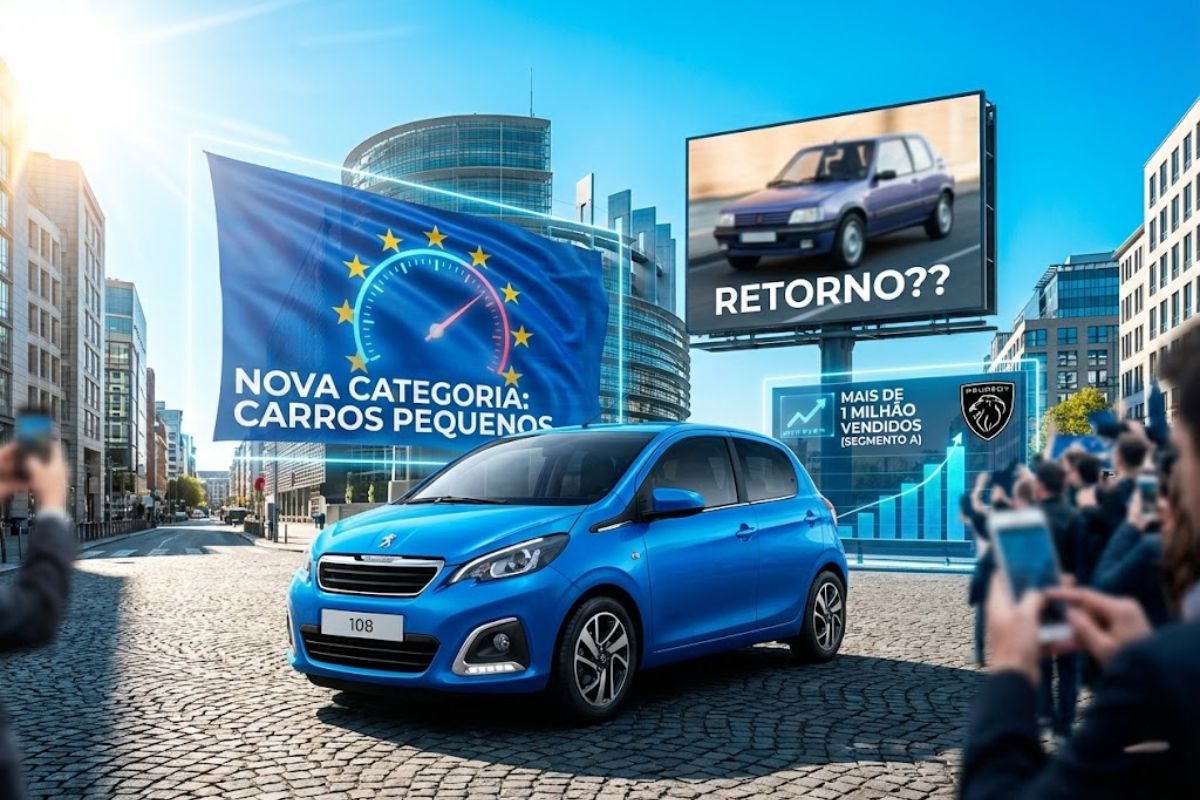

Four Years After Discontinuation, Peugeot 108 Returns to the Center of the Brand’s Plans, But Depends on New European Regulatory Category for Small Cars that Reduces Costs, Simplifies Safety Requirements and Allows Profit on an Urban Hatch That is Truly Affordable to Low-Cylinder European Consumers Today
The Peugeot 108 quietly left the scene four years ago but never left the automaker’s radar. Now, the small urban hatchback is back on the strategic agenda of the French brand, which admits to having sold over 1 million cars in segment A in the recent past and is seriously considering its return.
This possible revival of the Peugeot 108 does not depend solely on commercial will. The manufacturer conditions the return of a cheap urban hatchback on the creation of a new regulatory category in the European Union, specific to small cars, that allows for cost cuts, relaxes requirements, and makes it feasible to produce compact models with a competitive entry price and some profit margin.
Return of the Peugeot 108 Depends on New Rule in the European Union

According to Peugeot, the old Peugeot 108 will only return to the market if the European Union approves a regulatory category specific to small urban cars.
-
Renault Kwid Outsider 2023: Affordable Used Hatchback with 1.0L Engine, 15.7 km/l Efficiency, and Ample Cargo Space for Around $11,000

-
Chevrolet SUV Offers 153 hp Engine, 620 km Range, and ADAS Features at a Lower Price Than a New Kwid

-
London buses run on biofuel made from coffee grounds, turning café waste into sustainable public transport fuel without engine modifications.

-
Major Automaker Considers Closing 4 Factories, Putting 45,000 Jobs at Risk Amid Chinese Competition in Brazil


The idea behind this new class is to create a set of requirements that better fits the size, use, and role of these vehicles in the daily mobility of cities.
Today, the same safety packages, onboard technology, and emissions requirements applied to larger models also extend to small ones, driving up the final cost.
The brand’s management admits that, without regulatory changes, there is no way to offer a Peugeot 108 cheap enough for consumers while being profitable enough to justify the investment in a new generation.
Three Decades of Urban Cars and More Than 1 Million Sold
The possible return of the Peugeot 108 relies on a consistent history in the so-called segment A.
The journey began with the 106 in 1991, succeeded by the 107, and culminated in the very 108, which sustained the brand’s offerings among urban models until its discontinuation around four years ago.
Peugeot executives remember that, when considering the generations, the brand sold over 1 million cars in segment A in a relatively short span.
This volume shows that there is, or was, a real space for compact vehicles like the Peugeot 108, aimed at those looking for a simple, economical hatchback that is easy to park in large urban centers in Europe.
Why Small Cars Became Too Expensive to Survive
The problem is not the lack of demand, but the math that does not add up.
With the tightening of safety and emissions regulations, along with the demand for more electronics and connectivity, the industrial cost of entry-level models has escalated rapidly.
For the Peugeot 108, this meant grappling with ever-increasing costs in a segment where the final price has a rigid limit.
Other manufacturers followed the same path. Classic A-segment models like Citroën C1, Ford Ka, Vauxhall Viva, and Skoda Citigo were also discontinued in the same period.
The diagnosis is similar: to maintain an urban hatchback with all the equipment required today and still call it cheap, it would be necessary to sacrifice margins to a level considered unsustainable.
208 Became Entry Door, But Did Not Replace the Role of Urban Hatch
With the exit of the Peugeot 108, the brand’s entry-level function has shifted to the 208, a larger, more sophisticated, and naturally more expensive supermini.
It serves the commercial role of first contact with Peugeot but does not occupy exactly the same space that the old urban hatch occupied in the daily life of cities.
In practice, the 208 offers more comfort, technology, and performance, but loses some of the simplicity and low running costs that made the Peugeot 108 attractive for those who only needed a compact car for short trips, congested historic centers, and tight parking spaces.
It is this niche, between acquisition cost and operational cost, that the brand sees as potential if the new regulatory category is approved.
Segment A May Welcome a New Generation of Affordable Urban Cars
The discussion about the return of the Peugeot 108 occurs in a broader context, where other manufacturers are also assessing an organized return to the urban car segment.
Brands like Dacia and BYD have already expressed interest in offering entry-level compact models for Europe if the regulatory environment becomes more favorable.
The logic is similar for all: an urban car of this type needs to be cheap to buy, cheap to produce, and still be profitable.
Without an adjusted regulatory framework, the risk is to repeat the cycle that led the Peugeot 108 and its competitors to be discontinued.
With new rules, however, a different generation of economical urban cars could once again occupy European streets, including a possible direct successor to the 108.
Stellantis Group Balances Electric Luxury and Returns to Compact Cars
While discussing the future of the Peugeot 108 and a new urban car, the Stellantis group is expanding its brands’ presence at other ends of the European market.
DS, also French and focused on luxury, is beginning the delivery of the DS No8, a high-end electric crossover with extended range, targeting traditional rivals like BMW and Audi.
At the same time, DS is preparing the DS No4 and a replacement for the DS 7 Crossback, reinforcing its strategy to compete for higher margins at the top of the lineup.
In this scenario, the eventual return of the Peugeot 108 would function as a counterweight within the group, ensuring presence in both premium segments and at the base of the pyramid, as long as the regulatory and financial equation allows.
All or Nothing: Regulator Decides the Fate of the Next Peugeot 108
Publicly, Peugeot leadership’s reading is straightforward: until the European Union approves a new category for small cars, there is no economic space for a new Peugeot 108.
The brand recognizes the historical importance of segment A but states that current conditions make it unfeasible to launch an entry-level urban hatchback at the low price that the public expects.
If the European regulator moves forward with specific rules for compact models, reducing requirements and adjusting equipment standards, the scenario changes.
In this case, Peugeot admits that there is a “natural gap” to reintroduce the Peugeot 108 or a direct successor in the market, reviving the tradition of the brand’s small urban cars and competing again for those looking for the first affordable urban car in Europe.
And for you, if the European Union relaxes the rules and the Peugeot 108 returns as a cheap urban hatch, would it make sense to choose a compact like that as a first car or second vehicle for the family?