






 Portuguese
  Spanish
  3 min of reading
  1 comment


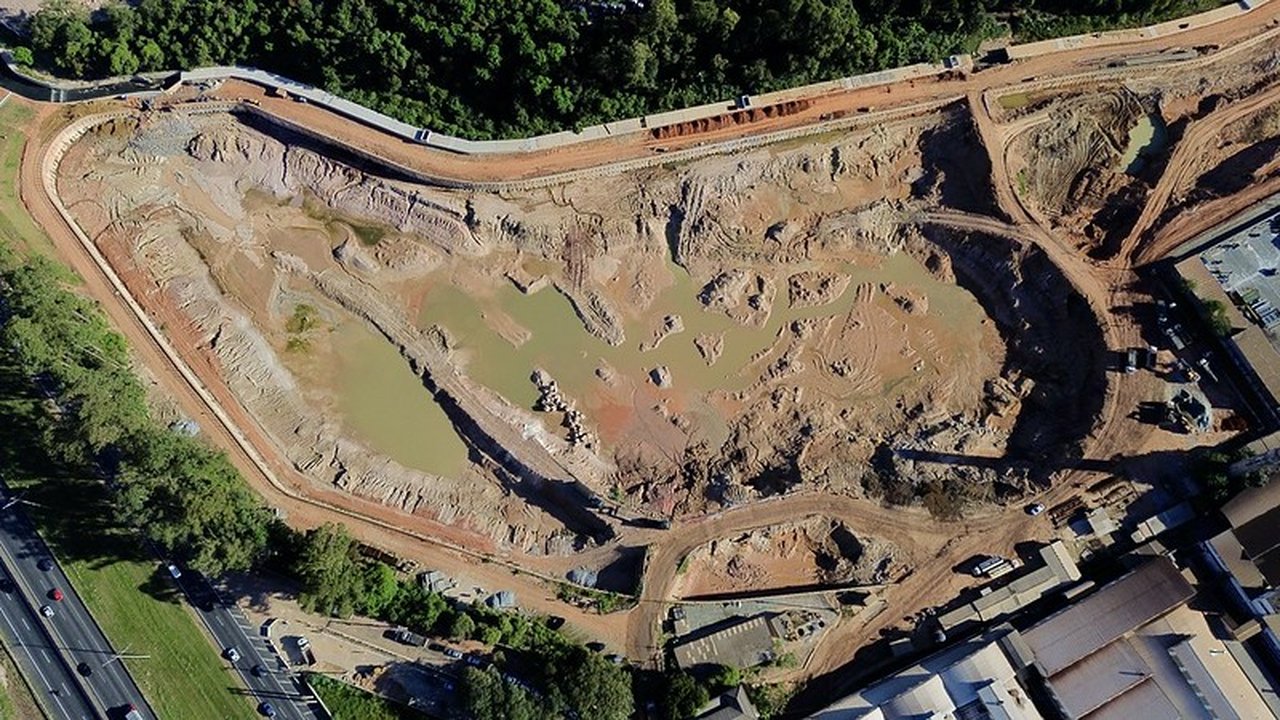


What Is at Stake: 900,000 m³, 49 Hours and 6 Pumps
The Jaboticabal reservoir is designed to hold rain peaks in one of the most critical areas of Greater São Paulo: the confluence of the Jaboticabal stream with the Meninos and Couros rivers, near the Anchieta Highway, between the capital and São Caetano.
The proposal is straightforward: store 900,000 m³ (equivalent to 360 Olympic swimming pools) and return the water in a controlled manner, softening the floods.
The post-rain draining will be done by six pump sets, each with a capacity of 850 L/second, totaling 5.1 m³/s. At this nominal flow, emptying 900,000 m³ would take 49 hours, about two days, respecting the capacity of the receiving water body.
-
Bolivian Female Construction Workers Form Association to Combat Discrimination and 38% Pay Gap in the Industry

-
Near Amsterdam, residents buy land and discover they must also build streets, manage drainage, handle waste, and grow food on half their plot.
-
Brazil’s WEG to Open New Factory in China by 2027, Expanding Production of Large Rotating Electric Machines and Low to Medium Voltage Motors in Rugao

-
Chinese Shipyard Secures $1 Billion in Orders for Low-Carbon Container Ships Amid Global Fleet Renewal Efforts


2) Where and How: Open Work, Channeling, and Depth
It is not a hidden tunnel. It is an open-air reservoir, with a characteristic depth of ~13 m, stepped slopes, and entry/exit devices with energy dissipation and solid retention. The package includes about 700 m of channeling from Jaboticabal to quickly direct flows to low-velocity zones, where solids settle before reaching the pumps. Along with civil works, the project operates with construction site drainage, excavation water management, and licensed waste disposal, crucial points to prevent flooding from becoming sedimentation.
Scale in context: the volume exceeds references in the RMSP, such as Pacaembu (75,000 m³) and units in Aricanduva. In São Bernardo, for example, the Paço has a capacity of 220,000 m³. In international comparison, it resembles large-scale solutions (like the SMART Tunnel in Kuala Lumpur), keeping in mind the differences in function and cost.
Deadline, Cost, and Governance: Who Pays, When It Delivers, Who Cares
The estimated investment is R$ 573 million (including expropriations). The latest advancement reports indicated 75% completion by June 2025, with an expected completion date in December 2025. This timeline matters for a simple reason: each rainy season lost without the system fully operational is another stress test for neighborhoods historically affected.
Governance is the Achilles’ heel: routines for cleaning grates, removing sludge, inspecting coatings, and telemetry integrated into control centers need to be contracted and budgeted. Without this, macro-drainage becomes a short-term promise. The project mitigates peaks; it does not eliminate floods on its own. It depends on the micro-drainage of each neighborhood, the maintenance of galleries, and the management of solid waste that comes with the runoff.
Expected Impact: Who Benefits and What Could Still Go Wrong
According to reported estimates, about 100,000 people may benefit directly or indirectly in the Sacomã–Heliópolis–Ipiranga–Centro de São Caetano axis. Benefits? Fewer spillovers, better traffic flow on rainy days, and greater predictability for businesses, buses, and workers. A positive side effect: the project creates an urban landmark that tends to enhance the surroundings and attract complementary investments (lighting, internal roads, maintenance accesses).
Risks? Extreme rainfall outside the project scenario; poorly modulated discharge; maintenance falling short of what’s necessary; and the old temptation to “complete and forget.” In other words: the Jaboticabal reservoir buys time, and that time needs to be well utilized by the city, the state, and society.
What You Need to Remember
- Capacity: 900,000 m³ (360 Olympic swimming pools).
- Pumps: 6 units of 850 L/s (total 5.1 m³/s).
- Emptying: ~49 hours at nominal flow.
- Cost: R$ 573 million.
- Deadline: 75% by June/2025; expected delivery in December/2025.
- Scope: open-air reservoir, ~13 m deep and ~700 m of channeling.
It is a necessary infrastructure, with the potential to reduce recurring damage, if accompanied by continuous maintenance, integration with micro-drainage, and telemetry operation. Without that, it becomes an expensive giant underutilized.
And you, do you think the city is prepared to maintain the system in everyday life, or do we run the risk of seeing the reservoir become just another project that works only on paper?
Leave your opinion in the comments.





A governança do atual governo é precária e incompetente. Sem uma administração eficaz tenderá a se tornar um elefante branco para criatório de rãs, jacarés ou outros tipos.