






 Portuguese
  Spanish


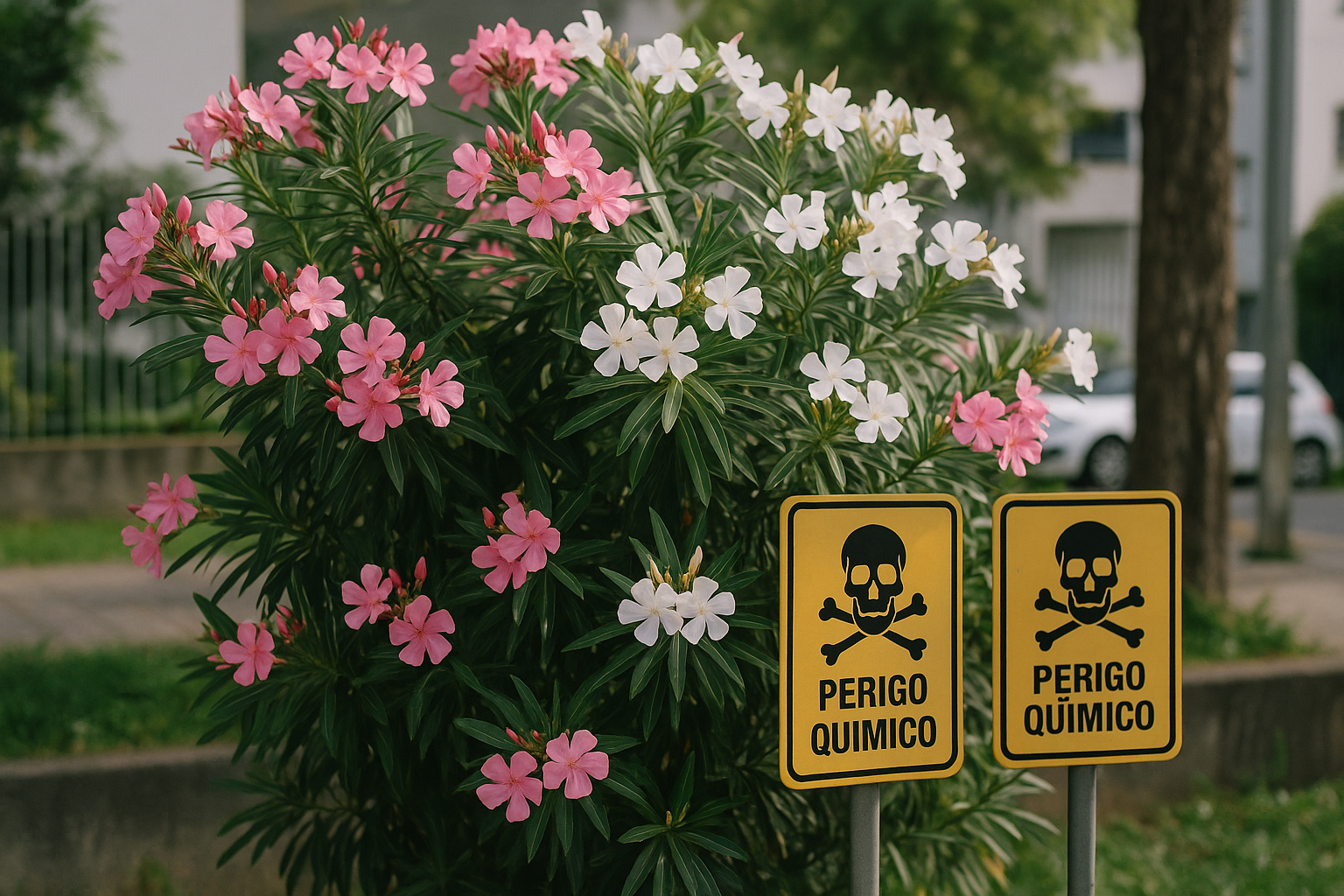


Ornamental Plant Widely Distributed in Brazil Raises Concerns Among Experts Due to High Toxicity, Strong Urban Adaptation, and Risks Little Known to the Population That Lives Daily with the Species
The Oleander (Nerium oleander), also known as oleander, is one of the most common ornamental plants in public areas and private gardens in various states of Brazil. However, behind the striking flowers in shades of white, yellow, pink, and red lies one of the most dangerous species in the world. According to an article published by Folhapress and the UOL portal, all parts of the plant are highly toxic to humans and animals, making its presence a little perceived but potentially serious risk.
The plant, which originates from the Mediterranean and western China, has been used for decades in urban landscaping projects. Its visual appeal justifies its popularity, as it easily adapts to different climates, grows as a shrub or small tree, and withstands urban conditions well. However, this efficient adaptation has contributed to its widespread dissemination across the national territory.


Confirmed Presence in Almost All Brazilian Regions Reinforces Experts’ Alert About Poisoning Risks
According to Flora do Brasil (JBRJ), oleander occurs in a wide variety of states, covering almost all regions of the country. In the North, it appears in Tocantins; in the Northeast, it is present in Alagoas, Bahia, Ceará, Maranhão, Paraíba, Pernambuco, Piauí, Rio Grande do Norte, and Sergipe. In the Midwest, it grows in the Federal District, Goiás, Mato Grosso do Sul, and Mato Grosso. In the Southeast, it is found in Espírito Santo, Minas Gerais, Rio de Janeiro, and São Paulo. Finally, in the South, it occurs in Paraná, Rio Grande do Sul, and Santa Catarina.
-
Cold War Secret Plane Lost Engine Mid-Flight, Forcing Six to Parachute in Darkness; Wreckage Remains in Death Valley Mountains 73 Years Later

-
Opened in 1980, Shopping Recife was Pernambuco’s first mall and helped transform Boa Viagem into a bustling and sought-after district in southern Recife.
-
Tired of Monthly Water Supply, South African Villagers in Limpopo Connect Mountain Spring to Taps, Bringing Water to 5,000 People with $700 Initiative

-
Rare Case of Neurocysticercosis in Spain: 60-Year-Old Man’s Suspected Brain Cancer Turns Out to Be Tapeworm Cysts, Avoiding Invasive Cancer Treatments





This extensive distribution reinforces the need for awareness, especially since many people are completely unaware of the plant’s toxic potential. The information was disclosed by UOL and confirmed by official botanical data, drawing attention to the fact that oleander coexists daily with millions of Brazilians without the risk being perceived.
Moreover, research shows that the species adapts easily to urban areas, growing both in isolation and in rows or decorative groupings. This means that schools, plazas, avenues, condominiums, and even residences may be harboring a silent danger.
From Leaves to Flowers: The Chemical Composition of the Plant Explains Why Even Smoke from Burning Can Cause Severe Poisoning
Research from USP and toxicological data from CIATox/SC confirm that the toxicity of oleander is present in all its parts: sap, leaves, flowers, roots, and even in the smoke released during its burning. Among the most dangerous substances are oleandrin and strophanthin, compounds capable of directly affecting heart function.
Symptoms of poisoning can arise quickly and include nausea, vomiting, dizziness, drowsiness, visual disturbances, mental confusion, cardiac changes, pulmonary edema, and in severe cases, the risk of coma. The combination of these effects makes the plant considered extremely dangerous, even in small quantities.
For this reason, its use in urban landscaping has been increasingly discouraged. In Araranguá, in the south of Santa Catarina, the city hall issued an official alert in April of this year about the risks of oleander. According to the announcement, despite the showy flowers, the plant poses a danger especially to children and pets.
The city hall emphasized that all parts of the species are toxic and recommended that residents avoid planting, replace existing specimens, and keep children and pets away from areas where the plant is present. The alert highlighted that, although it may seem harmless and decorative, oleander can cause severe poisoning even through accidental contact or minimal ingestion of its leaves.
Additionally, the municipal administration highlighted the importance of awareness campaigns, as many residents do not even know how to identify the plant. To reduce the risk of accidents, the municipality suggested safe and equally ornamental alternatives, such as azalea, hibiscus, aroeira, pitanga, clusia, gabiroba, and jabuticaba. These options provide beauty to urban landscaping without the risk of potentially fatal poisoning.
Meanwhile, experts continue to emphasize the need for care and the gradual replacement of oleander in public areas. Although its presence is common and often unnoticed, it is a plant whose toxic potential has been proven by academic studies, toxicological reports, and official alerts. Therefore, knowing its risks and adopting preventive measures is essential to protect the health of residents, children, and animals in all regions of Brazil.
Have you heard of any cases of poisoning or even death involving oleander in your city or region?




Sou escritora e no meu livro “Ausentes” uma pessoa tenta assassinar alguém com um suco contendo chá da planta.
Sobre a espirradeira, tudo que li não é verídico, minha mãe torrava as folhas, esmagava até virar pó e ao cheirar, ela realmente provoca muito espirro. Fiz muito uso dela, ninguém tinha renite, sinusite, nem bronquite, nem problema de amídalas, ufa era muito bom. Quero ver alguém queimar, perto de pessoas, vai ter espirro pra todo lado. Dor de cabeça, ninguém tinha, não se gastava com remédio, pra nada.