






 Portuguese
  Spanish
  4 min of reading
  4 comments


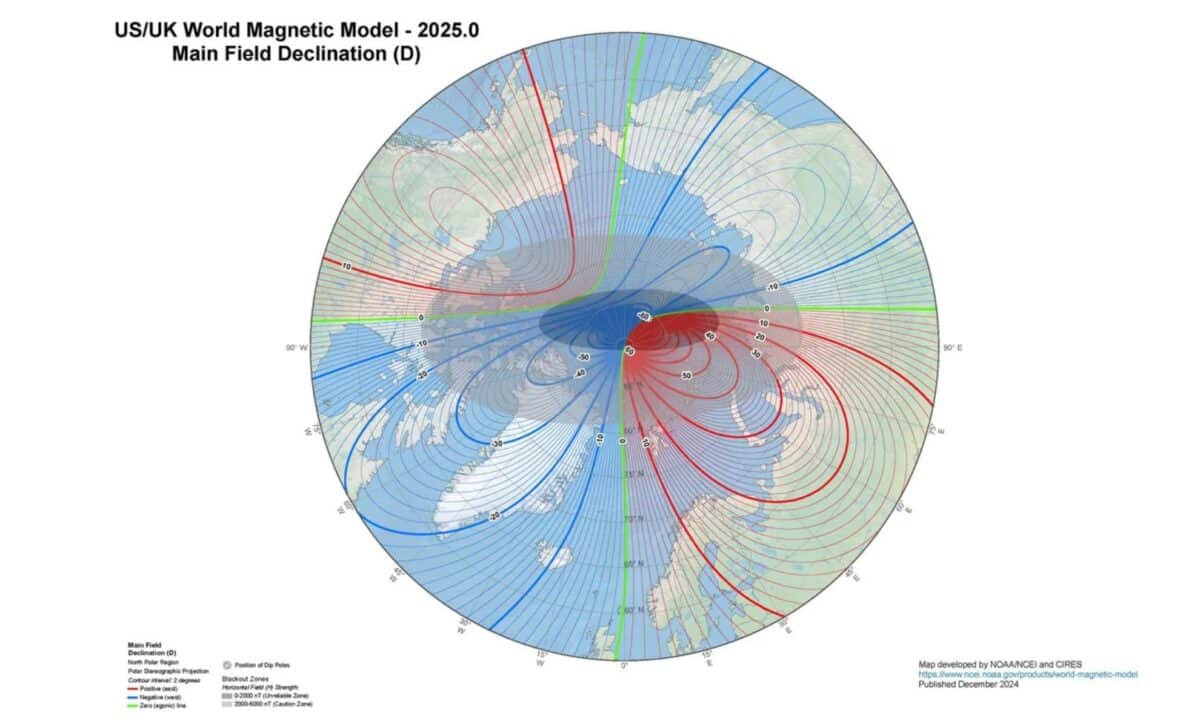


The Earth’s Magnetic North Pole Has Changed Again, and Scientists Are Investigating the Reasons Behind This Accelerated Displacement That Could Impact Global Navigation and Communications.
The Magnetic North Pole, a fundamental anchor of the Earth’s magnetic field, continues to move rapidly, shifting its position from the Canadian Arctic towards Siberia.
This movement is not just a geographic curiosity but rather a reflection of complex and turbulent processes in the core of the Earth.
The latest data model of the magnetic field, the World Magnetic Model (WMM), reveals fundamental information about the phenomenon that directly affects global navigation systems.
-
It accompanies Earth, but it is not a moon: Chinese probe reaches Kamo’oalewa and begins an unprecedented mission to investigate where the strange asteroid came from, what its internal structure is like, and whether its origin is linked to an ancient collision that launched fragments of the lunar surface into space.

-
Space technology used to search for water on Mars is now hunting for invisible leaks under the streets of São Paulo, using satellites, AI, and chlorine signals to help Sabesp recover up to 6.7 billion liters of water.

-
Japan sends ship to extract mud rich in rare earths at nearly 6,000 meters deep in the Pacific, attempts to lift 350 tons per day from the seabed, and transforms sediments near Minamitori Island into a strategic weapon to reduce dependence on China.
-
Venus Aerospace promises a rotating detonation hypersonic engine that takes the Stargazer to Mach 9 and crosses oceans in 1 hour, but the flight that made history barely surpassed the speed of sound.



What Causes the Movement of the Magnetic North Pole?
The Magnetic North Pole is not fixed due to internal activity within the Earth’s core. The outer core is composed of molten iron and nickel, which flow chaotically, creating electric currents and generating a magnetic field through a process known as geodynamo.
This causes the Magnetic North Pole to move constantly, unlike the geographic North Pole, which is fixed. This phenomenon occurs at a rate of tens of kilometers per year.
Dr. William Brown from the British Geological Survey (BGS) explains that the current behavior of the magnetic pole is unique.
“The magnetic north has slowly moved around Canada since the 1500s. But in the last 20 years, it has accelerated towards Siberia. This change, which previously occurred gradually, has increased from 50 to 35 kilometers per year in the last five years”, says the scientist.
This movement is not just a geophysical curiosity; it offers important clues about the Earth’s internal dynamics, processes still poorly understood by scientists.
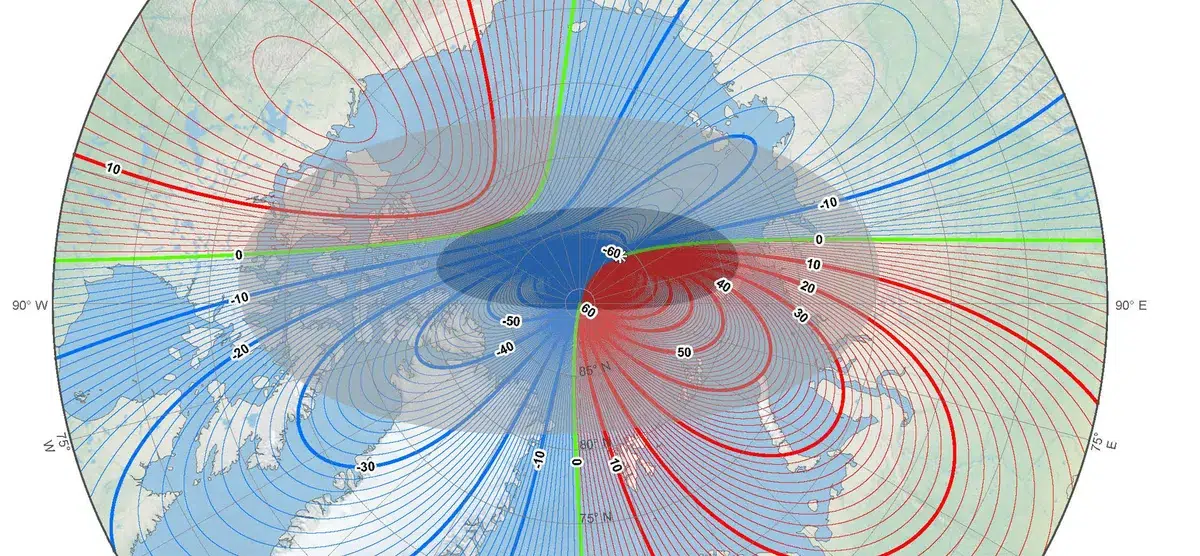
Image credit: NOAA/NCEI
Impact of the Movement on Navigation Technologies
The constant movement of the Magnetic North Pole has direct implications for the accuracy of modern navigation systems.
From GPS systems to sensors in smartphones, including maritime and military navigation, all of these rely on accurate measurements of the magnetic field.
The WMM, created by scientists from the National Centers for Environmental Information (NCEI) and BGS, provides essential updates for technologies that depend on this data. The latest version of the WMM, released on December 17, 2023, brought significant improvements:
- Enhanced spatial resolution: accuracy increased to about 186 miles at the equator, compared to over 2,000 miles in the previous version.
- Valid projections until 2029, ensuring reliable navigation systems over the next five years.
Brown adds: “With these updates, users of navigation systems should not notice significant changes. Accuracy remains high, allowing deviations to be kept under control.”
The Evolution of the Movement of the Magnetic North Pole
The movement of the Magnetic North Pole is not linear. Since the 1830s, it has shifted over 2,250 kilometers towards Siberia. The rate of displacement notably increased in the late 20th century, requiring special attention from scientists and authorities.
- 1830–1990: The movement was less than 15 kilometers per year, a gradual shift towards Siberia.
- 1990–2005: Accelerated to 50–60 kilometers per year, marking the beginning of a noticeable change.
- 2019: An out-of-cycle update was necessary due to rapid and unexpected changes.
- 2020–2023: The movement slowed to about 35 kilometers per year, an unexpected decrease.
This data shows how the Magnetic North Pole does not move predictably, reflecting the complexity and unpredictability of the Earth’s core.
What Does the Future Hold?
As scientists update the WMM every five years, the next forecast will include more accurate data on the speed and direction of the Magnetic North Pole’s movement.
This migration process continues to provide valuable insights into the Earth’s internal mechanisms, which are essential for maintaining the magnetic field that protects the Earth from solar radiation.
According to Brown, “with each update, we gain more information to refine forecasts. In about five years, the accuracy of the model begins to decline, so we make a new forecast with the most recent data.”
What Comes Next?
The Magnetic North Pole will continue to move unpredictably. For now, most users do not notice the changes, but the behavior of the Earth’s magnetic field has significant implications for navigation systems.
Scientists and experts continue to closely monitor the movement of the pole, ensuring that navigation technologies remain accurate and functional as the Earth continues to transform beneath our feet.
This constant evolution of the Magnetic North Pole is a window into the mysteries that still surround the Earth’s core, keeping scientists alert and seeking answers to complex questions about how our planet functions.







Oh Fábio, se o deslocamento foi de 50 pra 35km por ano, alimentou!?????
Mais profissionalismo!
Espiritismo também inclui a ciência em seus estudos!
Transição Planetária….pesquisem que acharam respostas mais rápidas senhores cientistas!