






 Portuguese
  Spanish
  6 min of reading
  0 comments


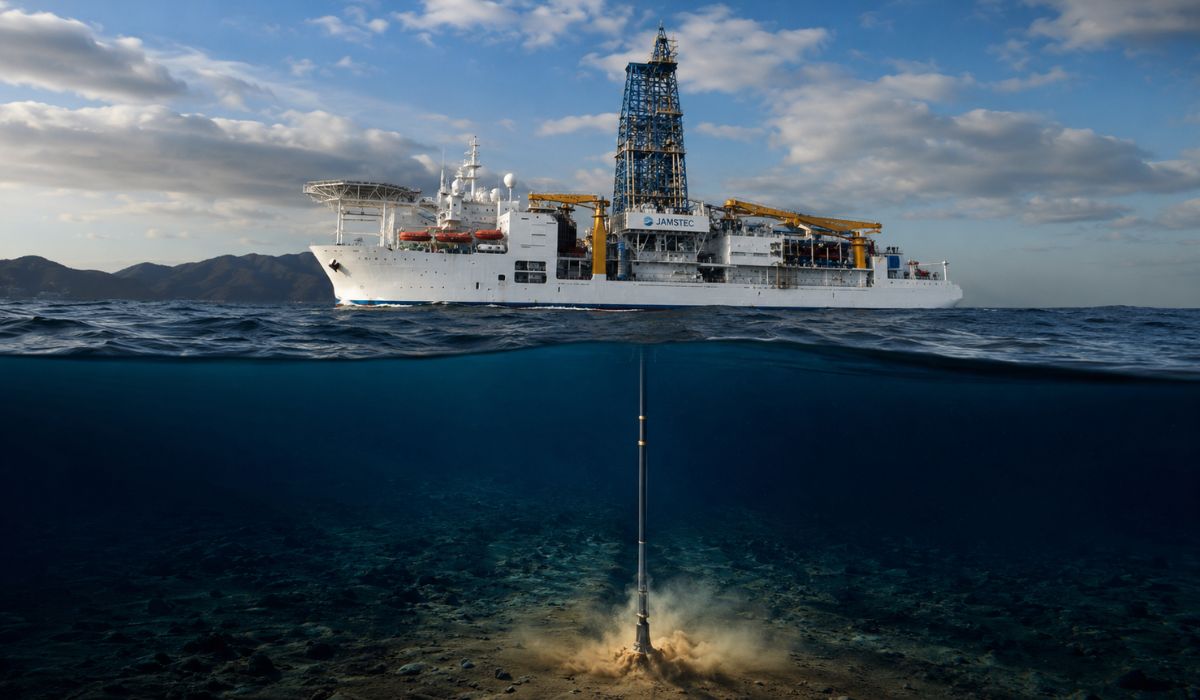
A Japanese expedition in the Pacific has placed deep sediments at the center of a technological dispute involving critical minerals, economic security, and the limits of exploration in little-known areas of the ocean.
Japan recovered rare earth-rich mud from the bottom of the Pacific Ocean in an operation conducted by the scientific vessel Chikyu, near Minamitori Island, about 1,900 kilometers southeast of Tokyo.
The mission, carried out in 2026, is part of a Japanese government project to test whether sediments located at almost 6,000 meters deep can be used in the future as a domestic source of critical minerals.
The operation involved the continuous removal of mud from the seabed at a depth considered extreme for this type of test.
-
Space technology used to search for water on Mars is now hunting for invisible leaks under the streets of São Paulo, using satellites, AI, and chlorine signals to help Sabesp recover up to 6.7 billion liters of water.

-
Venus Aerospace promises a rotating detonation hypersonic engine that takes the Stargazer to Mach 9 and crosses oceans in 1 hour, but the flight that made history barely surpassed the speed of sound.

-
Brazilian student creates a cheap formula that makes plants grow up to 90% faster and wins an award in a global scientific competition.

-
Europe unveils armored tank with remote turret, 1,500 horsepower, and 120-millimeter cannon




According to Reuters, the Chikyu departed from Shimizu port on January 12, 2026, arrived at the work area on January 17, and began recovering the material on January 30.
The first successful collection was confirmed on February 1.
The test does not represent the start of commercial mining.
The current stage serves to assess whether the system can bring sediments from the seabed to the surface stably, as well as to allow analyses of the volume, composition, and concentration of the elements found.
With this data, Japan will be able to study the technical, economic, and environmental feasibility of larger-scale exploration.
Rare earths in the Pacific and Japan’s interest
Rare earths form a group of elements used in high-tech industrial chains.
These materials appear in components of electric motors, high-performance magnets, electronic equipment, turbines, sensors, defense systems, and precision devices.
In the case of the sediments near Minamitori, Japanese authorities cited the presence of elements such as dysprosium, neodymium, gadolinium, and terbium.
These minerals are used in industrial and technological products, including electric vehicle motors and magnets used in high-efficiency equipment.
The search for alternative sources is directly related to Japan’s economic security.
China concentrates significant stages of the global rare earth supply chain and has adopted export controls on critical minerals and related products.
For economies dependent on industrial technology, restrictions in this market can affect sectors such as automobiles, electronics, energy, and defense.
The Japanese initiative, however, is still in the testing phase.
According to Reuters, the project has received about 40 billion yen since 2018, but there is no official goal for commercial production nor a public estimate of exploitable reserves.
Therefore, the recovery of the mud does not allow for the conclusion, at this moment, that Japan will be able to replace rare earth imports in the short term.
How the Chikyu retrieves sediments from nearly 6,000 meters
The Chikyu is operated by the Japan Agency for Marine-Earth Science and Technology, Jamstec.
The vessel was designed for scientific drilling in deep waters and, according to the agency itself, has the capacity to drill up to 7,000 meters below the seabed in scientific research.
On the mission near Minamitori, the challenge was to adapt piping systems and recovery equipment to transport sediments in a water column of nearly 6,000 meters.
The operation requires technical control because it occurs under high pressure, in a region far from the coast and subject to interruptions due to weather conditions.
According to Science Japan, a publication of the Japan Science and Technology Agency, the recovery devices, including a riser tube system, operated without problems during the mission.
The work, however, had to be temporarily halted due to bad weather.
The collected samples must undergo dehydration and subsequent analysis.
The Japanese government foresees a new phase in February 2027, with a larger-scale test.
The announced goal is to assess the capacity to recover about 350 tons of sediment per day.
There is also a plan, by March 2028, to evaluate the possibility of industrializing the extraction of rare earths in deep waters.
Minamitori gains importance in the race for critical minerals
Minamitori, also called Minamitorishima, is a remote Japanese island in the Pacific.
The region has started to be monitored by researchers because studies indicated the presence of mud with strategic elements within the Japanese exclusive economic zone, at depths between 5,000 and 6,000 meters.
The investigation of these deposits shows how the ocean floor has entered the agenda of countries seeking alternative sources of critical minerals.
Instead of relying solely on terrestrial deposits, governments and scientific institutions are studying whether marine sediments can, in the future, be integrated into industrial supply chains.
There are still significant obstacles between experimental collection and a commercial operation.
The material needs to be pumped, dehydrated, transported, separated, and refined.
Each step involves costs, technical losses, and impacts that need to be measured before any decision on large-scale production.
The environmental dimension is also part of the project.
The Japanese operation includes onboard and seabed monitoring because deep-sea activities can displace sediments and alter areas inhabited by organisms adapted to specific conditions.
So far, authorities treat the initiative as a recovery and analysis test, not as commercial mining.


China, Japan, and the dispute for mineral supply
The mission near Minamitori occurs in a context of international dispute over minerals essential to the technology industry.
According to Reuters, Shoichi Ishii, director of the program linked to the Japanese Cabinet, stated that a Chinese naval fleet entered the waters near the research area on June 7, 2025.
At the time, the Japanese ship was conducting resource surveys within the country’s exclusive economic zone from May 27 to June 25.
Ishii told the agency that there was “a strong sense of crisis” in the face of what he classified as intimidating actions.
The Chinese Ministry of Foreign Affairs responded to Reuters that the activities of its military ships were in accordance with international law and international conventions.
The Chinese government also urged Japan to avoid “exaggerating threats and provoking confrontation.”
The exchange of statements illustrates the political sensitivity of the topic.
For Japan, developing recovery technology and eventual processing of critical minerals can enhance supply security.
For China, the movement occurs in a Pacific area linked to strategic resources and production chains in which the country maintains a dominant position.
The test that still depends on new data
The collection carried out in 2026 demonstrated that Japan managed to operate a deep-sea sediment recovery system.
This stage, however, does not alone answer the main questions about cost, scale, environmental impact, and the ability to transform the mud into a regular source of rare earths.
There is also no official estimate released of exploitable reserves in the current project.
Without this data, it is not possible to measure how much the deposits near Minamitori could represent in Japanese supply nor compare their relevance with already established suppliers in the global market.
The analysis of the samples should indicate the concentration of the elements, the efficiency of the collection system, and the processing challenges.
Only from these results will the Japanese government have more concrete elements to decide if deep-sea exploration can advance to an industrial stage.
The operation, for now, remains in the field of applied research and technological development.
The question that still depends on data is whether the mud extracted from almost 6,000 meters deep can become a viable source of minerals used in electric cars, electronics, radars, and other industrial equipment.


Be the first to react!