Portuguese
  Spanish





Discover China’s Golden Bridge, The Largest Two-Level Bridge In The World Revolutionizing Mobility In Wuhan.
In the heart of Wuhan, over the powerful waters of the Yangtze River, stands China’s Golden Bridge, a true masterpiece of modern engineering. Inaugurated in October 2019, this suspended bridge not only connects the districts of Hanyang and Wuchang but also stands out as the largest two-level bridge in the world, facilitating the lives of millions of people daily.
China’s Golden Bridge features two impressive levels. The upper level has six traffic lanes and sidewalks for pedestrians, while the lower level adds four more lanes, as well as bike paths. This bold construction, which cost around ¥8.5 billion (or US$1.27 billion), not only alleviates congestion on the Yangtze River crossings but also captivates with its vibrant yellow color, giving the impression of being made of gold.
Construction of China’s Golden Bridge
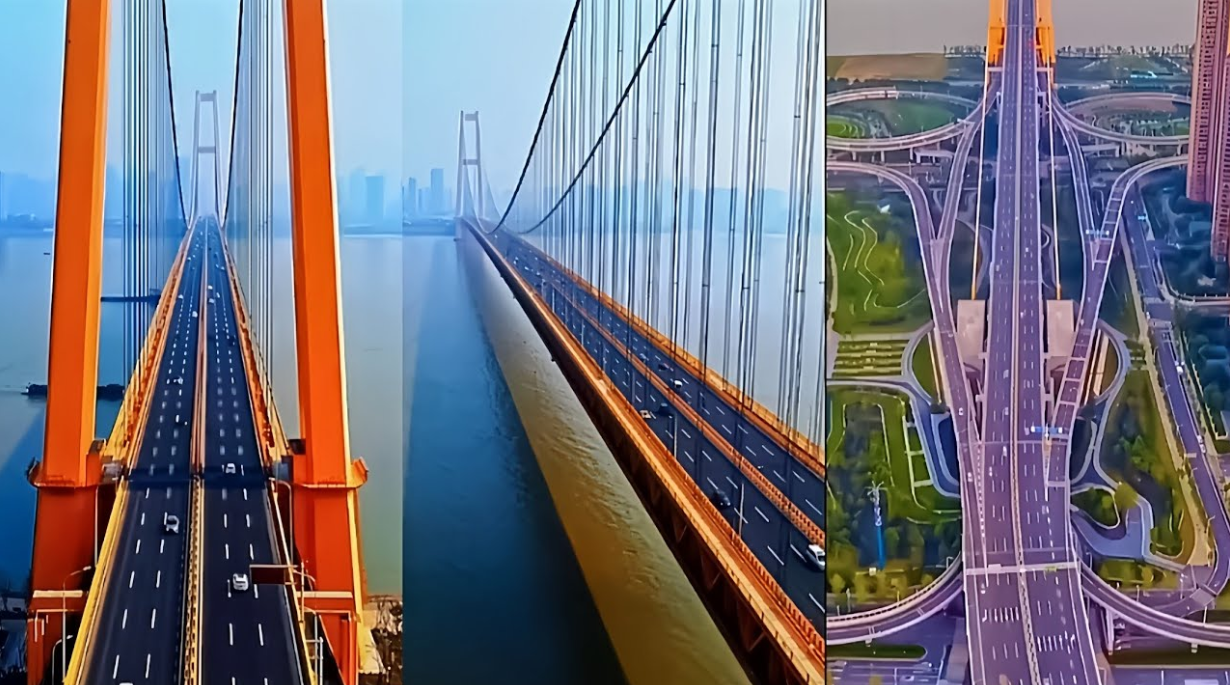
But how was it possible to construct such a complex structure over one of the most iconic and challenging rivers in the world? The construction of China’s Golden Bridge involved meticulous planning and cutting-edge technologies. With a total length of 4,134 meters and a main span of 1,700 meters, the bridge majestically rises over the Yangtze River. The main towers, with heights of 254.9 meters in the North and 231.9 meters in the South, support main cables that ensure the stability and safety of the structure.
-
Epoxy Paint Revolutionizes Bathroom Makeovers in a Weekend at a Fraction of Renovation Costs

-
Finnish Man Buys Unwanted Island for a Bargain, Builds Home with Seven Trees and €400 Roof, Lives Off-Grid with Family in -35°C

-
Burnished Concrete Gains Popularity in Brazilian Homes for Its Durable Finish and Minimalist Aesthetic
-
Man Builds Modern Luxury Village from Scratch Without Blueprints, Using Only His Intuition and Skill




The construction of China’s Golden Bridge faced numerous technical and environmental challenges. From the use of pneumatic caissons for foundations in an underwater environment to the implementation of advanced real-time monitoring systems to ensure the bridge’s integrity during each stage of construction. Every detail was considered to overcome the adversities of the Yangtze River, one of the widest and deepest rivers in the world.
Symbol of Technological Advancement
In addition to its grandeur, China’s Golden Bridge brings significant benefits to Wuhan. The construction of this bridge has drastically reduced congestion, improved the quality of life for residents, and boosted the economic development of the region. The pedestrian and cyclist walkways encourage a healthier lifestyle, while the robust transportation infrastructure attracts investments and promotes urban integration.
China’s Golden Bridge is not only an important route for millions of vehicles and pedestrians, but also a symbol of technological advancement and the ambition of Chinese engineering in the 21st century. With its innovative construction and stunning design, this bridge stands out as a visual landmark in the urban landscape of Wuhan, representing the future of major infrastructure projects around the world.