Portuguese
  Spanish


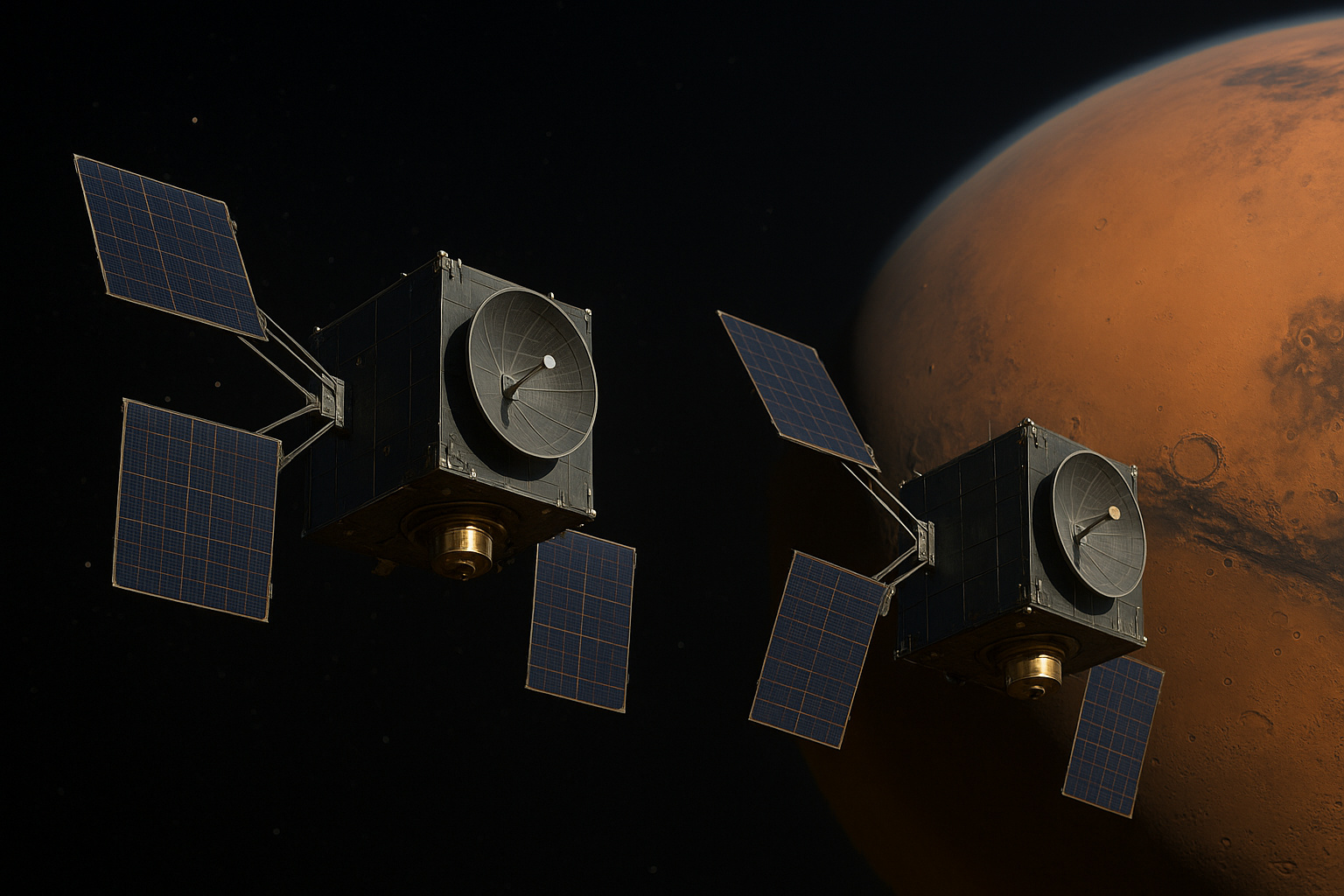

The Two Spacecrafts Bet on Low Cost, Orbital Innovation, and Unique Trajectory to Investigate the Atmospheric Dynamics of the Red Planet
The EscaPADE mission from Nasa emerges as an innovative initiative of the SIMPLEx program, as it uses two twin spacecraft to investigate why Mars lost its atmosphere. Additionally, the project bets on low cost, unique trajectory, and operational flexibility, maintaining the proposal to conduct planetary science with reduced budgets.
Technical Investigation Reveals Unique Orbital Approach
The EscaPADE uses two twin spacecraft on an unusual route to Mars. Thus, the mission employs a trajectory called “launch and hover”, created after delays prevented the use of the traditional transfer window. Although the strategy is bold, it allows launches on any day, as the spacecraft can wait for the ideal alignment in orbit.
The mission is led by the University of California, Berkeley, with support from Advanced Space and Rocket Lab. Therefore, the operation reinforces the commitment to high scientific value solutions. Jeff Parker, director of technology at Advanced Space, highlights that the project delivers results comparable to much more expensive missions, even operating with a budget under US$ 100 million.
-
She spent 73 years breathing inside an iron lung, survived the aftereffects of polio, and became the last woman in the United States dependent on the equipment before dying at 78 years old.

-
Brazilian students created a $1 filter using pine bark, cotton, and 3D-printed parts to clean cassava wastewater, reduce the toxicity of a hazardous waste, and transform contaminated water into biofertilizer.

-
Astronaut from Artemis II steps down after mission to the Moon and decision surprises after a record of 406,771 km, a historic 10-day journey, and an unprecedented achievement for Canada.

-
A fossil kept for years in a small museum in Montreal concealed 450-million-year-old soft tissue, a discovery that has only happened once before in history.


Orbital Flexibility and Strategic Steps of the Mission
After launch by the New Glenn rocket, the spacecraft head to Lagrange Point 2 (L2). Therefore, they use this gravitational point as a parking spot in space until the next ideal transfer window. Thus, the trajectory includes:
• Launch by New Glenn from Blue Origin
• Movement to L2 Point
• Stable orbit around L2
• Close return to Earth
• Orbital insertion into Mars after the ideal alignment
This strategy offers fuel efficiency, as it reduces complex maneuvers between celestial bodies. Moreover, it demonstrates how small spacecraft can operate with flexibility and low cost.
Operational Risks and Technological Challenges
Although the strategy offers flexibility, it adds risks because components suffer wear during long stays in deep space. However, Parker states that these risks are part of the effort to make planetary exploration more accessible. Additionally, he reminds that other SIMPLEx missions faced difficulties, such as Lunar Trailblazer and LunaH-Map, which had technical setbacks.
Even so, Parker argues that a successful mission would already justify the program. Thus, he emphasizes that SIMPLEx seeks high scientific value with reduced costs.
Scientific Impact and Relevance for the Future of Planetary Missions
The EscaPADE investigates how Mars lost its atmosphere, a fundamental theme for understanding the planet’s climate change. Therefore, the mission could become a reference for conducting low-cost planetary exploration. In addition, it reinforces the importance of more flexible and creative approaches in orbital missions.
The success will depend on the ability to balance risk, efficiency, and scientific accuracy. Thus, EscaPADE can mark significant advances for the SIMPLEx program and open the way for new strategies for space exploration.
What do you think should be a priority for Nasa’s low-cost missions: increasing operational flexibility or strengthening safety to ensure more predictable outcomes?