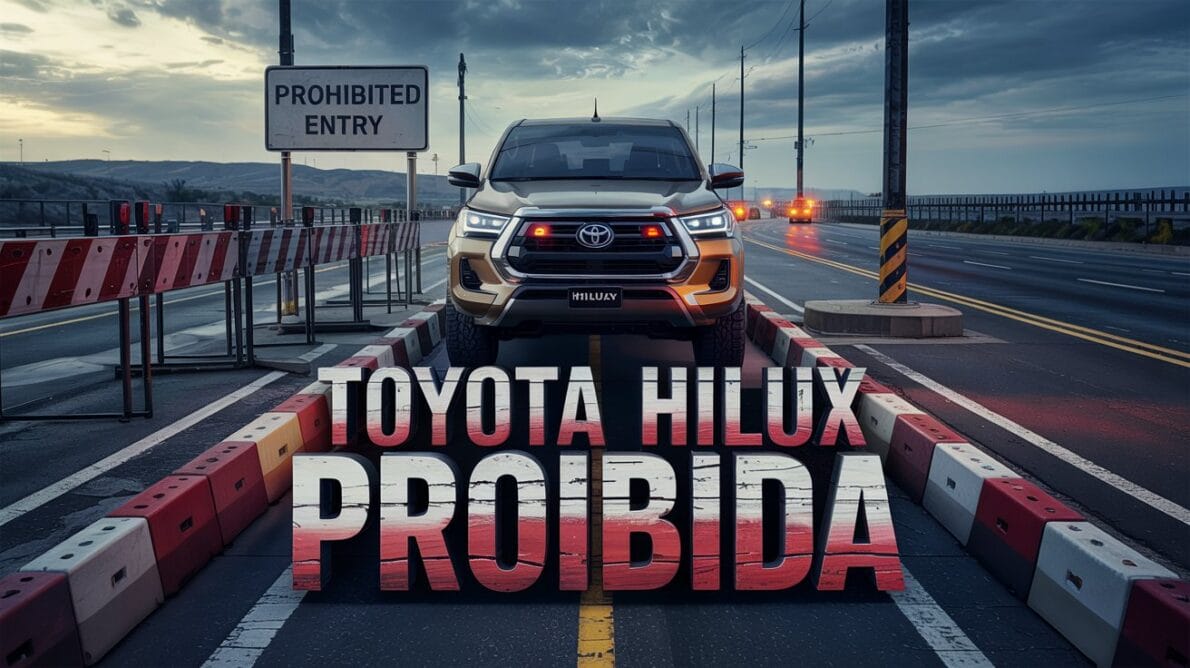
Entenda o motivo curioso que fez a Toyota Hilux ser proibida nos Estados Unidos, desafiando as expectativas de um mercado apaixonado por picapes.
28 people reacted to this.
Discover The Reason Why One Of The Most Legendary Cars In The World Is Banned In The Largest Pickup Market, And How An Unexpected Tax Generated This Curious Situation.
The Toyota Hilux is a legendary pickup that has earned a global reputation for its durability.
Considered indestructible, it is capable of facing extreme conditions, such as being submerged in the ocean, being destroyed with a building, or even enduring strong currents.
Even in such adverse situations, the Hilux continues to function as if nothing had happened.
It has become the best friend of farmers, explorers of remote places, humanitarian agencies, and even military groups in conflict zones.
When thinking of a reliable vehicle to cross deserts, climb mountains, or withstand years of intense use, it is the Hilux that comes to mind.
But what makes this phenomenon even more curious is that the Hilux, despite being a global icon, is practically banned in the United States.
Yes, the pickup famous for its durability is not available in American dealerships.
And the most surprising thing is that this absence is not related to safety failures, lack of interest, or reliability issues.
The real reason is quite unusual and has to do with chickens.
That’s right, chickens.
To understand this mystery, we need to go back in time and explore some import laws and a curious trade conflict.
The Origin Of The Toyota Hilux
The story of the Hilux began in the late 1960s, when Toyota decided to create a robust pickup capable of tackling difficult terrains without losing the slightest bit of comfort.
The name “Hilux” is a combination of the words “High” and “Luxury,” but ironically, the initial model was far from luxurious.
The idea was simple: create a reliable, practical, and durable truck, without fuss, capable of handling any type of terrain.
And the formula worked.
The Hilux quickly became a craze, especially in markets in Asia, Africa, and Latin America.
It proved to be not just a work vehicle but also an ideal model for everyday use.
In a short time, drivers from various parts of the world realized that the Hilux was not just another truck.
It became practically indestructible.
With proper maintenance, it could run hundreds of thousands of kilometers without issues.
Soon, its durability caught the attention of those needing vehicles for extreme conditions.
Whether on the roughest roads, in the middle of deserts, or even in war scenarios, the Hilux would survive almost anything.
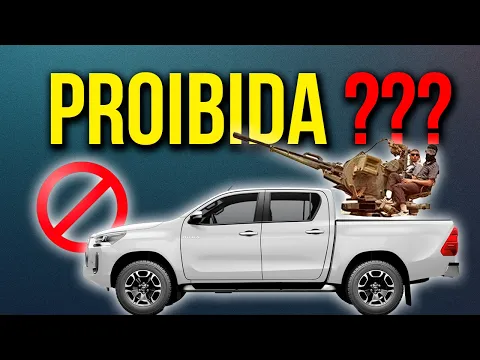
In fact, during some conflicts around the world, the number of armed Hiluxes was so large that the term “Toyota War” began to be used to describe battles where these pickups were equipped with machine guns and rockets.
Thus, unwittingly, Toyota saw its vehicle transformed into an improvised military tool, further enhancing its reputation.
The Exit Of The Hilux From The United States
Over time, the Hilux began to gain more sophisticated versions, including diesel models and 4×4 traction.
However, inexplicably, the Hilux disappeared from the dealerships in the United States.
And then comes the question: why does a country obsessed with pickups not have the Hilux?
The answer involves a curious and complex story, with a tax dating back to the 1960s.
This tax, known as the “Chicken Tax,” was created in response to a tariff imposed by European countries on American chicken.
As retaliation, the U.S. government, at the time led by Lyndon B. Johnson, imposed a 25% tariff on the import of certain products, including light pickups.
It sounds surreal, but yes, a trade dispute involving chickens affected the entry of pickups into the United States.
Initially, this tax targeted Volkswagen models, such as the famous Combi pickup Type 2.
However, the tax persisted, and its application extended to any manufacturer wishing to import light pickups produced outside the United States.
This made it much more expensive for Toyota and other brands to enter the U.S. market.
And, as we know, U.S. consumers love large, powerful, and affordable pickups.
Therefore, this 25% tariff made imported pickups too expensive to compete with locally produced models.
The Toyota Solution: Create A Model For The U.S.
Faced with this trade barrier, Toyota decided to create a pickup specifically for the U.S. market, manufactured locally to avoid the 25% tax.
This model, as you might guess, is the Toyota Tacoma.
The Tacoma is not simply a rebranded Hilux, although it shares the same DNA.
It was specifically designed to meet the preferences of the American consumer, who has different tastes when it comes to pickups.
The suspension of the Tacoma was adjusted to provide more comfort.
The engines were tuned to prioritize performance on the roads.
Additionally, the look was adapted to align with American market expectations.
This made perfect sense, since, in the U.S. pickup market, consumer taste is quite specific.
The best-selling pickups are full-size, like the Ford F-Series, especially the F-150, and the Chevrolet Silverado.
These models are large, with powerful V8 engines, spacious cabins, and are often used for both work and leisure.
But, of course, there is also a niche for mid-size pickups.
Models like the Toyota Tacoma, Chevrolet Colorado, Ford Ranger, and Nissan Frontier fall into this category.
However, the audience for these models demands a certain level of comfort, refinement, and performance, which was not the focus of the Hilux.
The Impact Of Environmental Regulations
Another factor that influenced the exit of the Hilux from the United States was the change in environmental regulations in the late 1980s and early 1990s.
Pollutant emission laws became stricter, especially for diesel engines.
Adapting the Hilux to these new requirements would require heavy investment, making it even more difficult to market the model.
The Final Decision Of Toyota
In light of these obstacles – the “Chicken Tax,” new environmental regulations, changes in consumer preferences, and competition with the Tacoma – Toyota decided, in mid-1995, to pull the Hilux from the North American market.
Meanwhile, the Tacoma was launched to fill this gap, better serving the needs of the local audience.
In the United States, Toyota began to offer the Tacoma, while for those wanting something even larger and more powerful, there was the Tundra, a full-size pickup intended to compete with models like the Ford F-150 and Chevrolet Silverado.
In the end, Toyota not only managed to navigate the bureaucratic and tax difficulties but also better served the American audience.
Hilux: A Myth
Although the Toyota Tacoma is an excellent pickup model, the Hilux remains a true myth.
It is a legend on wheels, admired for its durability, and continues to be one of the most iconic pickups in the world.
Now, the question remains: do you believe the Hilux would succeed in the United States, even with all the trade and regulatory barriers? Leave your opinion in the comments.
When you first accessed our site using a Social Access button, we collected your public profile information shared by the Social Access provider, based on your privacy settings. We also obtained your email address to automatically create an account for you on our website. Once your account is created, you will be logged into that account.
I disagreeI agree
I allow you to create an account.
When you first accessed our site using a Social Access button, we collected your public profile information shared by the Social Access provider, based on your privacy settings. We also obtained your email address to automatically create an account for you on our website. Once your account is created, you will be logged into that account.
I disagreeI agree
6 Comments
most recent
olderMost voted
crisóstomoSoaresRodrigues
#131670
28/04/2025 10:37
AMARICANOS NAO VÃO DEIXAR DE COMPRAR CARROS AMERICANOS, PRA COMPRAR JAPONÊS… ELES SAO REALMENTE PATRIOTAS…
Bob
#131379
23/04/2025 15:59
Sou muito mais a Mitsubishi Pajero diesel. Mais forte, mais bonita, mais confortável.
Misampri 45
#131365
23/04/2025 06:28
A Hilux dispensa comentários. Uma pick-up sem concorrente. A concorrente mais próxima é a Ford ranger que vende cinquenta por cento a menos. Portanto, se você deseja comprar uma pick-up média pode fechar o olho na compra de uma Hilux. Ah ! não se esqueça de comprar a última versão , a SRX plus, parece um corolla no quesito estabilidade. Outra coisa : dirige sozinha, basta colocar a velocidade de Cruzeiro, ela faz quase tudo por você. Claro, motorista atento sempre.
A journalist who graduated in 2017 and has been active in the field since 2015, with six years of experience in print magazines, stints at free-to-air TV channels, and over 12,000 online publications.
A specialist in politics, employment, economics, courses, and other topics, he is also the editor of the CPG portal. Professional registration: 0087134/SP.
If you have any questions, wish to report an error, or suggest a story idea related to the topics covered on the website, please contact via email: alisson.hficher@outlook.com. We do not accept résumés!






 Portuguese
  Spanish









AMARICANOS NAO VÃO DEIXAR DE COMPRAR CARROS AMERICANOS, PRA COMPRAR JAPONÊS… ELES SAO REALMENTE PATRIOTAS…
Sou muito mais a Mitsubishi Pajero diesel. Mais forte, mais bonita, mais confortável.
A Hilux dispensa comentários. Uma pick-up sem concorrente. A concorrente mais próxima é a Ford ranger que vende cinquenta por cento a menos. Portanto, se você deseja comprar uma pick-up média pode fechar o olho na compra de uma Hilux. Ah ! não se esqueça de comprar a última versão , a SRX plus, parece um corolla no quesito estabilidade. Outra coisa : dirige sozinha, basta colocar a velocidade de Cruzeiro, ela faz quase tudo por você. Claro, motorista atento sempre.