






 Portuguese
  Spanish
  6 min of reading
  0 comments


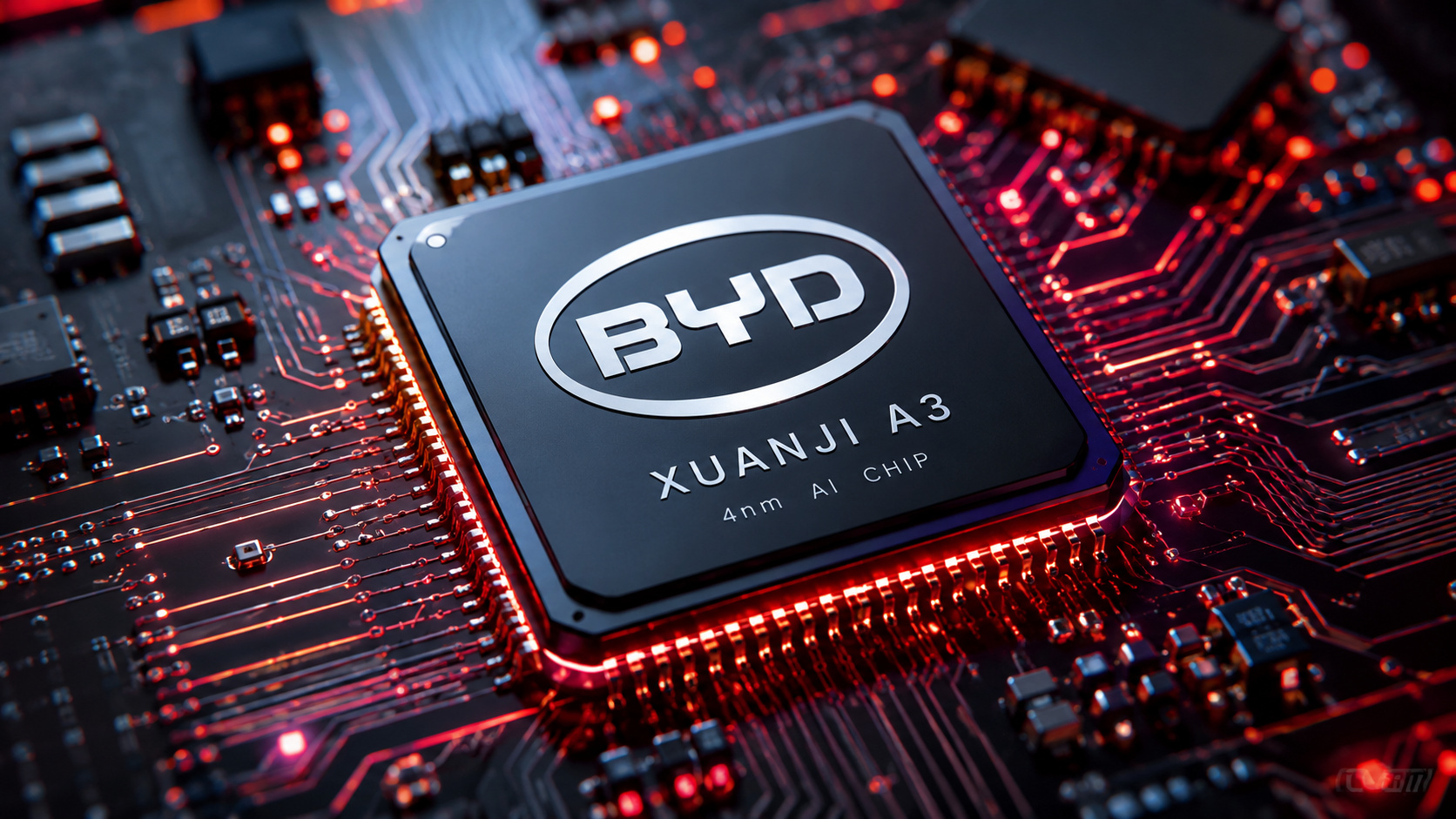
BYD presents the Xuanji A3, a new 4 nm chip created in China for intelligent driving, expanding its role in semiconductors and automotive innovation.
BYD has taken one of the most important steps in its technological journey by announcing the Xuanji A3, the first intelligent driving chip manufactured in China with 4-nanometer technology. The novelty was presented in Shenzhen and reinforces the automaker’s role in the strategic semiconductor market.
More than an advancement for the brand’s cars, the launch represents a significant move in the global race for technological autonomy. With the new component, the company seeks to reduce dependence on external suppliers, increase integration between hardware and software, and enhance its competitiveness in the smart vehicle segment.
According to information from Forbes on May 29, the announcement comes at a time when governments and companies are investing billions to strengthen their supply chains after the impacts of the global semiconductor crisis, which affected the automotive industry between 2020 and 2022.
-
Two new 300cc models from QJ Motor are expected to arrive in Brazil as SBM to target the CB 300F and shake up the low-displacement market, with more power and liquid cooling than Honda.

-
Camaro may reappear in 2027, but not as you remember: Chevrolet prepares the return of the icon with four doors, manual transmission, and an extreme performance version to face the new era of sports cars.

-
Space technology used to search for water on Mars is now hunting for invisible leaks under the streets of São Paulo, using satellites, AI, and chlorine signals to help Sabesp recover up to 6.7 billion liters of water.
-
Japan sends ship to extract mud rich in rare earths at nearly 6,000 meters deep in the Pacific, attempts to lift 350 tons per day from the seabed, and transforms sediments near Minamitori Island into a strategic weapon to reduce dependence on China.



Xuanji A3 places BYD among the protagonists of the new technological race
The Xuanji A3 enters the market with specifications that have caught the industry’s attention. According to BYD, the component has a processing capacity of 700 TOPS (trillions of operations per second), an indicator used to measure the performance of artificial intelligence systems.
When three units operate together, the total capacity reaches 2,100 TOPS, allowing embedded systems to process enormous volumes of data in real-time.
In practice, this means that smart vehicles will be able to identify pedestrians, vehicles, traffic lanes, road signs, and other environmental elements more quickly and accurately.
During the presentation, Stella Li, the company’s global executive vice president, highlighted that the manufacturer has become the first automaker in the automotive sector to produce a chip with 4-nanometer manufacturing technology.


How BYD’s chip can transform the production of smart vehicles
The development of the Xuanji A3 not only impacts the embedded technology of automobiles. It can also generate significant gains in the company’s cost structure.
By internally producing a strategic component, BYD reduces its dependence on external suppliers and gains control over an even larger part of the production chain.
The expected benefits include:
- Greater integration between hardware and software;
- Reduction in component acquisition costs;
- Less exposure to supply crises;
- Faster development of new technologies;
- Economies of scale in global production.
This vertical integration strategy has already been applied by the company in areas such as batteries, electric motors, and electronic systems. Now, semiconductors are becoming part of this proprietary ecosystem.
China accelerates investments in semiconductors amid global restrictions
The launch of the Xuanji A3 is also linked to China’s effort to expand its technological independence.
In recent years, the United States has intensified restrictions on the export of advanced chips, manufacturing equipment, and artificial intelligence accelerators to Chinese companies.
In response, the Chinese government has encouraged various sectors of the economy to strengthen their domestic semiconductor production.
In this scenario, BYD emerges as one of the main representatives of this industrial strategy. The company seeks to reduce dependence on foreign companies and strengthen the national production chain in one of the most important sectors of the modern economy.
The movement follows a trend observed in several countries that have started to treat chips as strategic assets for economic and technological security.
The semiconductor crisis changed the automotive industry’s strategy
BYD’s decision is also explained by the effects of the global semiconductor crisis.
At the beginning of the pandemic, many automakers reduced their component orders anticipating a prolonged drop in sales. However, the recovery of the automotive market occurred more quickly than expected.
At the same time, chip manufacturers directed their production capacity to meet the strong demand for notebooks, smartphones, consoles, and other consumer electronics.
Several factors worsened the scenario:
- Storms that affected industrial facilities in Texas;
- Drought periods in Taiwan;
- Accidents in sector factories;
- Global logistical bottlenecks.
According to a survey by AlixPartners, the semiconductor shortage resulted in losses exceeding US$ 200 billion for the global automotive industry in 2021 alone.
Also according to the consultancy, approximately 11 million vehicles were not produced that year due to a lack of electronic components.
In Brazil, data from Anfavea indicates that around 370 thousand vehicles were not manufactured in 2021 due to the chip shortage.
Energy efficiency is another differential of the Xuanji A3
In addition to processing capacity, the new chip was also developed with a focus on energy efficiency.
According to information released by the company itself, the Xuanji A3 consumes approximately 20% less energy than competing solutions.
This factor is particularly important for smart and electric vehicles, where each gain in efficiency can contribute to increasing battery range.
The combination of high performance and lower energy consumption tends to become an important differential as driver assistance systems and autonomous driving become more sophisticated.
Billion-dollar investment reinforces BYD’s commitment to innovation
The development of the new chip is part of a broad research and development program by the company.
Although the company has not disclosed the specific investment allocated to the Xuanji A3, Stella Li stated that the project is part of the manufacturer’s global R&D program.
Currently, this program moves about 100 billion yuan, equivalent to approximately R$ 74 billion.
The resources are allocated to areas considered strategic for the future of mobility:
- Artificial intelligence;
- Autonomous driving;
- Advanced batteries;
- Digital infrastructure;
- Semiconductor development.
The volume of investments helps explain why BYD has become one of the most valuable companies in the automotive sector, currently reaching a market value close to US$ 118 billion.
Autonomous Driving and New Projects Expand BYD’s Presence in Brazil
In addition to the chip announcement, the company revealed new plans for the expansion of its technologies.
The manufacturer confirmed that the Tianshen autonomous driving system is expected to arrive in the Brazilian market in 2027. The platform will be compatible with advanced levels of automation, including L3 and L4 standards.
Another highlight involves the planned investments for Rio de Janeiro.
Recently, the company announced the creation of a research and development center, in addition to the construction of a data center aimed at supporting projects related to autonomous driving.
The company also plans to install its first automotive testing center in Brazil. The complex will be built in the area of Galeão International Airport and will involve an estimated investment of R$ 300 million.
The structure will occupy approximately 183,000 square meters and was inspired by a similar facility that the company currently operates in Zhengzhou, China.
What BYD’s Advancement Reveals About the Future of the Industry
The launch of the Xuanji A3 shows that the competition for leadership in the automotive sector is no longer happening only among automakers.
Today, the competition involves artificial intelligence, software development, semiconductor production, and mastery of critical technologies for the mobility of the future.
By developing its own chip, BYD strengthens its technological independence, expands its innovation capacity, and reduces vulnerabilities associated with the global supply chain.
At the same time, the project reinforces China’s strategy to increase its self-sufficiency in sectors considered essential for the country’s economic and technological growth.
More than just a new electronic component, the Xuanji A3 represents an important step in transforming BYD into a global technology giant, prepared to compete in an industry increasingly based on artificial intelligence, connectivity, and smart vehicles.
With information from Forbes.


Be the first to react!