






 Portuguese
  Spanish


Three Brothers Born in New York in the 1960s Were Separated at Birth, Raised Without Knowing Each Other, and Secretly Observed in a Study. The Case Remains Shrouded in Secrecy Until 2065, When the Documents Will Be Opened.
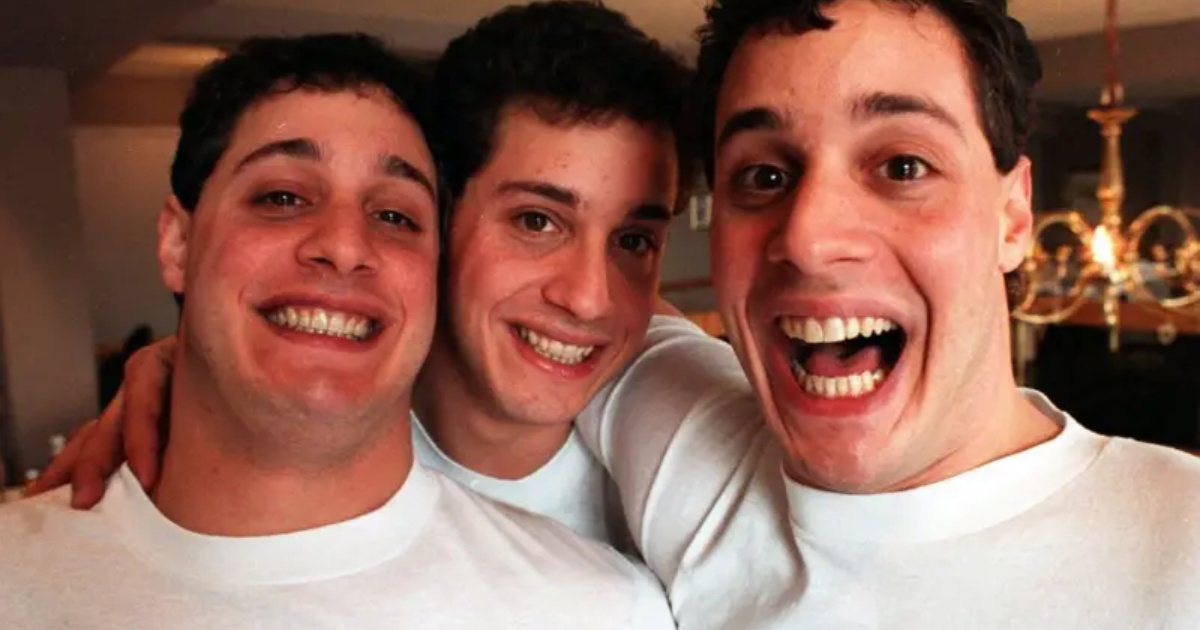
Three identical brothers born in July 1961, in a suburb of New York, were separated as infants and adopted by different families, without their adoptive parents knowing about the existence of the others.
The case, which gained major attention when revealed, remains surrounded by doubts and will only have complete answers in 2065, when confidential documents about the experiment will finally be opened to the public.
Unexpected Encounter and International Repercussion
According to a report by the BBC, the surprising story began to unfold in 1980, when Robert “Bobby” Shafran, at 19, arrived on his first day at Sullivan Community College in New York State.
-
Brazil Secures Second Place at WorldSkills 2024 in Lyon, with 64 Young Professionals and 8 Medals, Including Gold from a Rio de Janeiro Hairdresser

-
3,000 Military Personnel from 10 Countries, Including US and Chinese Marines, Train Together in Brazil’s Savanna: Operation Formosa Becomes Largest Naval Ground Exercise Before First Cancellation Since 1988
-
UAE Sends 110 Date Palm Trees to Brazil, Signs $4 Million Deal to Boost Date Production in Bahia’s Hinterland, with Presidential Palace Receiving 10 Saplings
-
The Day the Soviet Union Forfeited Against Chile, Leading to an Uncontested Goal and a Spot in the 1974 World Cup


Immediately, he was greeted by classmates and staff as if he were an old friend named Eddie.
The resemblance was so striking that Michael Domnitz, a friend of Eddie Galland, did not hesitate to ask Bobby if he was adopted and if his birthday was July 12, 1961.
Upon confirming the coincidences, Bobby and Michael sought out Eddie, initiating a series of discoveries that would forever change their lives.
The reunion between Bobby and Eddie was described by Bobby as “weird and fantastic,” highlighting how even trivial details, such as lip issues during the winter, were identical between them.
The New York media quickly reported on the case, catching the attention of David Kellman, who also had the same birthday and identical physical characteristics.
David immediately identified with the published photos in newspapers and, after reaching out, confirmed he was the third brother of the trio of twins.
Cohabitation, Differences, and Family Tragedy
After the reunion, the three brothers quickly became celebrities, participating in TV shows and interviews.
They decided to live together and even opened a restaurant, called Triplets, in reference to their newly discovered bond.
However, daily living revealed personality differences and conflicts, leading Bobby to distance himself from the business.
Eddie’s emotional situation also deteriorated, culminating in his death in 1995 after a period of depression.
Separation, Adoption Agency, and Scientific Experiment
With the revelation of their biological ties, the brothers’ adoptive parents sought explanations from the responsible agency, the defunct Louise Wise Services in New York.
The justification given was that it would be difficult to find a family willing to adopt three siblings at once.
However, it was later discovered that the separation of the brothers was part of a scientific study conducted by Austrian psychoanalyst Peter Neubauer.
The experiment aimed to analyze the extent to which environment or genetics influence human development.
As Bobby and David reported, during their childhood, their families regularly received researchers who conducted tests, filmed daily interactions, and assessed their performance in various tasks.
These visits occurred until the brothers turned ten years old.
Despite the insistence of the adoptive parents, the true purposes of the visits and the study were never revealed during the boys’ childhood.
Data Secrecy and Future Revelations
The revelations about the experiment came to light years later, thanks to the investigation of journalist Lawrence Wright.
He located references in scientific articles about a secret study involving the separation of identical twins for comparative analysis of the impact of genetics and the environment on individual formation.
Peter Neubauer and his team followed several families, but the collected data was never published.
The official documents of the study are kept confidential at Yale University, with plans to be opened only in 2065.
This currently prevents both the brothers and the public from knowing the real impact of the experiment or even how many children were affected by the procedure.
According to reports, at least four pairs of identical twins participated in the research.
Psychological Consequences and Scientific Ethics
The brothers reported that during childhood, they exhibited similar behaviors, such as aggression and episodes of banging their heads in cribs, which was later interpreted as possible signs of separation anxiety.
The case raised relevant ethical questions about the limits of scientific research, family consent, and the rights of adopted children.
Bobby and David express the hope that, in the future, the information generated can contribute positively to other children, despite the suffering caused.
“It would be nice to know if some conclusions could be useful. So that all of this wouldn’t be in vain,” Bobby stated in an interview with the BBC.
Documentary and Pop Culture
In 2019, the story of the three brothers gained a new chapter with the release of the documentary “Three Identical Strangers,” directed by Tim Wardle.
The production reconstructs the brothers’ journey and brings to light debates about ethics, science, and identity.
Even with extensive media coverage and documentary developments, much of the details about the experiment remain unknown.
Access to the sealed files, scheduled for 2065, may finally clarify the mystery surrounding the brothers’ lives and the true purpose of the study.
In light of this scenario, the question remains:
How far is it acceptable to subject human lives to scientific experiments in the name of advancing knowledge?


