






 Portuguese
  Spanish


Public Sector Robot Suffers ‘Accident’ After One Year of Service in South Korea. Case Sparks Debate on AI Failures and Use of Robots by Municipalities.
An unusual incident has rekindled the global debate over the limits of automation in the public sector. In the city of Gumi, South Korea, a robot serving as a municipal employee was found fallen at the bottom of an internal staircase in the government building. According to official reports, the equipment, which operated as an “assistant supervisor,” had exhibited abnormal behavior moments before falling. The case is being treated as an accident, but raises serious questions regarding the reliability of artificial intelligence in everyday operational functions.
Public Sector Robot Was Seen as an Example of Public Innovation
The city of Gumi, with approximately 420,000 inhabitants, was a pioneer in implementing a project that placed technology at the center of public administration. Since August 2023, the robot — developed by Bear Robotics — had been circulating among the floors of the main municipal building, performing tasks such as document delivery, reading announcements, and even brief interactions with citizens.
Described as the first public sector robot in South Korea, the equipment was developed to operate based on location systems and artificial intelligence, using sensors to navigate safely through the hallways. Its performance had been considered positive by the municipal administration, which intended to expand the project’s use to other sectors.
-
The ‘tsunami’ of investments directed at Artificial Intelligence (AI) and semiconductor companies, which prioritize security and more predictable profits, has been a determining factor in the declining trajectory of Bitcoin.

-
Samsung eyes strategic chip factory in South Korea and could shake up the global AI landscape with advancements in HBM memories and advanced packaging.

-
Nvidia makes agreements in South Korea for AI factories and takes data centers, advanced chips, and global cloud to another level by 2027
-
ChatGPT reveals which human job it would choose if it could really work


The Accident: AI Failure or System Collapse?
The episode occurred on June 26, 2024, around 4 p.m. Staff reported that the robot was “standing in a corner,” displaying unusual behaviors, such as random and repetitive movements. Soon after, it fell from the top of a staircase, being found in parts on the ground floor.
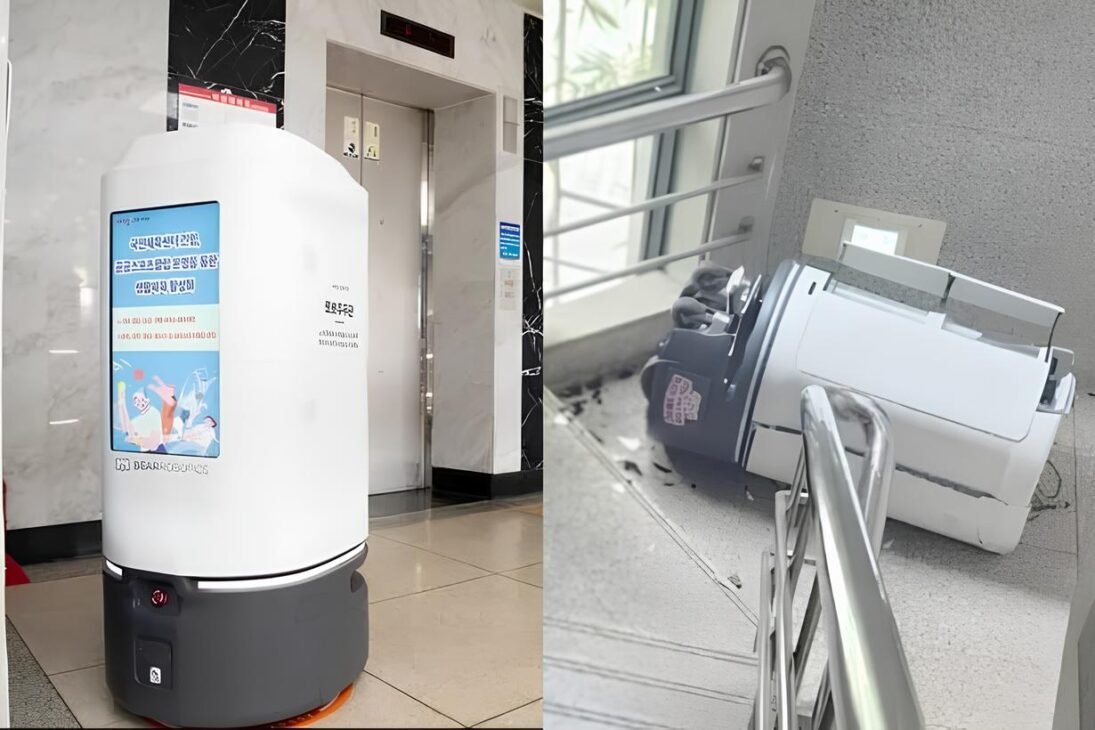
The Gumi municipal government confirmed the incident and initiated an investigation to determine the cause of the fall. Experts are assessing whether there was an AI failure, navigation error, or mechanical defect. The case remains under analysis while specialists evaluate potential technical and operational failures.
Although the robot did not pose a danger to others, the incident received widespread national and international coverage. Internet users commented on the case with humor and irony, even making analogies to the concept of ‘burnout,’ a term related to emotional exhaustion, though applied here figuratively to machines.
The Growing Adoption of Robots in the Public Sector
The use of robots in public environments is not new, especially in technologically advanced countries like South Korea. According to data from the International Federation of Robotics (IFR), the country has one of the highest densities of industrial robots in the world, with over 900 robots per 10,000 workers in the manufacturing sector.
This advancement is also starting to spill over into public administration. Robots are being used for patrolling urban areas, reception in government buildings, waste collection, and logistical support in public hospitals. The case in Gumi was seen as a pilot model for medium-sized cities.
However, the accident with the robot in South Korea exposes technical vulnerabilities that still need to be considered before large-scale adoption.
Public Sector Robot: Limits and Risks of Automation in Government Service
The presence of a public sector robot raises questions about technical, ethical, and legal responsibility. Who is accountable in case of failures? The municipality, the manufacturer, or the AI system itself? Even though the efficiency benefits are attractive, the episode in Gumi serves as a warning regarding the risks embedded in using emerging technologies in critical environments.
In Brazil, some experiences with robots in the public sector have already been recorded, mainly in citizen service areas and judicial process automation. However, unlike South Korea, there is still a cultural and structural barrier that limits a more aggressive expansion of this trend.
Robot Accident in South Korea: Case Resonates with Experts and International Outlets
Following the accident’s repercussions, outlets such as BBC, The Guardian, Xataka, and TechCrunch reported on the incident. Various artificial intelligence experts also commented on the case. Robotics specialists point out that sensor and navigation algorithm failures are still recurring challenges in autonomous robots.
According to studies published by IEEE and institutions like Stanford University, errors in spatial mapping, obstacle reading, and simultaneous command integration can lead to unexpected behaviors, such as collisions, freezes, or incorrect movements toward unsafe areas — including stairs or confined spaces. These issues are typically linked to inadequate sensor calibration or limitations in training algorithms for complex and dynamic environments.
Municipality Uses Supervisor Robot: Innovation or Marketing?
On the other hand, the project has also raised questions among some citizens and experts, particularly regarding the cost-benefit of employing robots in administrative functions.
Although the amount invested by the Gumi municipality has not been officially disclosed, similar initiatives in Asian cities have already sparked debates about whether the resources allocated to robotics could be better directed toward priority areas such as health, education, or urban mobility.
The robot’s collapse reinforces doubts about the actual benefit of such initiatives. Many citizens question whether resources could be better spent in areas like education, health, or urban mobility. The Gumi municipality has yet to announce whether it intends to replace the robot with another model or if the project will be terminated.
AI Failures: A Growing Challenge
Cases like this highlight the challenges of advancing artificial intelligence in real-world contexts. According to studies published by institutions such as IEEE and Stanford, operational failures in mobile robots are common even after long periods of testing in controlled environments.
In addition to mechanical and software failures, interaction with humans, dynamic environments, and unexpected obstacles continues to be one of the largest challenges for autonomous robotics. The episode in Gumi falls within this statistic and reinforces the importance of contingency systems and emergency protocols.
The Future of Automation in the Public Service
Despite the incident, it is likely that the use of robots in public offices will continue to grow. The pursuit of efficiency, cost savings, and modernization of processes makes this path nearly inevitable. However, it is essential that the implementation of these solutions is accompanied by rigorous testing, human oversight, and realistic risk assessments.
Cities like Dubai, Tokyo, and Singapore already have robots operating in various public functions with good results. However, these projects are usually supported by robust technical teams and constant monitoring — something that may not be present in all initiatives.
More Than Technology, Responsibility Is Required
The case of the robot accident in South Korea, although attention-grabbing due to its unusual nature, reflects the real challenges faced when seeking to apply artificial intelligence in the daily operations of public administration. The AI failure is not just a technical issue, but also one of planning, expectation, and governance.
The proposal to have a public sector robot can indeed bring benefits, as long as it is grounded in solid criteria of safety, efficiency, and ethics. The municipality that uses a supervisor robot must be aware that innovation requires more than investment: it demands responsibility towards society and commitment to the common good.
The incident in Gumi does not mark the end of public automation but serves as a reminder that, even with robots, the human factor — in planning, oversight, and error correction — remains essential.


