





 Portuguese
  English
  Spanish
  3 min of reading
  0 comments


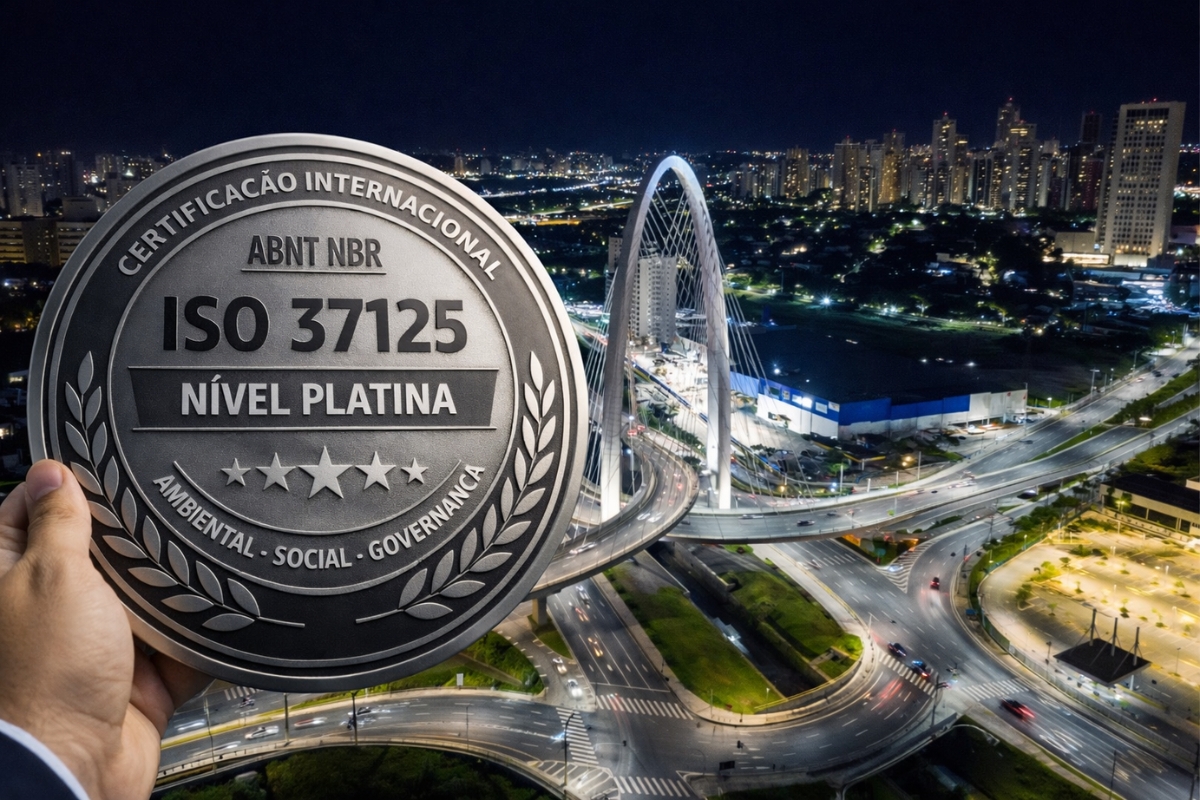
Recognition Puts the City on the Global Radar for Data-Driven Management and Results in Sustainability
São José dos Campos made history by becoming the first city on the planet to obtain the ABNT NBR ISO 37125 certification at platinum level, the highest tier of the standard.
This achievement reinforces the municipality’s leadership in urban innovation, sustainability, and public management focused on indicators.
The certification also consolidates years of technical planning and structured public policies, with direct effects on how the city organizes services, monitors results, and improves the daily lives of its residents.
-
About 150 workers are driving, one by one, 4,585 BYD electric cars off a 220-meter ship at the Port of Itajaí. The 48-hour mega-operation is the largest shipment from the Chinese automaker in Santa Catarina this year.

-
Samara left the city, built a small power plant on her property, and now lives surrounded by waterfalls, her own energy, sustainable recycling, and preserved nature in the Serra da Mantiqueira.
-
The end of Japan? Population is disappearing, country loses more than 3 million inhabitants in just five years and birth rate falls for the tenth consecutive year, raising alarm about demographic collapse and lack of workers.
-
China surprises the world by inaugurating a new era: the country will create a “digital ID” for 28,000 humanoid robots from 100 manufacturers, while machines capable of cooking, doing laundry, and caring for the elderly begin free domestic testing in 2027.


What Happened and Why It Caught Attention
The certification was announced at a ceremony at the Municipal Palace, with participation from representatives of ABNT, specialists, authorities, and teams involved in the evaluation process.
The audit was conducted by the Technological Innovation Park, in conjunction with the City Hall, and validated according to international ISO standards.
The result places São José dos Campos among the global models of smart urban development, with a focus on metrics and performance verification.

How ISO 37125 Measures City Performance
The ISO 37125 complements the ISO 37120, ISO 37122, and ISO 37123 certifications, which focus on indicators of sustainable, smart, and resilient cities.
The certification evaluates 133 ESG indicators, organized into three central axes, increasing the demands on the planning and execution capabilities of public power.
The standard requires numerical proof and auditable evidence, with technical validation of results and not just good intentions.
What Enters the Environmental, Social, and Governance Pillar
In the environmental axis, factors such as greenhouse gas emissions, conservation of springs, waste management, urban forestry, and the use of renewable energy are included.
In the social axis, the evaluation involves the quality of health, education, security, inclusion, and the well-being of the population.
In governance, administrative transparency, data management, public participation, and efficiency of public services are observed, focusing on consistency and traceability.

Sustainability in Practice and Projects That Support the Certification
The city has expanded air quality monitoring with real-time systems and implemented environmental education programs in schools.
There was also an enhancement in the certification of the arboreal heritage and measures for the preservation of native species, specifically mentioning primates from the São Francisco Xavier region.
The strategy combines environmental actions and urban planning to reduce emissions and enhance quality of life, with initiatives such as sustainable mobility and the recovery of natural areas.
Waste Management and Mobility Are Included in the Improvement Package
Waste management stands out for dozens of Voluntary Delivery Points and a structured system for selective collection and solid waste processing.
Urban garden projects, spring recovery, and the expansion of the bike lane network reinforce emission reduction while encouraging new mobility habits.
This set of measures strengthens the city as a reference for integrated policies, with distributed actions and measurable objectives.

What May Happen from Now On
In 2024, São José dos Campos advanced with the Carbon Neutral City program, developed in partnership with IPT and supported by FAPESP.
The goal is to neutralize greenhouse gas emissions by 2030, positioning the municipality among the most ambitious in the country in decarbonization policies.
The certification also opens doors for participation in global debates, such as the COP 30, with expectations of presenting carbon neutralization strategies and sustainable urban solutions.
São José dos Campos achieved ABNT NBR ISO 37125 at the platinum level and reinforced its image as a city that uses indicators to guide public policies and improve quality of life.
With goals such as emission neutralization by 2030 and a focus on governance, data, and sustainability, the municipality establishes itself as a replicable model for other Brazilian cities.








-

-

-

-

14 people reacted to this.