Portuguese
  Spanish




The Little-Known Story of the Scottish Teacher Who, in 1887, Built the World’s First Wind Turbine, Powered His Own Cottage, and Offered Free Energy to the Village, Only to Be Refused out of Fear and Superstition
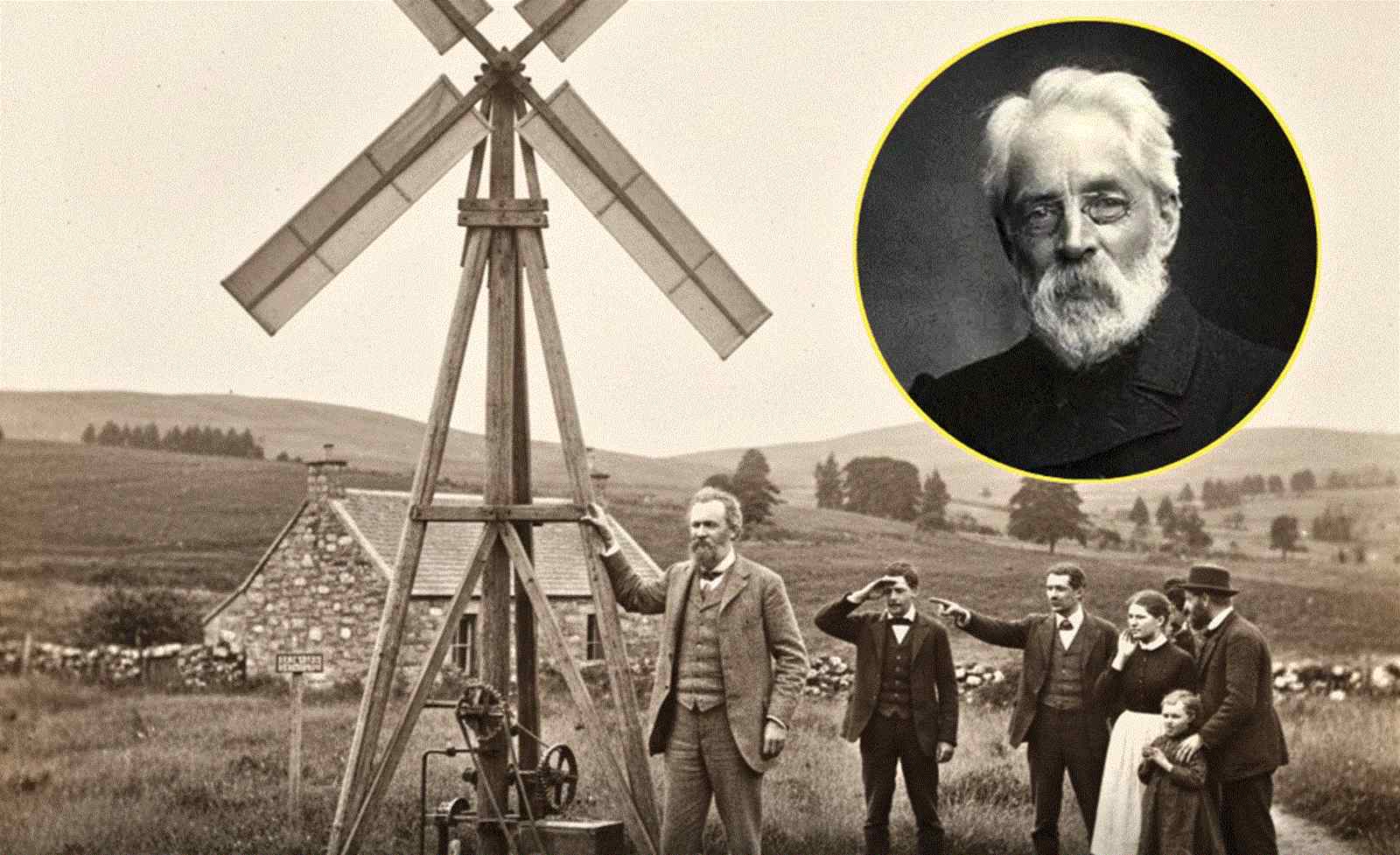
In July 1887, the Scottish teacher James Blyth conducted an experiment that would become a quiet landmark in the history of energy. At a time when electricity was still in its infancy and renewable solutions were not part of the public debate, he installed a wind turbine approximately ten meters high in his garden.
The goal was simple and straightforward: to generate electricity to light up the small holiday cottage used by his family in the village of Marykirk in northeastern Scotland.
The structure, made up of fabric sails mounted on a vertical axis, was designed to capture the force of the region’s constant winds. Blyth adapted the system to charge batteries and, at dusk, transformed this energy into domestic lighting.
-
China Develops Custom 140-Ton Electric Mining Truck with 770 kWh Swappable Battery, Deploys 290 Units in Xinjiang’s Largest Zinc Mine

-
Meta to Launch Arena, a New Prediction App Targeting 3.56 Billion Users, Competing with Polymarket and Kalshi

-
Scientist Challenges Famous Human Evolution Theory, Argues Homo Sapiens Evolved Gradually Over Thousands of Years
-
15-Year-Old American Builds Ocean Generator with PVC Pipe and 3D-Printed Propeller for $12, Wins National Prize, Presents at White House, and Makes Forbes 30 Under 30 List



In an era when the use of electricity was limited to urban centers and academic experiments, the feat stood out for its boldness and immediate functionality.
The First House Lit by Wind
The experiment not only worked but exceeded expectations. The turbine produced enough energy to power the residence and still generated a surplus.
Thus, Marykirk quietly witnessed what historians would consider the first house in the world lit exclusively by wind energy.
The efficiency of the system led Blyth to think beyond his own cottage. Given the potential of the equipment and the constant production of electricity, he decided to offer the surplus to the community.
His proposal was to install public lighting on the main street of the village, something that at the time would be seen as absolute modernity for a rural area.
The Unexpected Refusal
Despite the generous gesture, the idea did not thrive. The residents reacted with suspicion to the teacher’s offer. In a time when electricity still carried an aura of mystery and popular beliefs had strong influence, many saw the phenomenon of generating light from the wind as something that challenged the natural order.
The rejection was immediate and laden with superstition. Some inhabitants believed that manipulating forces of nature in this way could bring negative consequences to the community. Later records show that some even classified the technology as “the work of the devil.”
Even without any technical or scientific basis, this fear was decisive in preventing the village from becoming the first locality in the world to have public lighting powered by wind energy.
A Pioneering Effort Ahead of Its Time
The refusal did not stop Blyth from continuing to investigate applications and impacts of electricity generated from wind.
He continued developing research and published studies detailing how the turbine worked, the storage method, and the potential of wind energy as a practical solution for remote regions.
However, his invention found little space for commercial application at that time. The electrical infrastructure was still nascent, and the costs for scaling similar systems were considered high for the standards of the time.
Nonetheless, the initiative remained a reference in debates about alternative sources. Blyth’s equipment anticipated discussions on sustainability, distributed generation, and the utilization of natural resources by decades.
At the turn of the century, as electrification advanced and new technologies began to emerge, many scholars began to cite the 1887 experiment as a precursor to modern renewable energy.
The Historical Significance
Over time, the episode went from being just a technical curiosity to occupying a symbolic place in the trajectory of clean energy.
Blyth demonstrated that it was possible to transform wind into electricity in an accessible, functional, and continuous way. He also showed how innovation can confront cultural barriers even before facing technological limitations.
Today, the story of the Marykirk turbine is widely recognized as the documented beginning of wind energy applied to everyday life.
The cottage powered by wind marked a quiet change, although not celebrated in its time, and the gesture rejected by the residents remains an example of how the fear of the unknown can delay significant advancements.
James Blyth’s work preceded by decades the global interest in clean and renewable sources.
His turbine did not change the world immediately, but it paved the way for technologies that today illuminate entire cities, proving that some ideas arrive before the time they could be understood.