






 Portuguese
  Spanish


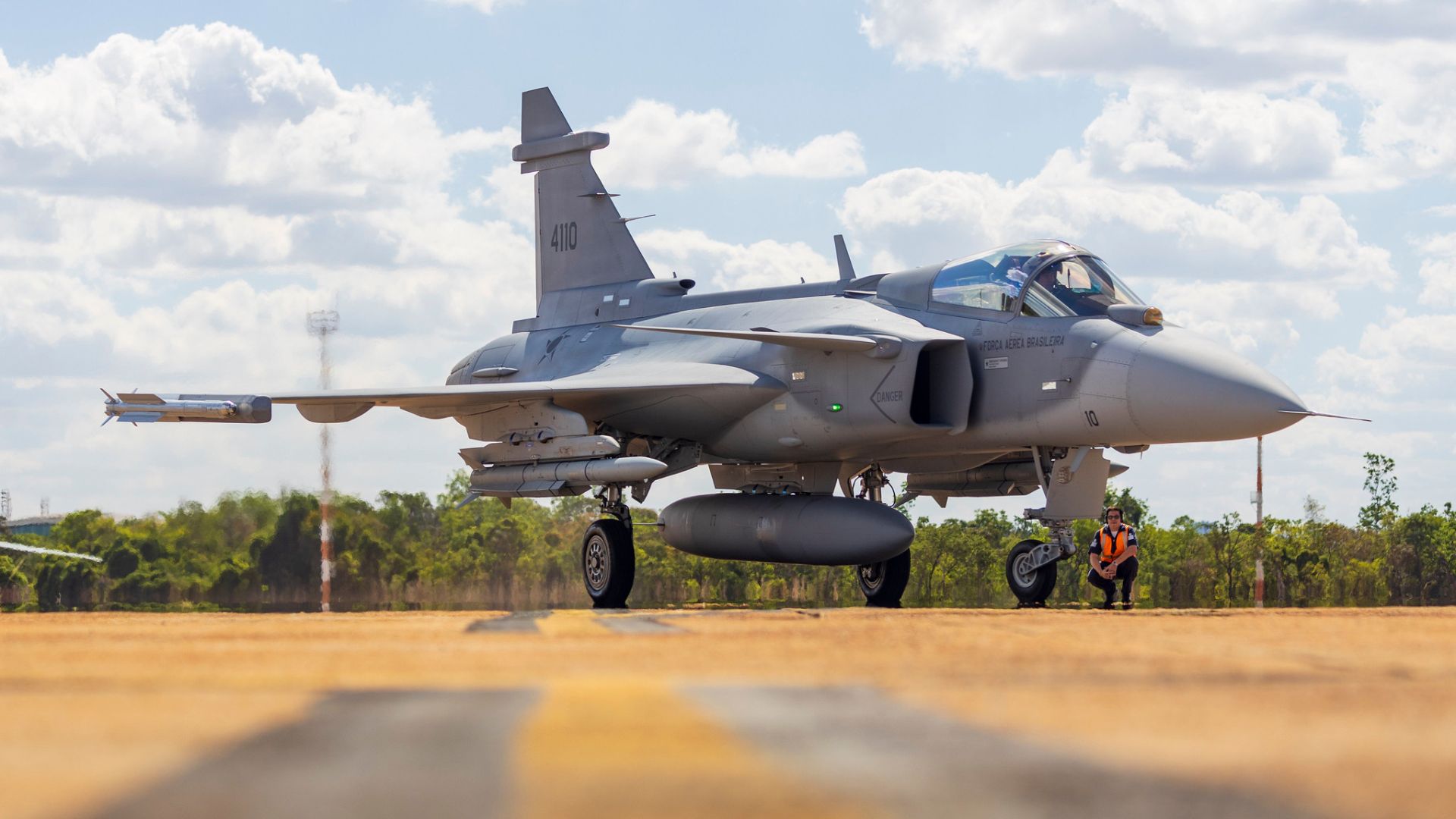


The Conclusion of the First Supersonic Fighter Assembled in National Territory Opens a New Phase in the Brazilian Aeronautical Industry, Increases the Strategic Autonomy of the FAB, and Repositions Brazil in the International Defense Scenario
Brazil is about to reach an unprecedented milestone in its industrial and military history. The first F-39 Gripen assembled in the country, the national version of the supersonic fighter Gripen E, is expected to be completed by the end of March 2026, consolidating the definite entry of the country into the select group of nations capable of producing supersonic combat aircraft. This advance represents a watershed moment for both the Brazilian Air Force (FAB) and the national defense industry.
The information was disclosed by the specialized portal FlightGlobal, based on statements from Saab’s marketing chief, Mikael Franzén. According to the executive, the schedule was slightly adjusted from initial forecasts which indicated delivery in 2025, but was revised due to payment delays from the federal government and restrictions in the global supply chain, factors that have affected various aeronautical programs around the world.
Production in Brazil Places the Country at a New Technological Level

The Gripen E, known in Brazil as F-39 Gripen, is originally developed in Sweden, but has been assembled in Brazilian territory as part of the FX-2 program, established in 2014. The assembly line was installed at the Embraer facility in Gavião Peixoto, in the interior of São Paulo, becoming one of the strategic pillars of the project.
-
Iraq floats and sinks under an arm of the Euphrates 10 giant concrete boxes of 46,000 tons and 125 meters each to assemble a 2.4 km submerged tunnel and open a new land route between Asia and Europe.

-
Scientists use more than 20,000 artificial birds and solar speakers to “trick” seabirds, reactivate nesting routes, and revive a colony on an island that seemed abandoned.

-
She spent 73 years breathing inside an iron lung, survived the aftereffects of polio, and became the last woman in the United States dependent on the equipment before dying at 78 years old.
-
Brazilian students created a $1 filter using pine bark, cotton, and 3D-printed parts to clean cassava wastewater, reduce the toxicity of a hazardous waste, and transform contaminated water into biofertilizer.




Of the total of 36 aircraft acquired by the FAB, slightly more than half will be assembled in Brazil, while the rest continues to be produced in Sweden. With both the Brazilian and Swedish lines operating at full capacity, Saab estimates a combined production of up to 36 fighters per year, a number equivalent to the original Brazilian order.
This new industrial arrangement not only ensures greater logistical predictability for the FAB but also positions Brazil as a potential exporting hub within the Gripen program. The expectation is that part of the aircraft intended for countries in Latin America will be produced on Brazilian soil, increasing the country’s geopolitical relevance in the defense sector.
International Demand Reinforces the Strategic Role of the Brazilian Line
The strengthening of the assembly line in Brazil occurs alongside the increasing international interest in the Gripen. Saab is even considering the opening of a third production line to fulfill larger-scale contracts. Among the confirmed clients are Colombia, which acquired 17 units, Thailand, with four aircraft ordered and an option for eight more, in addition to Ukraine, whose total number has not yet been officially disclosed.
In the current planning, Brazilian production will focus on the aircraft intended for Colombia, while the Thai fighters will come from Sweden. In the case of Ukraine, production may be divided between the two countries, depending on the conflict’s evolution and operational needs.
This international division reinforces Brazil’s role not only as a customer but also as a strategic industrial partner within the global Gripen ecosystem, which is rare in high-performance fighter programs.
Technology Transfer and National Systems Strengthen the Industry
The local assembly of the F-39 is just one part of the extensive technology transfer package outlined in FX-2. Throughout the program, Brazilian technicians and engineers have been trained in Sweden, and production lines for components have begun operating in national territory. Testing, certifications, and critical processes have also been conducted in Brazil.
The Brazilian Gripen incorporates systems developed by national companies, such as the Head-Up Display (HUD) and the Wide Area Display (WAD), manufactured by AEL Sistemas in Porto Alegre. These systems place the F-39 among the most advanced fighters in the world in terms of human-machine interface, enhancing the pilot’s situational awareness in modern combat scenarios.
Additionally, the program has boosted the creation of an industrial ecosystem that involves suppliers, research centers, and universities, with direct impacts on workforce qualification and the generation of strategic knowledge.
Operational Exercises Consolidate the F-39’s Capability in the FAB
In addition to industrial evolution, the Gripen is advancing in its operational maturity within the FAB. So far, the Air Force has already received 11 of the 36 contracted aircraft. In 2025, two more F-39E aircraft with registrations 4110 and 4111 arrived, expanding the operational fleet.
The first fighter assembled in Brazil reached the final assembly phase in 2024, and there are speculations that it may be the aircraft with registration 4109, which has not yet been incorporated into the 1st Air Defense Group – Jaguar Squadron, based in Anápolis (GO).
By the end of 2025, the program reached significant operational milestones. The Samaúma Operation certified in-flight refueling between the F-39 and the KC-390, significantly extending the fighter’s strategic range. The BVR-X exercise, held at the Natal Air Base (RN), marked the first live firings of the MBDA Meteor missile from the Brazilian Gripen, validating its combat capability beyond visual range.
Another exercise conducted at the Santa Cruz Air Base (RJ) is expected to allow the 1st GDA to take on air defense alert with the new fighter from Goiás, solidifying the Gripen as the backbone of national air defense.
Historic Milestone for Sovereignty and the Brazilian Aeronautical Industry
The completion of the first F-39 Gripen assembled in Brazil symbolizes much more than the delivery of an aircraft. It represents a technological, industrial, and strategic leap that repositions the country in the international defense scenario. By mastering the production of a next-generation supersonic fighter, Brazil reduces external dependencies, strengthens its industrial base, and enhances its deterrence capacity.
With an expected completion by the end of March, the project consolidates Brazil as the only country in Latin America to locally produce a modern supersonic combat jet, establishing a new standard for the national aeronautical industry and the future of the FAB.
Source: O Globo




So falta restaurar o sentimento de patriotismo, respeito ao povo e as FFAA . Atualmente o STF, PCC e facções estão destruindo a economia e a segurança do povo do Brasil!
Un Excelente prototipo…..son mega Estructuras que degan un legado Mundial