Portuguese
  Spanish


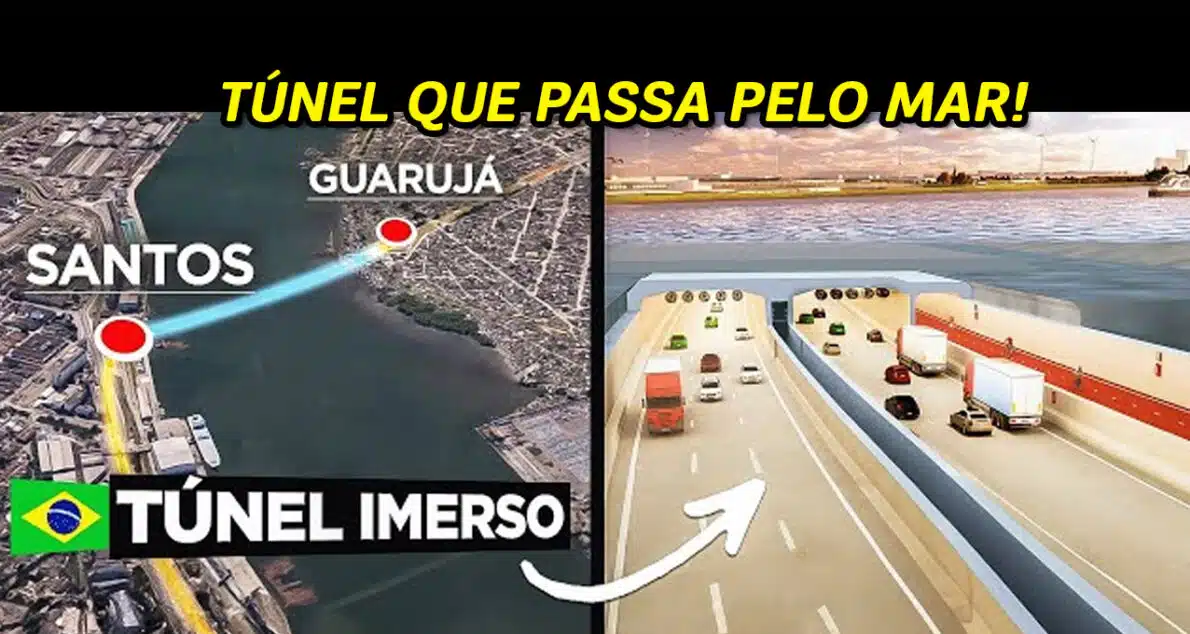


Brazil Will Have Its First Submerged Tunnel! With an Investment of R$ 6 Billion, the Historic Project Promises to End the Wait for Ferries, Connecting Santos and Guarujá Quickly and Safely. With an Auction Scheduled for 2025, the Megaproject Will Be a Milestone in National Infrastructure.
For decades, the connection between Santos and Guarujá has been synonymous with long and congested crossings, whether by ferries or long road routes.
The promise of a faster connection has always been present, but it has never materialized.
Now, an ambitious project aims to change this reality, bringing an innovative solution for mobility in the Baixada Santista.
-
Truck drivers avoid deliveries to supermarkets due to waits that can hinder trips, increase costs, and leave vehicles idle, while the law limits loading and unloading to five hours and provides for payment for the excess time.

-
Oil feels the weight of the war between the United States and Iran on the same day that Tehran buries its assassinated supreme leader and the world watches to see who will control the Strait of Hormuz, a strategic route for global oil.
-
The perks at Nubank are over: the bank announces a monthly fee for HBO Max, which was “free,” with a 12-month term on Ultravioleta, 6 months on Nubank+, and the fee starting from January 2027.

-
The Chamber releases R$ 10 billion to hold the price of diesel until December and proves that Brazilian fuel remains tied to Congress.




The Government of São Paulo approved this week the final modeling for the concession of the Santos-Guarujá Tunnel, a project estimated at R$ 6 billion.
The initiative, part of the State of São Paulo Public-Private Partnership Program (PPI-SP) and the Growth Acceleration Program (PAC), aims to build the first submerged tunnel in Latin America. The structure will be 1.5 km long, with 870 meters submerged, connecting the two cities beneath the sea.
A Solution to a Historical Problem
Currently, more than 21,000 vehicles depend daily on ferries to cross between Santos and Guarujá.
In addition, 7,700 cyclists and 7,600 pedestrians use smaller vessels, known as catraias, for the crossing.
These numbers highlight the need for a more efficient and permanent alternative for mobility in the region.
Project Details
The tunnel will feature three lanes in each direction, including one exclusive lane for the Light Rail Vehicle (VLT).
There will also be dedicated passages for pedestrians and cyclists, ensuring safety and accessibility for all users.
The expected depth is 21 meters below sea level, utilizing cutting-edge technology in the construction of submerged tunnels.
Investment and Job Creation
The financing of the project will be divided between the Government of São Paulo, the Federal Government, and the private sector.
Of the total investment, 86% will come from public contributions, equally divided between the state and the Union.
The expectation is that construction will generate around 9,000 direct and indirect jobs, boosting the local and regional economy.
Next Steps and Timeline
The Public-Private Partnership (PPP) tender for the Santos-Guarujá Tunnel is expected to be published in the second quarter of 2025, with the auction scheduled for the second half of the same year.
The contract signing is expected to occur in the fourth quarter of 2025, allowing for the immediate start of construction.
The expectation is that the crossing between Santos and Guarujá will take less than five minutes after the tunnel’s completion.
Impact on Mobility and Regional Development
The construction of the tunnel promises to transform the transportation dynamics in the Baixada Santista, offering a quick and safe alternative for residents and visitors.
Besides reducing travel time, the project should contribute to the economic development of the region by facilitating the flow of goods and people.
Governor Tarcísio de Freitas highlighted the importance of the project, stating that it addresses a long-standing demand from residents and has the potential to boost the local economy.
Challenges and Technical Considerations
Building a submerged tunnel involves significant technical challenges, such as excavating trenches in the seabed, installing concrete slabs, and assembling precast modules.
These modules will be constructed in dry docks and subsequently positioned at the final location.
The depth of 21 meters and the submerged length of 870 meters require meticulous planning and advanced technology to ensure the safety and durability of the structure.
Public Participation and Project Adjustments
The project underwent public hearings to gather contributions from society and experts.
In October 2024, a hearing in Guarujá discussed possible adjustments to the tunnel’s route to minimize expropriations and optimize financial viability.
Community participation is essential to ensure that the project meets local needs and causes minimal impact on the surrounding urban areas.
Future Expectations
With the completion of the Santos-Guarujá Tunnel, a significant improvement in the quality of life for residents of the Baixada Santista is expected.
The reduction in travel time and the provision of a permanent alternative to ferries should facilitate the daily lives of thousands of people.
Moreover, the project symbolizes an advancement in the country’s transportation infrastructure, positioning Brazil as a pioneer in the construction of submerged tunnels in Latin America.
According to experts, the Santos-Guarujá Tunnel represents an innovative solution to a historical mobility problem in the region.
With significant investments and collaboration between different levels of government and the private sector, the project has the potential to transform logistics and economic development in the Baixada Santista, addressing a long-standing demand from the population and bringing lasting benefits to the São Paulo coastline.