Portuguese
  Spanish


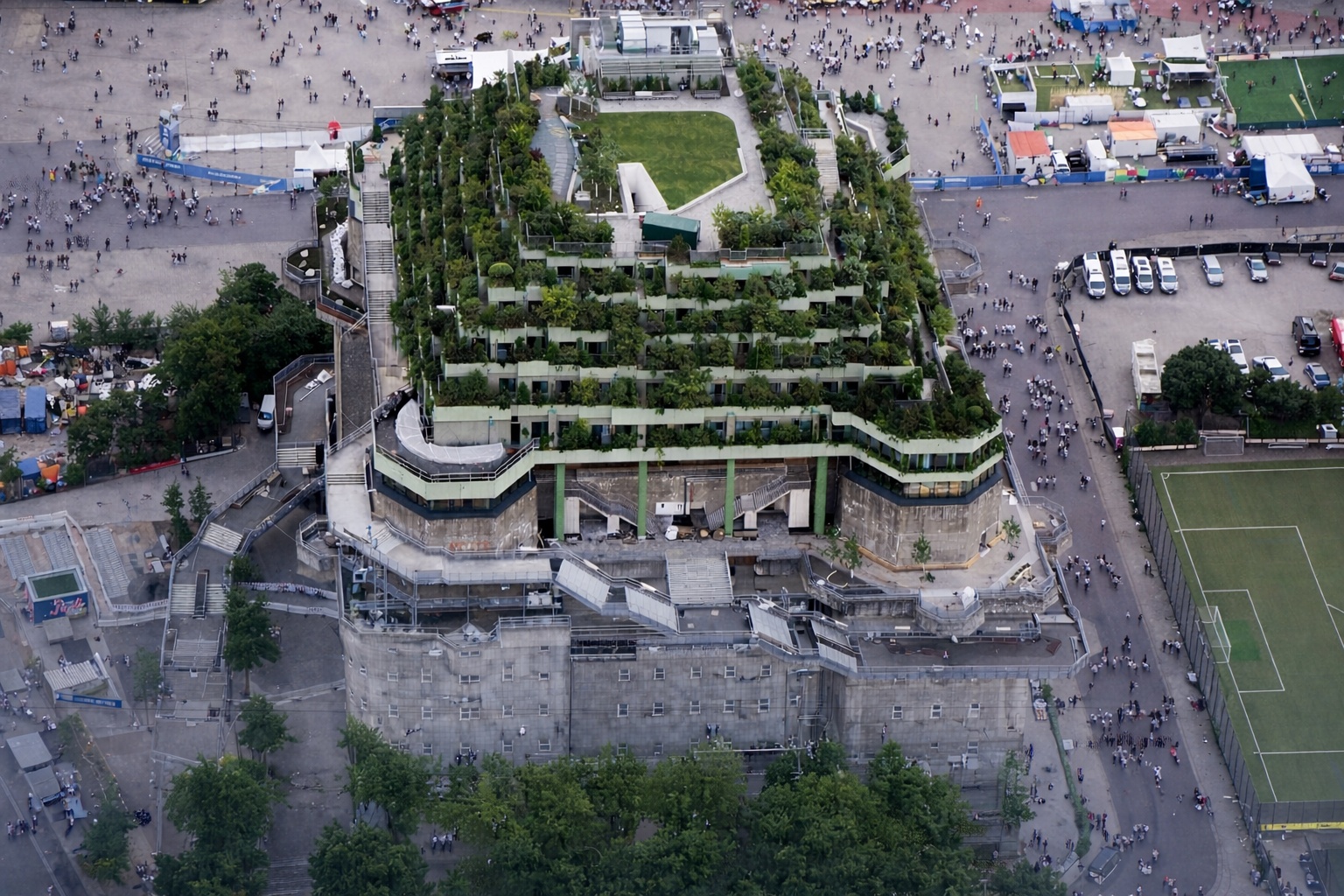


World War II Air Raid Shelter in Hamburg Became a Home by Repurposing 1.5-Meter Thick Concrete Walls, Showing How War Structures Can Become Residences.
The city of Hamburg housed some of the most massive defensive structures ever erected in an urban environment. Among them are the so-called Flakbunker, concrete colossi designed to shelter civilians, troops, and anti-aircraft batteries during intense bombings, especially after the escalation of Allied attacks starting in 1942. One of these structures, decades later, had an unlikely fate: it was adapted to function as a private residence, fully preserving its original structural logic.
These bunkers were not common buildings. They were survival machines. Designed to withstand direct impacts, shock waves, fires, and continuous vibrations, they prioritized mass, redundancy, and absolute rigidity. Repurposing one of these structures as a residence did not require traditional structural reinforcements, but rather the inverse challenge: how to inhabit a practically indestructible building designed for total war.
The Structural Logic of Hamburg’s Flakbunker
The German Flakbunker built in Hamburg follows an extremely heavy typology. The exterior walls, in many cases, exceed 1.5 meters in thickness with reinforced concrete, while slabs and roofs were designed to withstand the impact of aerial bombs and the overpressure generated by nearby explosions.
-
Mexico Sinks Giant Fabric Tubes Filled with Sand off Yucatán Coast to Create Invisible Barrier and Restore Hurricane-Damaged Beaches

-
Modern Liquid Porcelain Flooring Offers Seamless, High-Gloss Finish for Home Renovations Without Demolition
-
Brazilian Couple Builds Entire Cabin from Cement and Shade Cloth in Just 7 Days to Escape Renting, Using Affordable Farm Supplies Instead of Steel Mesh

-
Epoxy Paint Revolutionizes Bathroom Makeovers in a Weekend at a Fraction of Renovation Costs





Unlike civilian buildings, concrete was not just a load-bearing element, but a physical barrier against destructive energy.
The bunker adapted as a residence maintains this structure virtually intact. The massive walls remain the main load-bearing elements, and the absence of delicate foundations or slender systems allows the building to operate as a monolithic block. From an engineering standpoint, it is a construction whose structural safety margin far exceeds any contemporary residential requirements.
1.5-Meter Thick Walls and Excess Engineering as Heritage
The extreme thickness of the walls was not an arbitrary exaggeration. During the war, Hamburg was the target of massive bombings, including Operation Gomorrah, which destroyed large areas of the city. The bunkers needed to withstand not only shrapnel but also partial collapses of the surroundings, prolonged fires, and repeated vibrations.
When converted into a residence, this excess engineering began to function as natural thermal and acoustic insulation.
The large mass of concrete creates a high thermal inertia, reducing internal temperature fluctuations throughout the day and year. At the same time, the acoustic insulation is practically absolute, a direct result of the thickness and continuity of the structural material.
The Adaptation of a Windowless Building with No Residential Logic
Transforming an air raid bunker into a home did not mean “renovating” in the conventional sense. These structures were designed with few or no external openings, narrow corridors, compartmentalized spaces, and circulation thought out for emergency situations, not for domestic comfort.
The residential adaptation required targeted and extremely controlled interventions. Additional openings had to respect the structural integrity of the walls since any cut in a 1.5-meter thick element poses a real risk of compromising the building’s monolithic behavior.
In many cases, the solution was to work with indirect lighting, technical skylights, and repurposing existing openings instead of creating large conventional spans.
From Urban Fortress to Habitable Private Residence
The bunker adapted in Hamburg transitioned from a collective shelter and military platform to a domestic space without losing its structural identity. The logic of the conversion was not to erase the past, but to accept it as part of the building’s functioning.

The exposed concrete, compact volumes, and the sense of controlled enclosure remain central elements of the spatial experience.
From a construction perspective, this is one of the most extreme examples of complete reuse of heavy military infrastructure.
Unlike historical buildings adapted with modern reinforcements, the bunker already possessed structural capacity far exceeding necessary, allowing its occupation without invasive interventions in foundations or load-bearing systems.
A Building Designed for Destruction That Survived the Test of Time
Today, the house installed within a World War II air raid bunker in Hamburg represents an engineering paradox.
A structure designed to withstand mass destruction has found permanent use in peacetime, supported by a constructive logic that does not rely on efficiency, lightness, or optimization of materials, but on deliberate excess of concrete, thickness, and redundancy.

This reuse reveals how structures built for the worst-case scenario can remain nearly intact for decades, while much newer buildings already require reinforcements or demolition.
In the case of the bunker, what was protection against bombs became a domestic shelter, proving that some of the most durable constructions of the 20th century arose not from the pursuit of comfort, but from engineering taken to the absolute limit.