Portuguese
  Spanish


The record of Recanto da Mata shows the step-by-step of the iron, cement, and shade cloth wall, from the eucalyptus posts in plumb to the mortar applied with a light hand, in a low-cost technique that the couple learned on the internet to stop paying rent
Exchanging rent for a self-built home became a reality for a couple from the interior of Brazil with a surprising technique. According to the channel Recanto da Mata, in a record published in June 2026, Antonio and Adriana erected an entire cabin of cement and shade cloth in just 7 days, using the same cheap shade netting sold in agricultural stores instead of the expensive steel mesh.
The idea came from their own followers. About 80% of the suggestions the couple received asked to cover at least one room and stop renting, and the answer was the iron, cement, and shade cloth technique, which creates a strong wall with cheap material that anyone can find in the city, as Recanto da Mata explains. In 7 days, two working together, the cement and shade cloth cabin was built from scratch.
The iron, cement, and shade cloth technique that is inexpensive
The secret lies in replacing expensive material with affordable options. According to Recanto da Mata, the structure combines stretched iron bars as a frame, the shade cloth instead of industrial steel mesh, and the cement mortar applied on top, forming a sturdy wall without the costs of conventional construction.
-
Epoxy Paint Revolutionizes Bathroom Makeovers in a Weekend at a Fraction of Renovation Costs

-
Finnish Man Buys Unwanted Island for a Bargain, Builds Home with Seven Trees and €400 Roof, Lives Off-Grid with Family in -35°C

-
Burnished Concrete Gains Popularity in Brazilian Homes for Its Durable Finish and Minimalist Aesthetic
-
Man Builds Modern Luxury Village from Scratch Without Blueprints, Using Only His Intuition and Skill



It’s a homemade variation of ferrocement. Traditional ferrocement uses steel mesh to hold thin layers of mortar, and the couple’s insight was to replace this mesh with shade cloth, the agricultural shading plastic net, much cheaper, which holds the first layer of cement until the wall gains structure, as Recanto da Mata shows. The result is a wall that, in the couple’s words, is practical, economical, quick, and safe, the kind that hardly wobbles when finished.
The eucalyptus posts in plumb and level
The entire construction begins with the vertical foundation. According to Recanto da Mata, the eucalyptus posts were driven to about 2.42 meters high and fixed with concrete, with the couple adjusting the plumb and level of each post before the concrete hardens to ensure a straight wall.
The eucalyptus provides the backbone of the construction. The treated eucalyptus posts serve as a vertical structure, secured in concrete and reinforced with pieces of iron bar driven into the wood, a binding that is almost invisible but makes the piece very firm, as detailed by Recanto da Mata. It is on these eucalyptus posts that the iron framework and shade cloth will be stretched to receive the mortar.
The shade cloth stretched instead of expensive steel mesh
The step that defines the technique is stretching the cloth. According to Recanto da Mata, after stretching all the iron framework, the couple applies the shade cloth over them, creating the surface where the mortar will adhere, exactly the function that in an expensive construction would be served by a welded steel mesh.
The savings appear precisely there. The shade cloth costs a fraction of the steel mesh and is sold in rolls at any agricultural supply store, which greatly reduces the cost of the cement and shade cloth cabin without sacrificing strength, since the cement provides the final hardness of the wall, as explained by Recanto da Mata. It is this material substitution that transforms a construction technique into something accessible for those who want to get out of rent with little money.
The mortar applied with a light hand, layer by layer

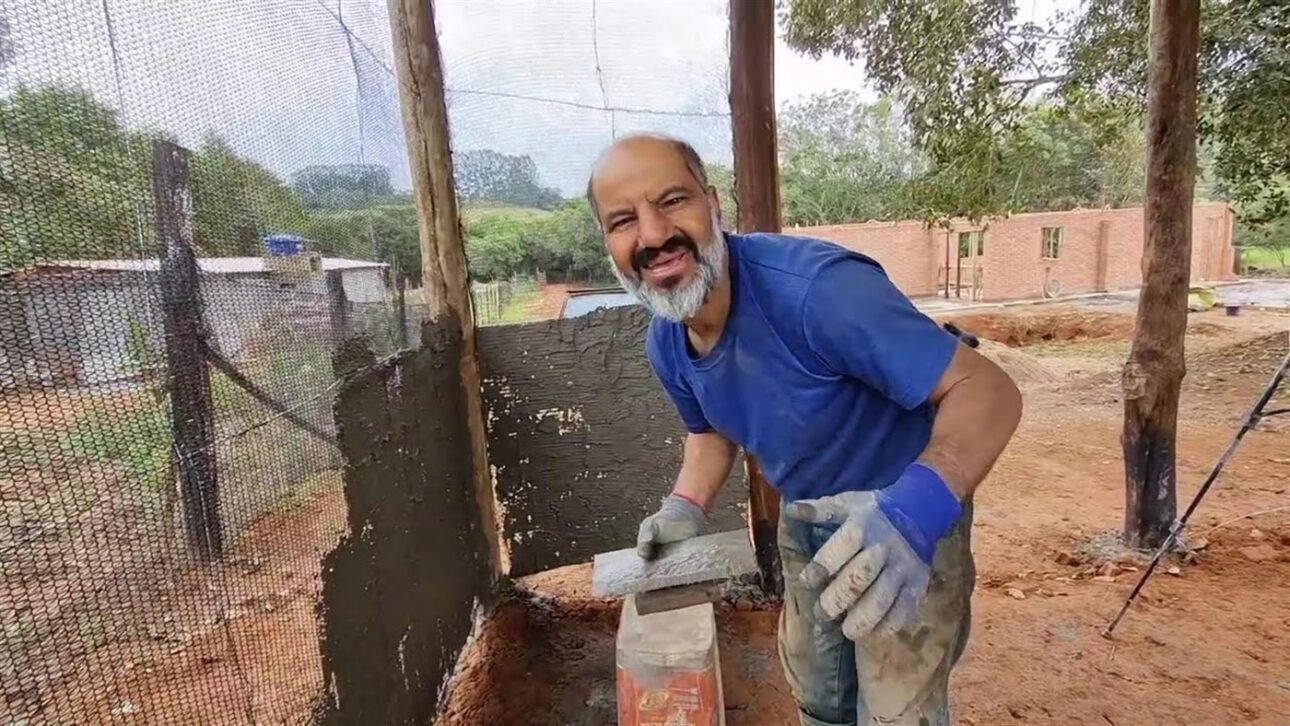
Applying the cement over the cloth requires a technique. According to Recanto da Mata, the first coat of mortar needs to be applied slowly and with a light hand, in one pass, moving to a different spot instead of insisting, because touching too much makes the material fall from the cloth before setting.
The couple was testing the tool in practice. The mortar was applied with a trowel and spatula, and the couple discovered that applying it once and moving on yields more and doesn’t come off, with the shade cloth part still soft until the concrete hardens and becomes the hard layer of the wall, as Recanto da Mata shows. After the first layer is dry and firm, the plaster and grout come to complete the interior finish.
The “golden tip” for securing the iron in the wall
The ingenuity appeared in an improvisation by the owner himself. According to Recanto da Mata, to close the gaps he drilled the structure with a drill, inserted the iron into the hole, and pushed the bar with a locking plier until it was secured inside, a solution he himself dubbed the golden tip.
The trick ensures firmness without extra parts. By pushing the iron to both sides inside the hole, the bar gets stuck and serves as support to stretch the shade cloth and receive the mortar, and a mark made with the saw beforehand helps to know if the iron entered equally on both sides, as Recanto da Mata records. It’s proof that the cement and shade cloth technique still leaves room for construction site invention.
Four days, two people, and the dream of leaving rent behind
The pace of the work impresses given the size of the team. According to the Recanto da Mata channel on YouTube, by the fourth day the cabin already had walls, a roof with tiles placed by two hands, and the floor being concreted with a slope for water to drain, all built solely by the couple.
Motivation is what gives meaning to the rush. The couple says they decided to build the cement and shade cloth cabin after reading stories from followers who lived in a single room with their children and no structure, and that the technique will finally allow them to leave the rent they had been paying for years, as Recanto da Mata reports. The construction, which started just to cover a place and store things, turned into a reinforced house when the couple decided to take on the challenge.
What the shade cloth cabin teaches those escaping rent in Brazil


The topic is the face of Brazilian self-construction. In Brazil, the cost of rent and building materials pushes millions of families to build gradually, and low-cost techniques like ferrocement, adobe, and ecological brick spread precisely because they fit the budget of those who build their homes with their own hands.
The lesson from the video is accessible and replicable. The cement and shade cloth cabin shows that it’s possible to close a sturdy wall by replacing the steel mesh with shading net and the brick with mortar over the eucalyptus structure, a cheap recipe for those dreaming of getting out of rent in the countryside, a consolidated popular housing context in the country. From the couple’s site to any family’s backyard, the equation is the same: cheap material plus labor becomes a home without financing.
The video covers the fixation of eucalyptus posts, the iron framework, the shade cloth, the mortar applied with a light hand, and the roof raised by the couple.
The cement and shade cloth cabin proves that it’s possible to get out of rent with cheap material, an internet technique, and a lot of labor. Tell us in the comments: would you build your house with shade cloth and cement to escape rent?