Portuguese
  Spanish


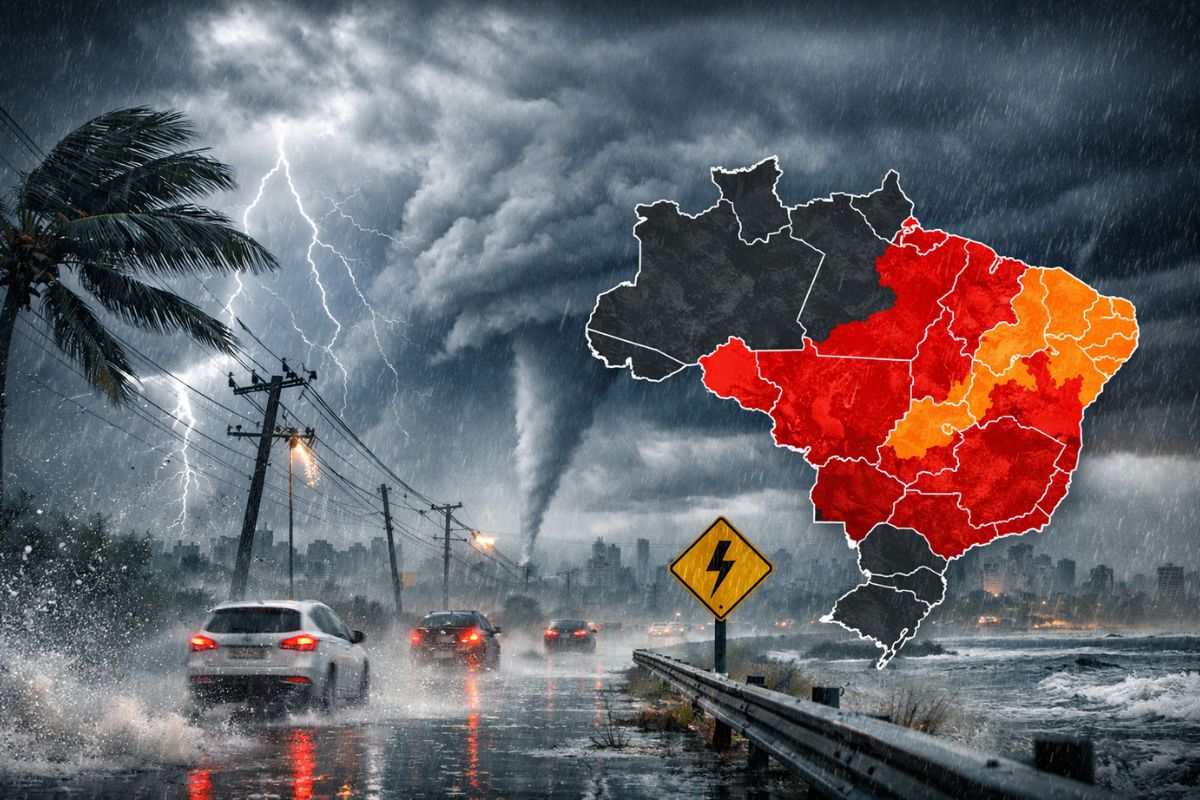


With a Warning Valid Until 10 AM on Thursday (19), Inmet Points to the Risk of Storms with Accumulated Rainfall of Up to 100 mm Per Day and Gusts Close to 100 km/h in Much of the Country; Paraná, Santa Catarina, Rio Grande do Sul, and São Paulo Gather the Most Worrying Signs at This Moment
The storms have become the central point of attention in the country with an orange alert that reaches 18 states and puts almost half of Brazil in a state of danger for heavy rain and strong winds. Inmet’s warning describes a scenario of great extent, but with a concentration of risk in areas where the combination of rain and wind usually causes impacts more quickly.
In the South and part of the Southeast, the context becomes even more sensitive because the recent history weighs: in São Paulo, the sequence of flash floods and incidents associated with bad weather has raised the level of social alert, while the population still deals with damage and loss of mobility in critical urban points.
What the Orange Alert Signals in Practice
The orange alert issued by Inmet indicates a dangerous situation for storms and heavy rain, with the potential to cause significant disruptions in a short period.
-
Goodbye traditional dishwasher: LG surprises and presents an integrated version that washes and dries in just 1 hour, uses microbubbles and steam, analyzes dirt with AI, chooses from 32 combinations, cleans bottles, and can operate at just 37 dB.

-
How to boost Wi-Fi signal without changing the router, according to technicians
-
Climate change threatens wild vanilla plants, could sever up to 90% of natural connections with pollinating insects by 2050, and jeopardizes the future of the world’s most valuable spice.
-
A farmer from Michigan held onto a heavy rock for 30 years, using it only to prop open the barn door, and when he finally took it to a university, he discovered it was an iron meteorite weighing over 10 kg and valued at $100,000.


It is not a “generic warning”: when there is a forecast of high volumes of rain and strong winds, the risk increases for events that form and intensify rapidly, especially in urban areas and regions with more susceptible terrain.
Within this framework, the combination is what concerns the most. Heavy rain combined with strong gusts increases the chance of falling branches and trees, power supply interruptions, electrical discharges, and sudden flooding.
In other words, the danger is not just how much it rains, but what the wind and instability can trigger simultaneously.
Where the Alert Reaches and Why the South and Southeast Concentrate the Focus
The storms under the orange alert encompass: Acre, Amazonas, Maranhão, Minas Gerais, Paraná, Rio de Janeiro, Rondônia, São Paulo, Bahia, Mato Grosso, Pará, Amapá, Ceará, Mato Grosso do Sul, Piauí, Rio Grande do Sul, Santa Catarina, and Tocantins. This list shows a broad outline, with the North, Northeast, Central-West, Southeast, and South under attention.
Even so, the most critical cut appears when one observes where the warnings combine and where the impacts tend to be more immediate.
Paraná, Santa Catarina, Rio Grande do Sul, and São Paulo concentrate the highest risk because they face the overlap of storms and heavy rain, creating conditions for chain occurrences, such as flooding that blocks roads, falling trees in traffic corridors, and localized power failures in entire neighborhoods.
How Much It Can Rain and Blow: The Numbers That Change the Risk
The warning mentions storms with up to 100 mm of rain per day and winds that can reach 100 km/h. To put this in perspective, 100 mm of rain is equivalent to about 100 liters of water per square meter throughout the day, a volume capable of overwhelming urban drainage systems and accelerating the formation of flash floods in sloped streets or in areas with high soil impermeability.
Winds close to 100 km/h greatly elevate the risk of damage to exposed structures and vegetation. Strong wind does not act alone: when there is saturated soil, trees become more unstable; when there is overhead power lines, loose branches and objects increase the chance of interruptions; and, when it rains with thunderstorms, the probability of electrical discharges associated with atmospheric instability rises.
What Can Happen in Cities When Storms Intensify
Among the most cited effects for this type of scenario are power outages, electrical discharges, falling branches and trees, and sudden flooding.
In urban environments, storms can transform thoroughfares into impassable areas in a short time, especially in low-lying streets, corridors near channelized streams, and regions where drainage encounters bottlenecks.
Moreover, the wind amplifies the impact of any preexisting failures in the city. Advertising boards, metal structures, fences, and even roofs can become vulnerable when the gusts increase, while large trees, even healthy ones, can give way when the wind’s force meets unbalanced canopies.
The result is often a sum of small events that, together, generate significant disruptions: interrupted traffic, risks of electric shock, and more frequent emergency responses.
São Paulo on Sensitive Alert After Recent Flash Floods and Deaths
In São Paulo, the current storms find a state still marked by accumulated occurrences since the beginning of Operation Chuvas 25/26 in December, with 17 deaths attributed to bad weather.
The most recent case mentioned occurred on Monday (16), when a 60-year-old woman, Alice Ferreira Conceição, was swept away by a flash flood in the northern zone of the capital.
The detailed history shows that some victims specifically died due to flash floods, in addition to records associated with falling trees, electrical discharges, landslides, and wall collapses in municipalities such as Guarulhos, São Paulo, Taubaté, and Ilhabela. On Tuesday (17), the capital and the metropolitan region faced new storms, with falling trees and flooding points that left stretches impassable, such as on Avenida Regente Feijó, reinforcing the perception that the risk is not abstract when the rain starts to intensify.
Safety Guidelines in Storms with Strong Winds
The recommendations highlighted by authorities for episodes of gusts are straightforward: do not take shelter under trees and do not park vehicles near transmission towers or advertising boards.
In times of instability, these structures can become points of danger due to falling, accidental contact with power lines, or displacement caused by wind.
Another important guideline is to reduce risks inside the home during the peak of the storm: if possible, unplug electrical devices and the main power panel.
On days of storms, this care helps limit damage to equipment and decreases exposure to sudden fluctuations in the network.
In addition to this, the safest behavior is to avoid unnecessary travel when there are sudden floods and prioritize higher and well-known routes, as the change in conditions can occur in minutes.
A Brazil in Two Dynamics: Intense Rain on One Side, Dry Air on the Other
While 18 states come under the radar of storms, there is an opposite dynamic in other areas of the country. Goiás, Pernambuco, and Espírito Santo, along with other points in the North and Northeast, appear with a yellow alert for low air humidity, highlighting how different air masses and regional patterns can generate distinct risks simultaneously.
This contrast helps explain why the risk communication needs to be localized: the threat of low humidity requires different precautions, while the orange alert for heavy rain and strong winds demands focus on flash floods, falling trees, electrical discharges, and power outages.
The alert depends on where you are, and that is what makes the list of states and the emphasis on the South and Southeast so relevant at this moment.
The advance of storms under orange alert in 18 states creates a national scenario of attention, but the concentration of risk in the South and part of the Southeast gains another dimension when combined with the recent impact of flash floods and deaths in São Paulo.
With rain that can reach 100 mm per day and gusts near 100 km/h, the difference between “just a storm” and an event with serious consequences could lie in details like saturated soil, urban infrastructure, and decisions made in just a few minutes.
I Want to Understand How This Affects Your Routine: where you live, what usually fails first when the storm intensifies (power, trees, flooding, traffic)? And what has been the most useful measure you have adopted or seen someone adopt to genuinely reduce risks on such days?