






 Portuguese
  Spanish


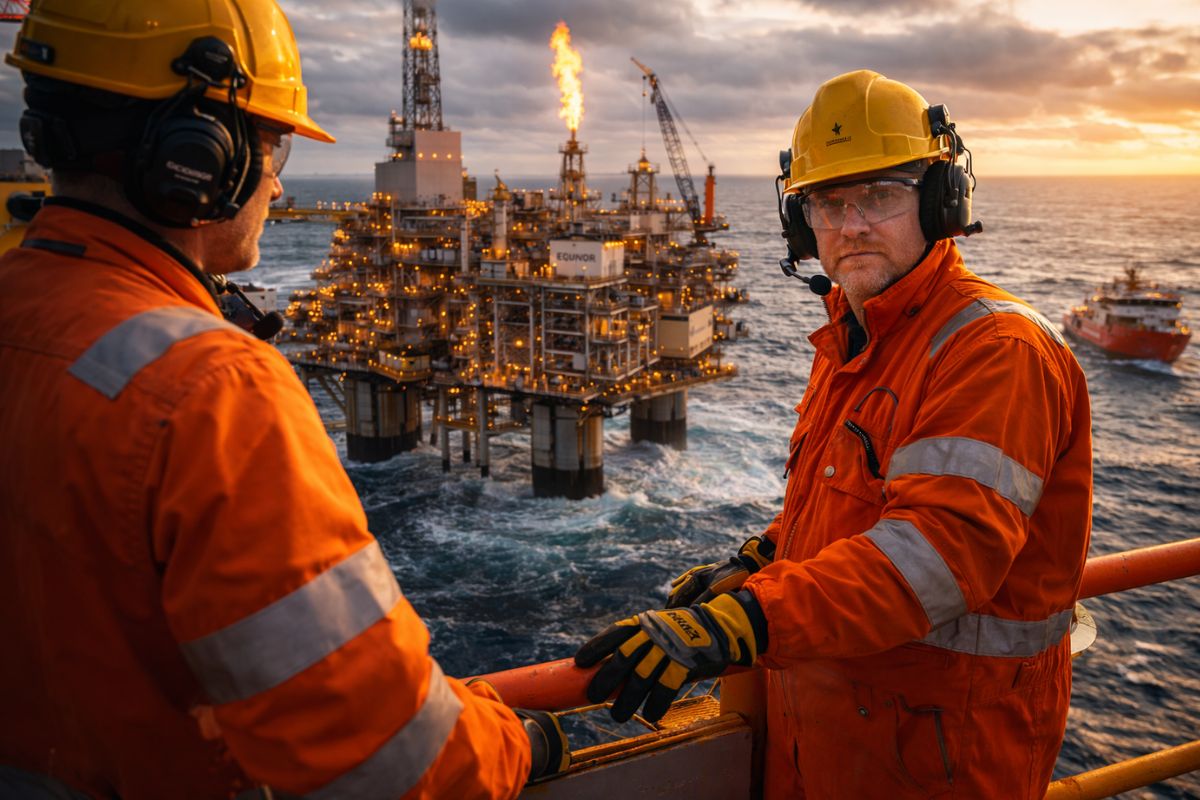


In Norway, oil platform work in the North Sea combines USD 60,000 per month with two-week offshore and four-week on-land rotations, reaching 250 days off. The package is appealing but requires certifications and a 12-hour shift.
Oil platform work in the North Sea, focusing on Norway, caught attention again in 2026 for a hard-to-ignore contrast: reports of pay that can reach USD 60,000 per month and the promise of up to 250 days off per year, while the routine imposes 12-hour shifts.
However, the equation is not simple. What looks like the “best job in the world” depends on technical preparation, rigorous certifications, and a rare emotional disposition to live weeks onboard, sharing space with international teams and under safety rules that allow no improvisation.
Why The North Sea Became A Showcase For High Salaries
In the North Sea, the showcase is built on an objective reality: the demand for energy remains high in 2026, and offshore operations need professionals capable of sustaining a continuous routine.
-
Brazil’s 2026 Tax Refund: Record 9.58 Million Filers in Largest Payout Ever, But a Key Detail on Priority Recipients Draws Nationwide Attention

-
Itaú Alters Hybrid Work Model, Increasing Office Days from 2028, Prompting Employees to Adjust to New Routine
-
Facing Labor Shortage, Japan Plans to Invest $34 Million to Attract Foreign Workers in Construction, Healthcare, Industry, and Commerce

-
Brazilian City Makes Remarkable Leap, Becomes 4th Wealthiest in the Country with GDP of R$ 134.1 Billion




It’s in this scenario that oil platform work appears as a way to access high income, with stories of monthly earnings of USD 60,000 circulating as a top reference.
Interest is growing because the value is not limited to the salary itself. Working onboard typically reorganizes life: for weeks, the schedule becomes work, rest, and socializing in the same place, creating a different rhythm from the traditional market.
For those willing to enter this cycle, the argument is pragmatic: earn more in less productive time and make up for it with long periods off schedule.
At the same time, the attractiveness feeds on comparisons with on-land positions.
The very logic of working onboard reinforces this: with a complete structure during the period at sea, some professionals see oil platform work as a way to accelerate personal projects with predictability, without relying on sporadic overtime or multiple jobs.
The Schedule That Buys Time Off And Takes A Toll On The Body
The most cited model combines two weeks onboard followed by four weeks on land.
When it works as planned, it becomes the dominant data in conversations: 250 days off per year, a number that changes the way people think about time, family, and routine.
In practice, this arrangement only holds with team discipline and with 12-hour shifts that repeat day after day.
There is a direct cost to this equation: the long shift reorganizes sleep, nutrition, and disposition, and the body needs to keep up.
Resting “on land” does not automatically erase fatigue; it serves as a counterbalance, not magic. This detail is where many understand that while long breaks exist, they come at a cost.
This is where the glamour loses strength. In a limited space, with intense interactions and constant safety rules, oil platform work demands physical resilience and a kind of “cool head” that cannot be improvised.
The distance weighs heavily, and even in Norway, where the proposal is seen as distinctive, the emotional cost of isolation becomes a filter for who can endure.
Rigid Certifications And Different Entry Doors
The demands start before boarding. Working in the North Sea is not simple: it requires education in industrial chemistry, engineering, or related fields, along with rigorous and mandatory safety certifications to handle the risks of the maritime environment.
These certifications are not just “details” but conditions for operating in an environment where mistakes have consequences.
For many, the first shock is not the sea or confinement, but the standard of control: procedures, checks, training, and the expectation to perform well under pressure, maintaining a disciplined routine.
But access is not limited to those with advanced technical diplomas. There are roles mentioned as entry points, such as welders and cooks, with opportunities for learning and internal progression.
Oil platform work, in this view, becomes a ladder: enter an operational position, fulfill safety requirements, and grow with training programs offered by companies.
Life Onboard, Isolation, And International Cohabitation
The structure of the platforms is described as complete, with accommodations and leisure activities that help navigate confinement.
Still, the scenario is the same: sea, metal, fixed hours, and a daily life where nearly everything is shared, from the dining hall to the corridors, with colleagues from various nationalities.
International cohabitation can be both a gain and a challenge. On one hand, it broadens perspectives and pushes communication to be objective, something that directly relates to safety.
On the other hand, it requires maturity: in limited spaces, differences in habits and work styles need to fit within common rules, and the routine does not offer quick “escapes” to relieve tension.
This cohabitation has both a practical and a psychological side. Oil platform work requires emotional balance to handle pressure, homesickness, and small conflicts that can escalate when there is no easy “escape.”
In the context of Norway and the North Sea, the routine may be professionally stable but personally demanding: those who go need to know why they are going.
Money, Career, And The Detail That Few Calculate
The financial package appears as the main lure: USD 60,000 per month is the number that attracts the most attention, and the 250 days of time off serve as a quality-of-life argument.
However, the package comes with counteroffers and, in companies, there is often coverage for transportation, meals, and training, a point that helps explain why so many people aim for Norway.
In practice, when costs like meals and transportation do not fall directly on the worker during the onboard period, the remuneration can have a cleaner effect on the personal budget.
This helps explain why oil platform work becomes an obsession for those wanting to save money quickly, but also why it frustrates those entering expecting an easy routine.
The trajectory, however, is not only short-term. There is also the promise of a growing career, with multiple positions and opportunities to climb the hierarchy as ongoing education progresses.
For some, the bet is professional: learn, accumulate experience, and transform certification into a rung of salary and responsibility, rather than treating the onboarding as an adventure.
And there is a point that usually enters late into the debate: special retirement.
In the mentioned context, the reference appears that, under Brazilian laws, workers can retire after 25 years of contributions due to working in an unhealthy environment, a reminder that life calculations involve rules from the country of origin, and not just salary or destination in the North Sea.
Oil platform work in the North Sea and Norway continues to attract because it mixes high pay with an uncommon amount of free time in the traditional market.
But the same formula comes with a high price in 12-hour shifts, safety demands, and the loneliness that appears when the routine repeats far from family, week after week.
If you had the chance to trade a routine on land for two weeks onboard and four weeks off, what would weigh more in your decision: the 250 days, the USD 60,000, or the impact on family? And, looking coldly, what kind of rigorous certifications would you be willing to face to enter the North Sea, especially focused on Norway?









Meu esposo já trabalha à 17 anos embarcado. Ele tira isso de letra.
Eu toparia essa experiência
Eu toparia qualquer coisa pelo menos pra dar o início de um novo ciclo na minha vida certo 🙌🏽