Portuguese
  Spanish


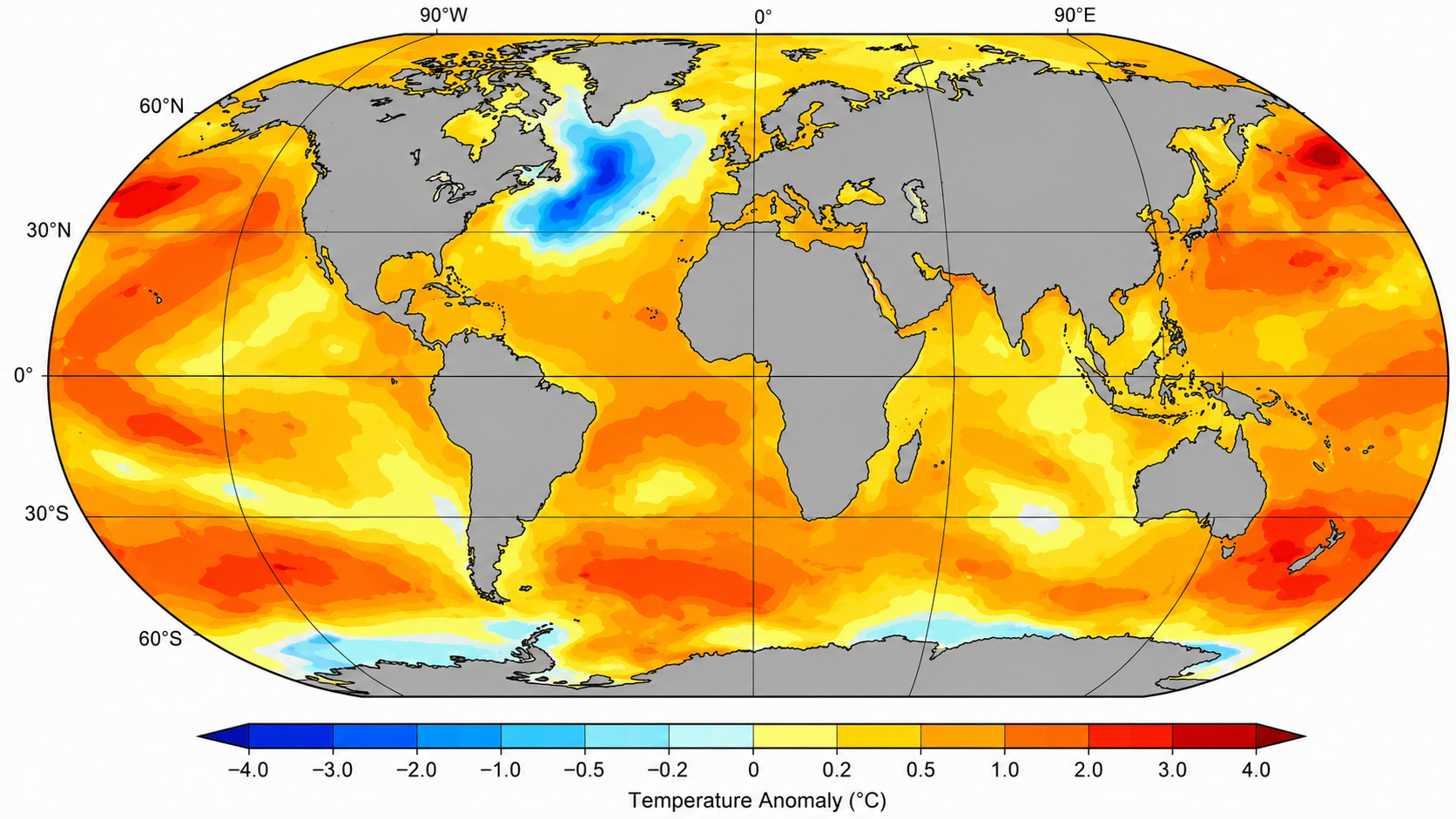

Cold spot in the Atlantic challenges global warming pattern and puts ocean circulation at the center of climate debate
A climatic anomaly observed south of Greenland has once again caught the attention of the international scientific community. The phenomenon, known as the Cold Blob, represents a region of the North Atlantic where temperatures have been decreasing over the past decades, even in a global scenario marked by ocean warming. The new assessment published in 2026 in the journal Geophysical Research Letters, led by Professor Stefan Rahmstorf from the Potsdam Institute for Climate Impact Research, indicates that the origin of the cold spot is mainly linked to changes in heat transport by the ocean. This behavior reinforces concerns about the AMOC, the Atlantic Meridional Overturning Circulation, considered one of the most important mechanisms for the planet’s climate balance.
Technical study reveals direct impact on Atlantic circulation
The analysis stems from temperature data sets obtained from measurements conducted in the North Atlantic and, therefore, offers a more detailed interpretation of the Cold Blob’s formation. The research indicates that the persistent cooling does not occur only at the sea surface but also involves significant changes in heat content at depth. After all, the region behaves in a manner opposite to the pattern observed in most oceans. Scientists state that a new reduction in Atlantic heat transport could have important consequences for the climate and weather conditions in Europe and other parts of the world. This diagnosis strengthens the view that the cold spot may serve as a signal of AMOC weakening.
AMOC has concerned climate experts for years
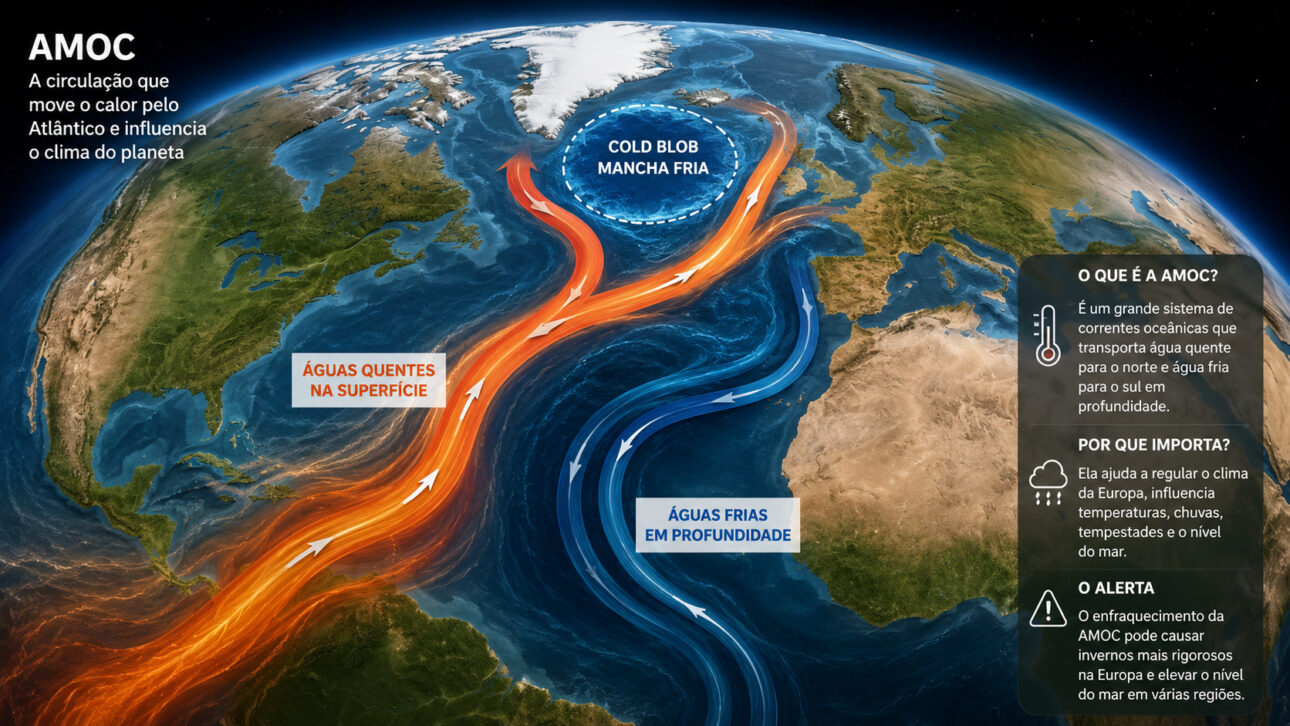
The Atlantic Meridional Overturning Circulation functions as a broad system of ocean currents responsible for redistributing heat across the planet. The AMOC transports warm water across the Atlantic surface towards the north and carries cold water, at depth, to the south. This movement helps balance temperatures and directly influences the climate of the North Atlantic. The study from the Potsdam Institute for Climate Impact Research states that the observed Cold Blob confirms the interpretation that the cold spot is associated with the weakening of this circulation in the subpolar gyre region. The possibility concerns climatologists because the AMOC affects patterns of rain, cold, heat, and storms.
-
Farmer Revives Arid, Abandoned Land in Brazil’s Bahia into Thriving Forest, Demonstrates How ‘Syntropic Agriculture’ Can Transform Rural Futures

-
Study Reveals 40% of Brazilians Unaware of Circular Economy, Highlighting Challenges in Sustainable Transition and Recycling Expansion
-
Brazilian Startup Converts Rain into Potable Water Without Chemicals, Surpasses 10 Million Liters, Joins $1.2 Million Project to Bring Simple Technology to Drought-Stricken Areas in Northeast Brazil
-
Brazilian Company Innovates with Treated Water Billing Model, Surpassing 10 Billion Liters and Offering Up to 40% Savings for Large Industries




Melting ice may alter salinity
Previous studies on episodes of intense cooling in Europe over the last 100,000 years indicate that melting ice sheets can weaken the AMOC. The influx of fresh water reduces the ocean surface salinity and, consequently, decreases the water density. As a result, less surface water sinks, which can slow down ocean circulation. This process changes how heat moves across the Atlantic and helps explain why the Cold Blob is treated as a climate warning. The cold patch ceases to be just a geographic curiosity and becomes a possible symptom of profound change in the oceanic system.
Alert in northern Europe increases concern
The Nordic Council warned in February 2026 of possible severe impacts linked to changes in Atlantic circulation. The body includes Denmark, Iceland, Norway, Sweden, and Finland, as well as associated territories such as Aland, the Faroe Islands, and Greenland. Among the scenarios discussed, Iceland could face extremely harsh winters, with temperatures far below the current standard. The island could also be surrounded by sea ice, something that hasn’t occurred since the Viking era. Although projections still involve uncertainties, the alert reinforces the strategic importance of the AMOC for the European climate and the meteorological stability of the North Atlantic.
Point of no return still challenges predictions
Researchers have been trying for years to identify when the AMOC could reach a point of no return in a global warming scenario. A collapse of this circulation could cause much colder winters in northern Europe. The sea level along the east coast of the United States could also rise rapidly, as the current normally helps keep water away from the continent. Atlantic storms could become more intense. However, predictions remain complex, as they depend on multiple oceanic and atmospheric factors. This degree of uncertainty makes monitoring the Cold Blob increasingly relevant among scientists and authorities.
Climate history reinforces risk of slow recovery
The climate history shows that changes in the AMOC can have prolonged effects. About 12,500 years ago, during the cold period known as the Dryas, the circulation took approximately 100 years to fully recover its functioning. In Greenland, temperatures took about 40 years to emerge from extreme glacial conditions. This past helps explain the researchers’ caution in the face of current signs. The recovery of an oceanic system of this magnitude can be slow, and the climatic impacts can last for decades.
Cold Blob enters the center of the climate debate
The cold patch in the North Atlantic has taken a central position in discussions about global warming, ocean circulation, and climate risks for Europe. The study’s authors cite early warning signs and point to clear evidence of AMOC weakening. This diagnosis does not represent an immediate prediction of collapse, but reinforces the need for scientific monitoring and political attention. The Cold Blob, therefore, emerges as one of the most observed signs of the North Atlantic at a decisive moment to understand the future of the climate.
Do you believe it should be a priority: to expand climate monitoring to anticipate risks or to accelerate global policies to reduce the impacts of climate change on the oceans?