Portuguese
  Spanish


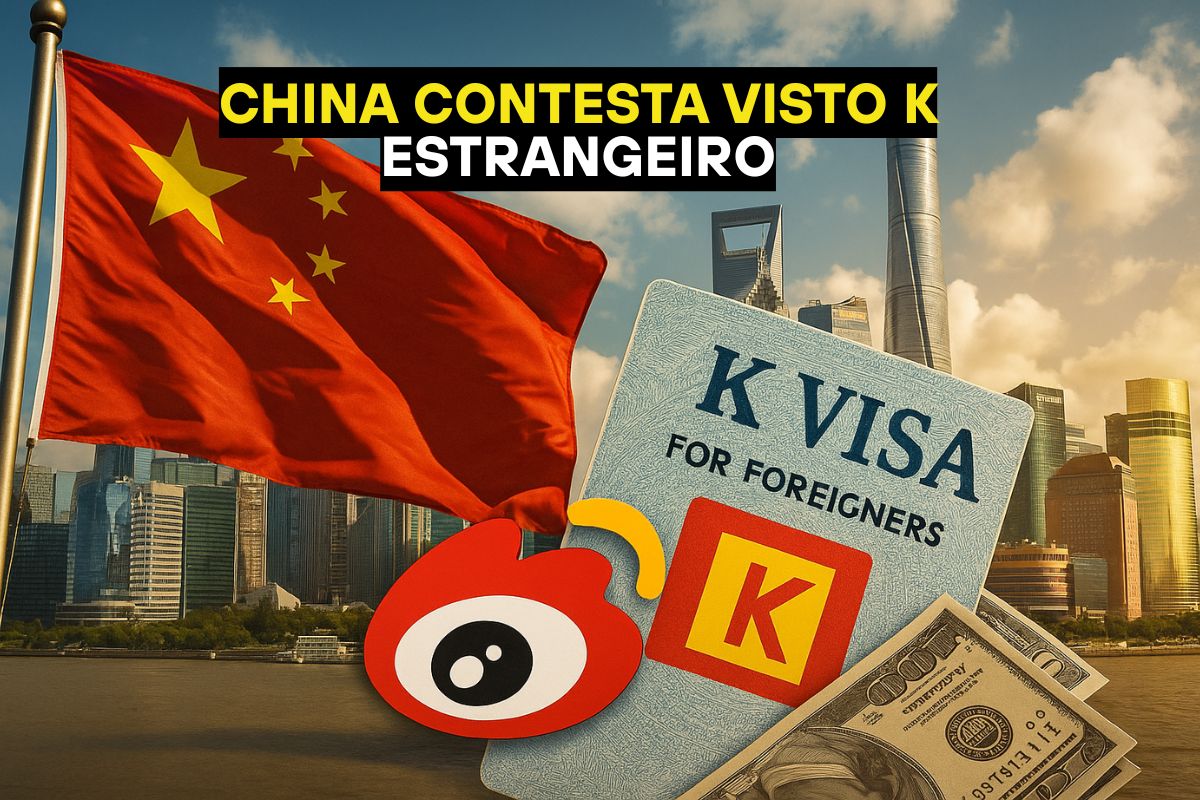


Weibo Debate Questions Regime Policy and Reveals Discontent with Treatment of Foreigners Amid High Unemployment Rates Among Youth.
The announcement of the K Visa sparked a rare protest on China’s social media, with thousands of messages on Weibo criticizing the regime’s new policy. Created to attract foreign talent in science and technology, the document was met with skepticism by internet users who fear increased unemployment, inequality, and even a migration crisis.
According to the Folha de S. Paulo, the criticisms expose unusual tension in a digital environment heavily controlled by the government, where open protests against official measures rarely gain traction.
Why the K Visa Provoked an Unprecedented Reaction
The K Visa came into effect on the 1st and was announced as part of China’s strategy to compete for global talent, in response to restrictions imposed by the United States on foreign students and workers.
-
He Left Construction, Partnered with His Wife, and Turned a Homemade Gelato Hobby into Brazil’s Largest Chain with 240 Stores and $100 Million Annually

-
Brazil Faces Caregiver Shortage Despite Having 34.1 Million Elderly, Highlighting a Major Challenge for Families
-
Brazil’s Assaí Generates $4 Billion in Quarterly Revenue, Profits $16.7 Million, Highlighting High Tax Burden

-
Former Marketing Agency Owner Thrives on Foraging for 250 Days, Sampling Over 170 Plants, and Says He No Longer Remembers Supermarkets


Unlike the American model, the Chinese document does not require high costs or prior ties to local institutions, which should facilitate the attraction of young professionals.
However, Chinese users viewed the measure as a devaluation of local graduates.
For them, the initiative favors foreigners at the expense of students graduating from universities in the country, who already face a saturated market and high youth unemployment rates.
Criticism on Social Media
Anonymous profiles accused the regime of creating a policy that benefits foreigners while ignoring internal difficulties.
Comments highlighted that the government would be “opening doors for African and Indian scholarship students” without guarantees of qualification. Others claimed that the visa could pose risks to national security.
One of the users quoted by the Folha de S. Paulo wrote: “Before, we could not handle the small number of foreigners who were treated as super citizens.
Now they want to bring even more?” This perception reinforces the idea that there is a feeling of inequality and preference for foreigners, viewed as unfair by the local population.
Who Supports and What Still Needs Clarification
Despite the wave of criticism, some internet users defend the K Visa, stating that it is not a work visa and that the category only provides for temporary and renewable residence, which should alleviate fears of a migration crisis.
For these supporters, the document can help strengthen technological innovation in the country, as long as more rigorous criteria are defined.
There is still no complete information about the qualification requirements. The Chinese immigration authority states that embassies and consulates will detail the specific rules, but it has not specified what academic or language requirements will be necessary.
The lack of clarity fuels the debate and increases resistance on social media.
Impacts for the Future
The rare protest on China’s social media shows how the young population views the K Visa as a threat in a highly competitive job market.
At the same time, the measure reveals the regime’s urgency to accelerate its competition with the United States in the race for scientific and technological innovation.
The success or failure of the K Visa will depend on how the policy is detailed and implemented. For experts, the central issue will be balancing the attraction of international talent with valuing local Chinese graduates, preventing social discontent from growing in parallel.
The discontent on Weibo raises a warning signal for Beijing: opening doors for foreigners can strengthen China in the technological race but may also provoke internal tensions.
And you, do you believe that China will be able to balance attracting foreign talent with valuing its own youth? Leave your opinion in the comments.