






 Portuguese
  Spanish


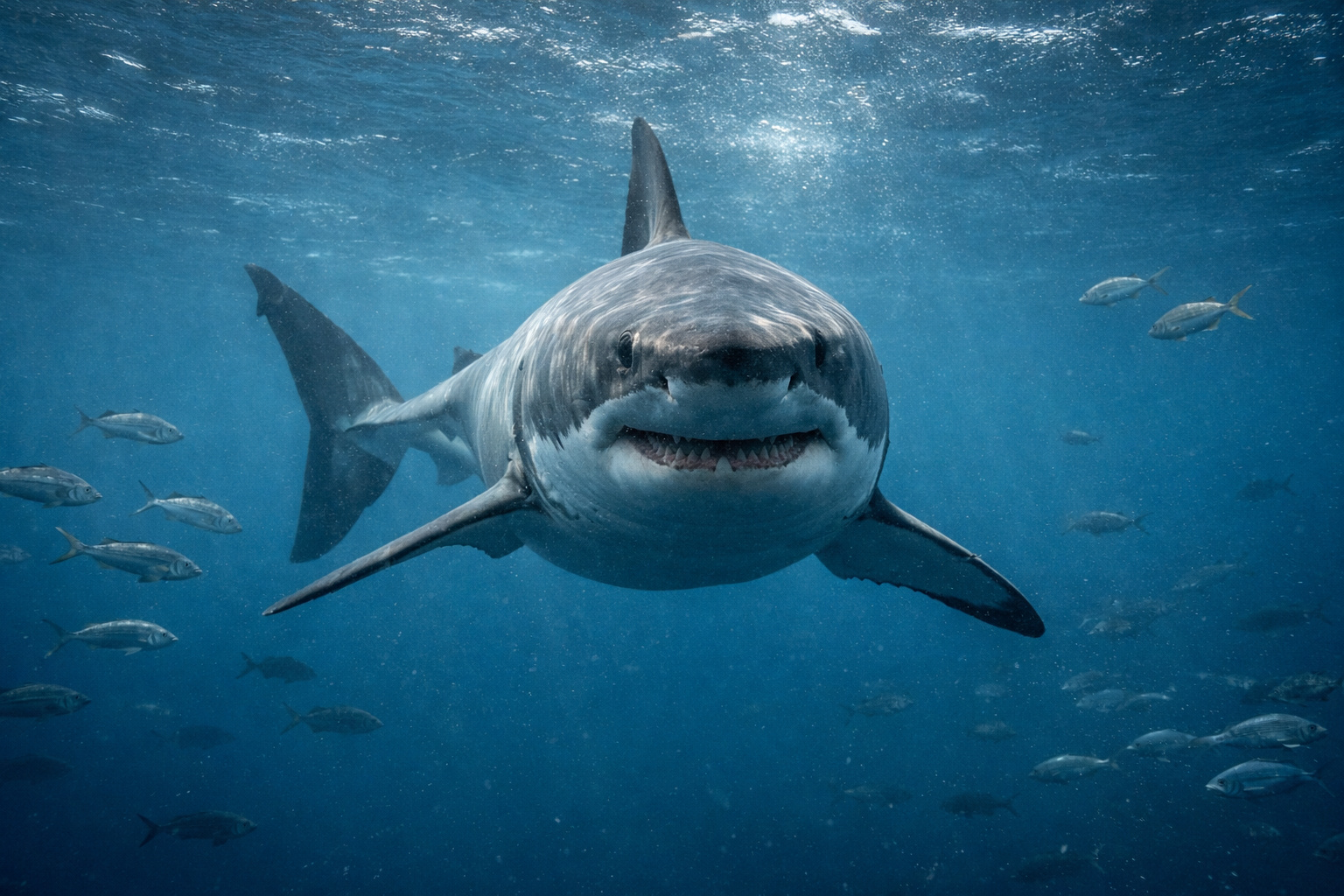


Predators That Emerged Tens of Millions of Years Before the First Forests on Earth Survived Five Global Extinctions, Maintained Their Biological Structure Almost Intact Throughout Geological Eras, and Today Face Real Risk from Overfishing and Human Action
Imagine a predator so ancient that it had already dominated the oceans 50 million years before the first trees appeared on Earth. This is the story of sharks, considered by scientists to be some of the oldest organisms still existing on the planet. While the first terrestrial forests began to form around 350 million years ago, these marine predators had already been traversing the seas for about 400 million years.
Throughout this extraordinary journey, sharks survived five mass extinctions that completely reshaped life on Earth. These events eliminated iconic species, such as dinosaurs, and wiped out as much as 90% of marine life in certain periods. Still, sharks endured, adapted, and remained at the top of the oceanic food chain.
This information was originally reported by ScienceAlert, in a report by Maria Eduarda Lameza, who gathered scientific data, fossil records, and modern genetic analyses to explain how these animals managed to survive global disasters that exterminated nearly all life around them.
-
Eight Artists Secretly Lived in a Hidden 70m² Apartment Inside a Shopping Mall in Brazil for Four Years

-
Artist Lives in Giant Wooden Egg Over a UK River to Observe Tides and Environmental Changes
-
Over 20 Metal Drums Repurposed into School Transport Train Boost Attendance in Australian Aboriginal Community

-
Abandoned Coal Crane at Copenhagen’s Old Port Transformed into Luxury Waterfront Retreat with Spa and Ship Views




A Nearly Perfect Biological Design Explains Survival

The main explanation for this impressive resilience lies in a highly efficient biological design. Experts point out that sharks have a skeleton made entirely of light cartilage, which reduces energy expenditure and increases mobility. Additionally, their teeth are continuously renewed throughout their lives, ensuring constant feeding efficiency.
Another decisive factor is the advanced development of their sensory systems. Sharks can detect minimal vibrations in the water, odors in extremely low concentrations, and even electrical fields generated by other animals, enabling them to locate prey even in low-visibility environments.
Fossil records of teeth and scales indicate that the basic structure of these cartilaginous fish has remained virtually unchanged for hundreds of millions of years. This evolutionary stability suggests that the body model of sharks has reached a level of rare efficiency in the history of life on Earth.
Fossil and Genetic Evidence Confirm Ancestral Lineage
In addition to fossils, modern genetic analyses reinforce this narrative of evolutionary continuity. Studies show that the current lineage of sharks retains identical molecular traits to those of relatives that swam in the primitive oceans during the Devonian period, a phase of the Paleozoic Era known as the “Age of Fishes”.
This period was marked by an explosion of marine diversity, when many of the main lineages of aquatic vertebrates emerged. While many of them disappeared in subsequent extinctions, sharks preserved their essential characteristics, adjusting only physiological details over time.
Thus, unlike many animals that needed to undergo radical transformations to survive, sharks have traversed entire geological eras while maintaining an extremely stable structural base, reinforcing the idea of a highly successful evolutionary model.
The New Threat Comes Not from Nature, but from Humans

Despite having survived catastrophic natural events, sharks now face an unprecedented challenge: human action. Experts estimate that around 100 million sharks are killed every year due to overfishing, putting various species at real risk of extinction.
The main driver of this hunting is the trade in fins, considered delicacies in some Asian countries. Additionally, fishing aimed at the meat and skin of these animals significantly contributes to population reduction. Moreover, the high rate of bycatch, when sharks become entangled in nets and equipment intended for other species, exacerbates the problem.
The situation worsens because sharks have slow reproductive cycles, with few offspring and long gestation periods. This means that populations cannot recover at the same pace they are exploited, creating a dangerous imbalance for marine ecosystems.
After traversing hundreds of millions of years and extreme global events, what changes when the main threat to sharks ceases to be natural and becomes caused by humans?




