Portuguese
  Spanish


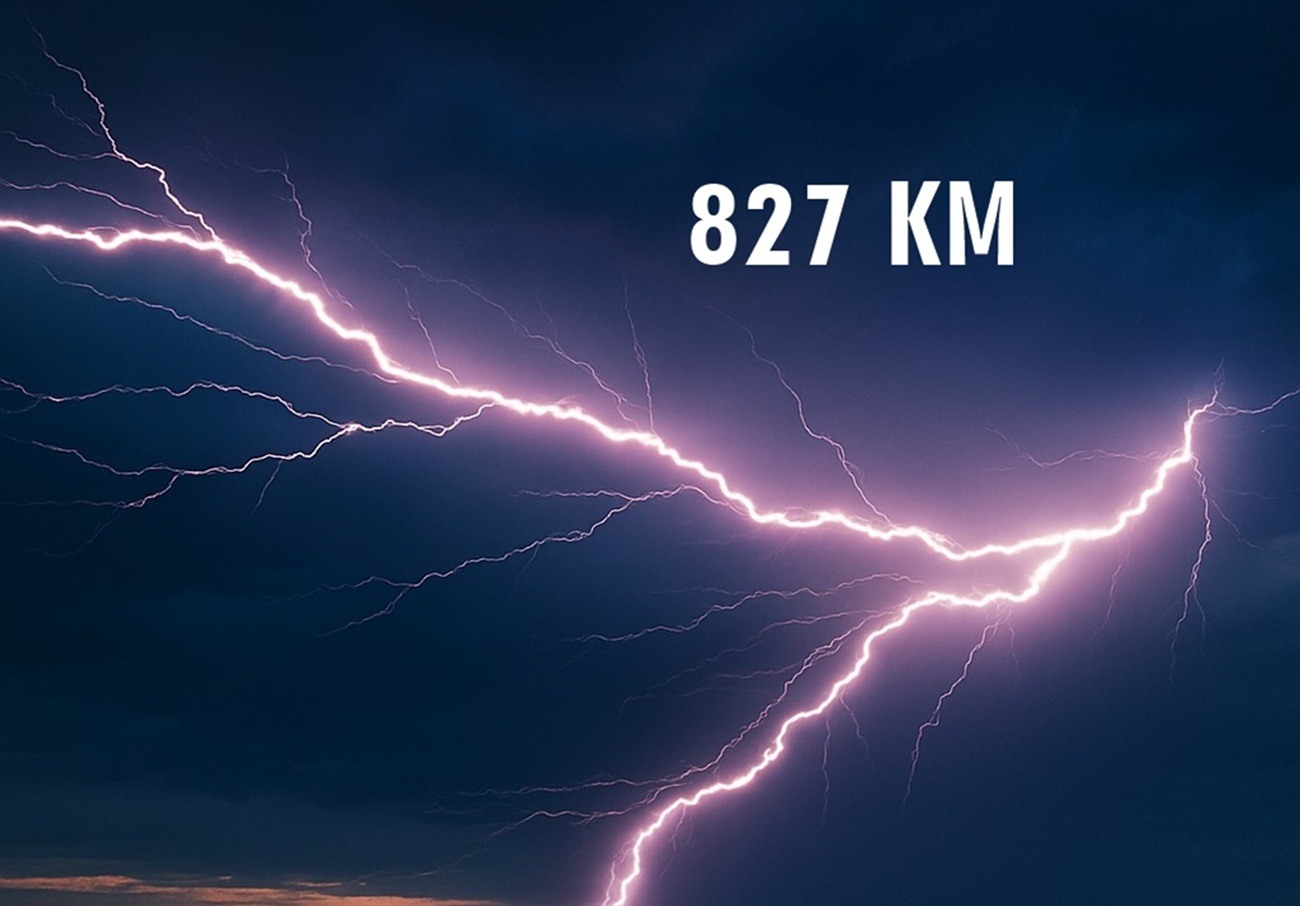


A lightning struck the skies of the United States and broke an impressive record. The phenomenon, recorded by satellites, reached 827 kilometers in length and revealed new challenges for safety during extreme storms. Scientists can now identify megaflashes with greater precision and warn about increasing risks.
A megaflash of lightning established the record for the longest electrical discharge ever recorded on the planet. The flash traveled 827 kilometers, crossing the skies of the United States in a single storm.
The electrical discharge occurred on October 22, 2017. The lightning extended from eastern Texas to the outskirts of Kansas City. This distance is comparable to the journey between Paris and Venice, or between Washington, D.C. and Detroit.
The World Meteorological Organization (WMO) confirmed the feat after a new analysis of data from that time. The GOES-16 satellite, newly launched at the time, recorded the storm and enabled the detection of the phenomenon years later.
-
Extreme Heat of 41.3°C Warps Roads in Germany, Causes Autobahn Asphalt to Crack, Injures People, and Forces Snowplows to Cool Down Highways

-
AI Security System in Brazil Aims to Cut False Alarms by Differentiating Pets from Intruders, Enhancing 24/7 Monitoring for Homes and Businesses

-
Archaeologists Discover 1,500-Year-Old Byzantine Mosaic with Greek Biblical Inscription in Israel, Uncover Ruins of 10 Buildings Near Kiryat Gat
-
Ohio Carpenter Finds 308-Gram Meteorite the Size of a Baseball After Dreaming of Its Location





Comparison with Previous Records
This megaflash surpassed the previous record by 61 kilometers, which was recorded in April 2020. At that time, a lightning traveled 768 kilometers also in the United States.
According to the WMO, the methodology used for the measurements was the same: the maximum distance from the great circle, which considers the total extent of the flash on the Earth’s surface.
Therefore, the new record not only represents an impressive number. It also reinforces scientific confidence in current atmospheric observation instruments.
Storms in the Great Plains
The record lightning occurred in the Great Plains of North America. This region is known for hosting mesoscale convective systems — cloud formations that favor the occurrence of megaflashes.
The most important thing is that this phenomenon had not been identified in the original analysis of the storm. The discovery was only possible thanks to advances in meteorological data processing techniques.
According to the WMO, the event is a milestone in studies of extreme storms. It demonstrates how new technologies can reveal details that were previously invisible to the human eye or to older radars.
Advancements in Detection Technology
The GOES-16 satellite represented a leap in the capability to map lightning. It continuously monitors large areas of the Earth from geostationary orbit.
According to researcher Michael J. Peterson from the Severe Storm Research Center, most of the critical megaflash points in the world are now covered by satellites. This allows for the observation of phenomena previously considered rare or even impossible to record.
“The extremes of lightning capability are difficult to study because they exceed the limits of what we can practically observe,” Peterson stated.
Risks and Alerts to the Public
Despite the beauty and fascination, lightning poses significant risks. The WMO Secretary-General, Celeste Saulo, warned that these discharges kill many people every year.
According to her, recent discoveries reinforce the need for preventive actions. Electrified clouds with high discharge potential are dangerous for aviation and can even start wildfires.
Therefore, the WMO integrates lightning studies into its “Early Warnings for All” initiative aimed at protecting the global population.
Safety During Storms
Expert Walt Lyons emphasized safe locations during a lightning storm. According to him, the ideal shelter is a large building with wiring and plumbing.
The second safe option is a fully enclosed vehicle with a metal structure. Structures like bus stops, tents, or motorcycles do not provide adequate protection.
Therefore, knowing these guidelines can be crucial in risky situations.
Progress in Science and New Challenges
Professor Randall Cerveny, WMO Rapporteur on Weather and Climate Extremes, highlighted the symbolic value of the record. For him, the measurement shows the advancement of science and environmental observation.
Furthermore, Cerveny believes that even larger phenomena may exist. As satellites capture more data and tools evolve, new discoveries are expected to emerge.
The distance covered by the 2017 megaflash may soon no longer be the longest ever recorded. But for now, it remains a reminder of the force of nature and the importance of scientific knowledge.