Portuguese
  Spanish


Electronic nose for food created in Berkeley uses 16 sensors and artificial intelligence to detect spoilage and allergenic substances.
Researchers at the University of California, Berkeley developed an electronic nose capable of recognizing gases emitted by spoiling products and identifying small amounts of substances linked to food allergies.
Presented in a study published by the scientific journal Science Advances on June 17, 2026, the device uses 16 chemical sensors and machine learning models to interpret different odor patterns.
The technology was tested with fruits, milk, eggs, raw chicken, nuts, almonds, and peanuts. In addition to distinguishing fresh products, the system was able to recognize foods kept at room temperature for 24 or 48 hours, indicating different stages of the spoilage process.
-
Massive Leak Puts iPhone 18 Pro in Spotlight Months Before Launch as Hackers Release Over 200,000 Confidential Apple Documents

-
Ghost Particle Travels Billions of Years Through Deep Space, Detected in Antarctic Ice, Leads Scientists to Hidden Galaxy 11 Billion Light-Years Away
-
Researchers Identify Factor Influencing Dementia Risk Beyond Age and Genetics
-
Iranian Engineers Develop Solar-Powered Mobile Water Purification System for Isolated Regions, Offering Sustainable Solution for Water-Scarce Communities



The project is still in the experimental phase but already has a portable version connected to a mobile app. Possible applications include refrigerators capable of alerting when food starts to spoil and equipment aimed at protecting people with allergies.
System interprets a combination of gases
The device does not attempt to identify foods through a single chemical component. Its operation depends on the simultaneous reading of different molecules released into the air.
The array comprises 16 sensors, each prepared to react to specific combinations of gases. When these molecules come into contact with the device’s materials, they cause changes that are transformed into electrical signals.
Individually, these signals may not clearly reveal which food is being analyzed. Therefore, the Berkeley team resorted to machine learning to compare the sensors’ responses and find characteristic patterns.
The method is similar to how the sense of smell recognizes odors from various information received simultaneously. The difference is that the electronic nose converts these chemical responses into data processed by computational models.
Artificial intelligence learned signs of spoilage
To train the system, the researchers exposed the sensors to food in different conditions. Milk, eggs, and raw chicken were included in the experiments, as well as fruits and nuts. The samples were evaluated fresh and after being left unrefrigerated for set periods.
By comparing the signals, the models learned to differentiate a newly analyzed product from another kept at room temperature for 24 or 48 hours. This capability could allow future equipment to detect changes before the consumer notices obvious signs of spoilage.

In a smart refrigerator, for example, the technology could monitor meats, vegetables, and dairy products and issue alerts when the released gases indicate a loss of quality.
Sensor detected a minimal amount of nut
The tests also evaluated the equipment’s sensitivity to foods associated with allergic reactions. According to the results published in the Science Advances study, the device was able to detect an amount of nut equivalent to approximately one-hundredth of a common unit.
The system was also trained to recognize compounds related to peanuts and other nuts, such as almonds.
The accuracy opens up a possible application for people who need to avoid contact with specific ingredients. A portable device could assist in analyzing environments or products, although the device still requires further testing before everyday use.
Nanotubes allow operation without heating
The team replaced materials often used in gas sensors with carbon nanotubes.
These nanotubes function as conductive elements and allowed the device to operate at room temperature. The choice also increased sensitivity to the molecules present in the samples.
Metal oxide-based sensors usually require heating during operation. The architecture created in Berkeley eliminates this need and allows the incorporation of materials that could lose their properties at high temperatures.
The fabrication of the sensitive films was carried out in a single deposition step. According to the project, this approach simplifies the production of the matrix and facilitates the combination of different materials in the same device.
Electronic nose already has a portable version
In addition to the equipment used in laboratory tests, the researchers developed a portable prototype integrated with a mobile phone app.
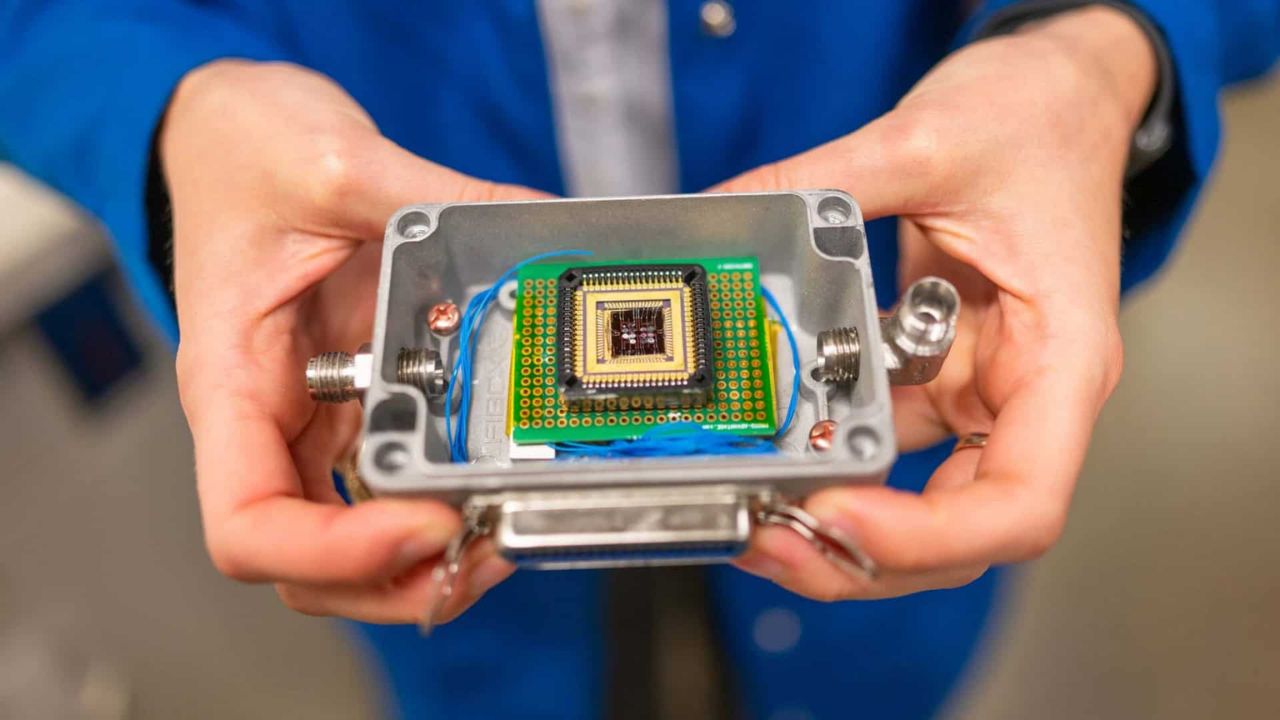
This configuration expands the possibilities of application outside laboratories. Instead of relying on a fixed structure, the user could bring the device close to the food and monitor the interpretation via smartphone.
The format may also interest companies working with storage, transportation, and quality control of food products.
In industrial environments, such sensors could monitor stocks and identify early changes that compromise the safety or preservation of goods.
Mixture of odors still represents a challenge
Despite the performance presented, the researchers themselves acknowledge that the device still needs to be evaluated in situations closer to domestic routine.
The experiments did not include environments with a wide variety of mixed gases. A kitchen or refrigerator can store several products at the same time, each releasing its own molecules.
This overlap can make it difficult to separate patterns and reduce the precision of the electronic nose.
The next advances will depend on the system’s ability to distinguish the odor of a specific food amid signals produced by meats, vegetables, fruits, beverages, and containers stored in the same space.
Research brings together engineering, sensors, and computing
The work was conducted by members of the electrical engineering and computer science departments at the University of California, Berkeley.
The research was led by a doctoral student linked to a group dedicated to the development of advanced sensors. The project also received collaboration from other scientists at the institution and a partner university located in South Korea.
The publication of the results in the journal Science Advances presents the academic validation of the experiments and details the combination of sensitive materials, electrical signals, and machine learning models.
The integration of these areas allowed the transformation of invisible molecules released by food into patterns that can be recognized by a computational system.
Technology may change the relationship with the refrigerator
If it advances to commercial use, the electronic nose could add a new function to connected appliances.
Instead of just controlling the temperature or recording which products are stored, a refrigerator equipped with chemical sensors could assess the preservation state of the contents.
The consumer would receive alerts about foods nearing spoilage and could make decisions before consuming or discarding the product. The technology could also help reduce risks related to the ingestion of unsuitable items.
The application against allergens broadens the project’s scope but requires additional care and new tests in real conditions.
For now, the device developed in Berkeley remains an experimental prototype. Even so, the results show that the combination of carbon nanotubes and artificial intelligence can give machines a sense of smell-like ability to analyze what reaches the table.
With information from Olhar Digital